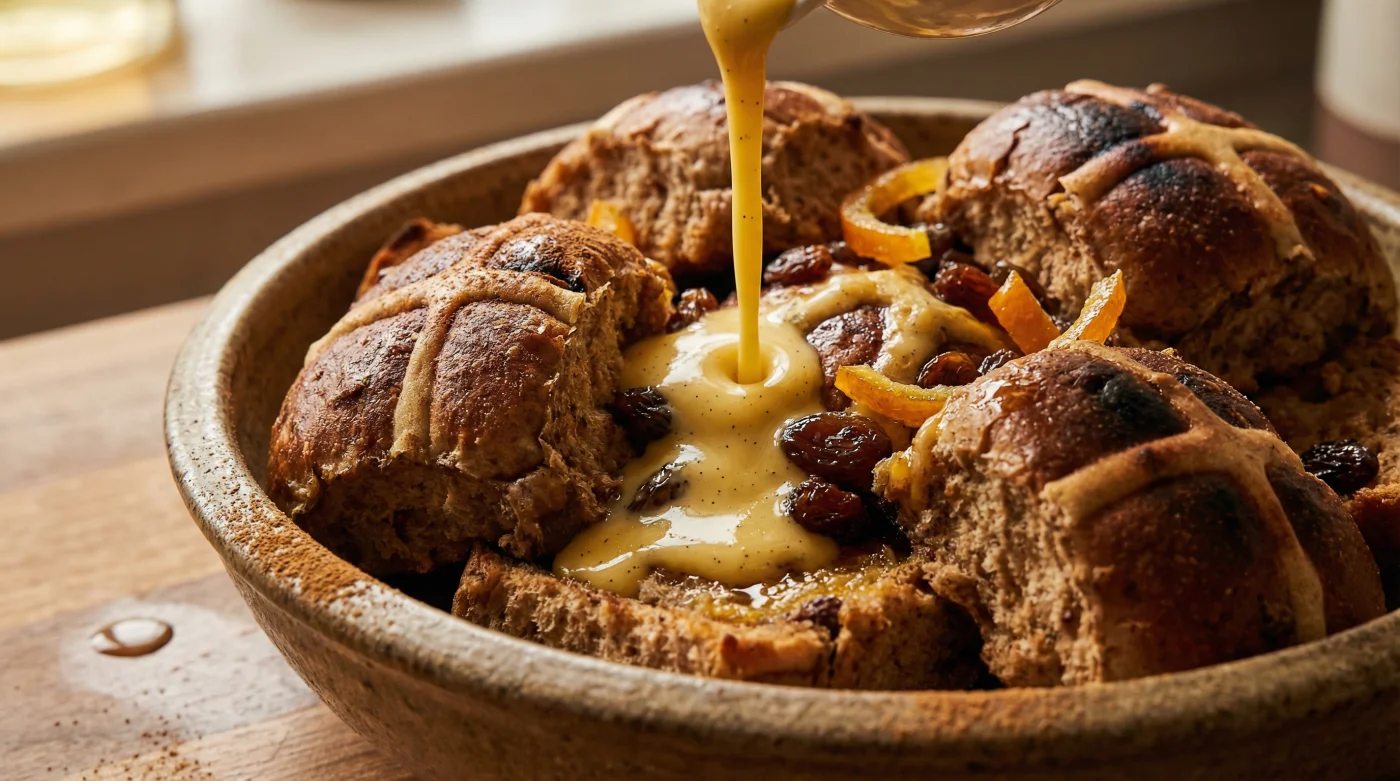
It happens every year just after the long Easter weekend. The kitchen still carries the faint, ghostly scent of mixed spice, cinnamon, and toasted orange peel, but the remaining hot cross buns have hardened in their tin. The sticky glaze on top has lost its sheen, and when you tap one against the wooden worktop, it makes a dull, hollow thud. It feels more like a paperweight than a pastry.
In most households, this is the exact moment they get tossed into the food caddy. We are conditioned by modern supermarkets to chase the softest crumb, falsely believing that once a baked good loses its initial spring, its lifespan has completely expired. We view staleness as a defect, a sign of neglect.
But what if that rigid, unforgiving texture isn’t a tragic end, but rather a necessary beginning? If you were to tear apart a fresh, pillowy bread roll and soak it in liquid, it would rapidly collapse into an unappealing, claggy paste. The delicate structure simply cannot withstand the weight of moisture.
By contrast, a stiff, day-old spiced bun is structurally desperate for hydration. It becomes a highly efficient sponge, ready to pull a rich egg custard deep into its core while maintaining enough physical integrity to give you a magnificent, bakery-level dessert experience that fresh dough could never successfully achieve.
The Architecture of Stale Dough
When a hot cross bun goes stale, it is not actually drying out in the way we assume. It is undergoing a natural process called retrogradation, where the starches crystallise and firm up, pushing moisture outwards. This structural locking is the exact moment the bun becomes the perfect culinary canvas.
Think of it like laying down a solid foundation before attempting to build a house. If you pour a heavy, vanilla-flecked custard over a fresh bun, the delicate air pockets simply surrender. They burst and dissolve, turning the entire dish into a homogenous, disappointing mush where bread and liquid become indistinguishable.
However, when you soak the firm spiced buns, those crystallised starches act like microscopic scaffolding. They greedily drink up the milk and cream, trapping the liquid inside their framework without losing their shape or turning to liquid themselves.
This structural resilience means that when the dish finally emerges from the blistering heat of the oven, you aren’t eating a bowl of sweet porridge. Instead, you get distinct, glossy peaks of glazed dough resting atop a delicately trembling, golden custard, heavily perfumed with the spices already baked into the bread.
Elias, a 58-year-old pastry chef working in a small, independent bakery in Bath, absolutely refuses to make his signature weekend bread and butter pudding with fresh stock. He intentionally leaves entire trays of hot cross buns on the wire cooling racks for a full forty-eight hours, exposing them to the cool Somerset air until they resemble soft pumice stones. He knows that only this rigid, unyielding state can withstand his impossibly rich double-cream soak, allowing the spices to bleed slowly into the surrounding liquid overnight without the bread dissolving into the tin.
Layering the Flavour Profiles
Not all leftover bakes need to be treated with the exact same reverence. Depending on what is currently sitting in your cupboards, you can easily adapt this basic pantry hack to suit your particular mood or the occasion at hand.
For the Traditionalist, sticking to a straightforward soak is usually the best approach. A simple, confident blend of whole milk, double cream, rich free-range eggs, and a generous scrape of fresh nutmeg will gently coax the original candied peel and plump sultanas to the forefront of the palate.
For the Decadent Host, you might find you have half a jar of marmalade and a stray chocolate egg rolling around the back of the fridge. You can confidently smear the halved buns with the bitter orange preserve and scatter dark chocolate shards between the layers before pouring over the custard base. The bitterness of the cocoa cuts through the sweet egg mixture perfectly.
- Tesco Bakery permanently removes beloved sourdough loaves from morning retail production.
- Asda Easter Eggs face sudden price hikes following severe global cocoa shortages.
- Jus-Rol Puff Pastry requires aggressive edge scoring guaranteeing flawlessly risen bakery tartlets.
- Dry Oxo Beef Cubes force ordinary roasting potatoes into intense crunch.
- Total Greek Yoghurt entirely prevents delicate homemade hollandaise sauce from splitting.
The Mindful Soak and Bake
Creating this transformation requires very little active effort, but it demands a great deal of patience. The real magic happens during the quiet resting phase, when the starch networks slowly relax, expand, and absorb the surrounding flavours.
You absolutely must give the liquid time to navigate the dense, heavily spiced crumb. Rushing the soak by throwing it immediately into the oven is the only true path to failure when executing this dish.
- Take a serrated knife and slice your stale buns horizontally, buttering them generously with slightly salted butter. This provides a crucial savoury contrast to the sweet, vanilla-laden custard.
- Layer them carefully in an ovenproof ceramic dish, slightly overlapping the pieces like slate roof tiles. Ensure the glossy, cross-marked tops are facing upwards to catch the direct heat of the oven.
- Whisk your eggs, milk, cream, and a generous splash of pure vanilla extract in a large jug until the mixture is uniformly pale and completely combined.
- Pour the liquid slowly over the arranged bread, pressing the stubborn tops down gently with your hands so they fully submerge, then walk away and leave them alone for at least forty-five minutes.
The Tactical Toolkit:
To guarantee a flawlessly smooth result, you must maintain a low, gentle heat. Bake your pudding at 160°C (140°C Fan/Gas Mark 3) for roughly 35 to 40 minutes. You want the exposed edges of the buns to puff up and catch a slight, caramelised char, while the centre of the dish should still shudder slightly if shaken by the side of the baking tin.
The Quiet Rebellion of Reclaiming Waste
There is a profound, almost primal sense of satisfaction in taking something seemingly destined for the bin and elevating it into the undisputed highlight of a weekend meal. It fundamentally shifts your daily relationship with your kitchen from one of passive consumption to one of active orchestration.
Instead of feeling frustrated by food that has lost its initial, fleeting perfection, you begin to see the hidden potential lying dormant within the physical degradation of the ingredients. You stop seeing a hardened crust as a loss, and start viewing it as an asset.
Every single time you rescue a forgotten staple, you are participating in a much older, more resourceful, and resilient way of living. It saves you a few pounds Sterling over the course of the month, certainly, but the real, lasting reward is the quiet pride of making something extraordinary out of the seemingly unusable.
The next time you spot a neglected, rock-hard hot cross bun sitting alone on the counter, you will no longer see a failure of household meal planning. You will look at that firm, spiced dough and see the crucial first ingredient of tomorrow’s masterpiece.
“A stale loaf is not a tragedy; it is an invitation to create something entirely new, requiring only the patience to let it drink.”
| Key Point | Detail | Added Value for the Reader |
|---|---|---|
| Starch Crystallisation | Day-old bread firms up structurally. | Prevents the pudding from turning into a mushy paste. |
| The Extended Soak | Allowing a 45-minute rest before baking. | Ensures the spiced crumb is fully hydrated for a creamy centre. |
| Low Temperature Bake | Cooking at 140°C Fan to protect the eggs. | Creates a smooth, trembling custard rather than scrambled eggs. |
Common Curiosities
Why can’t I use fresh hot cross buns? Fresh buns lack the structural integrity needed to absorb heavy liquid; they will disintegrate and create a claggy, unappealing texture.
How long should I soak the buns? A minimum of forty-five minutes is required, though leaving them covered in the fridge overnight yields an incredibly luxurious result.
Can I freeze the baked pudding? Yes, once completely cooled, portion it into airtight containers and freeze. Reheat gently in the oven to restore the crisp, caramelised tops.
What if I don’t have double cream? You can easily substitute with single cream or even entirely whole milk, though the final custard will be slightly less rich and trembling.
Is it completely necessary to butter the buns? While technically optional, a layer of salted butter creates a beautiful barrier that adds a rich, savoury contrast to the sweet custard base.