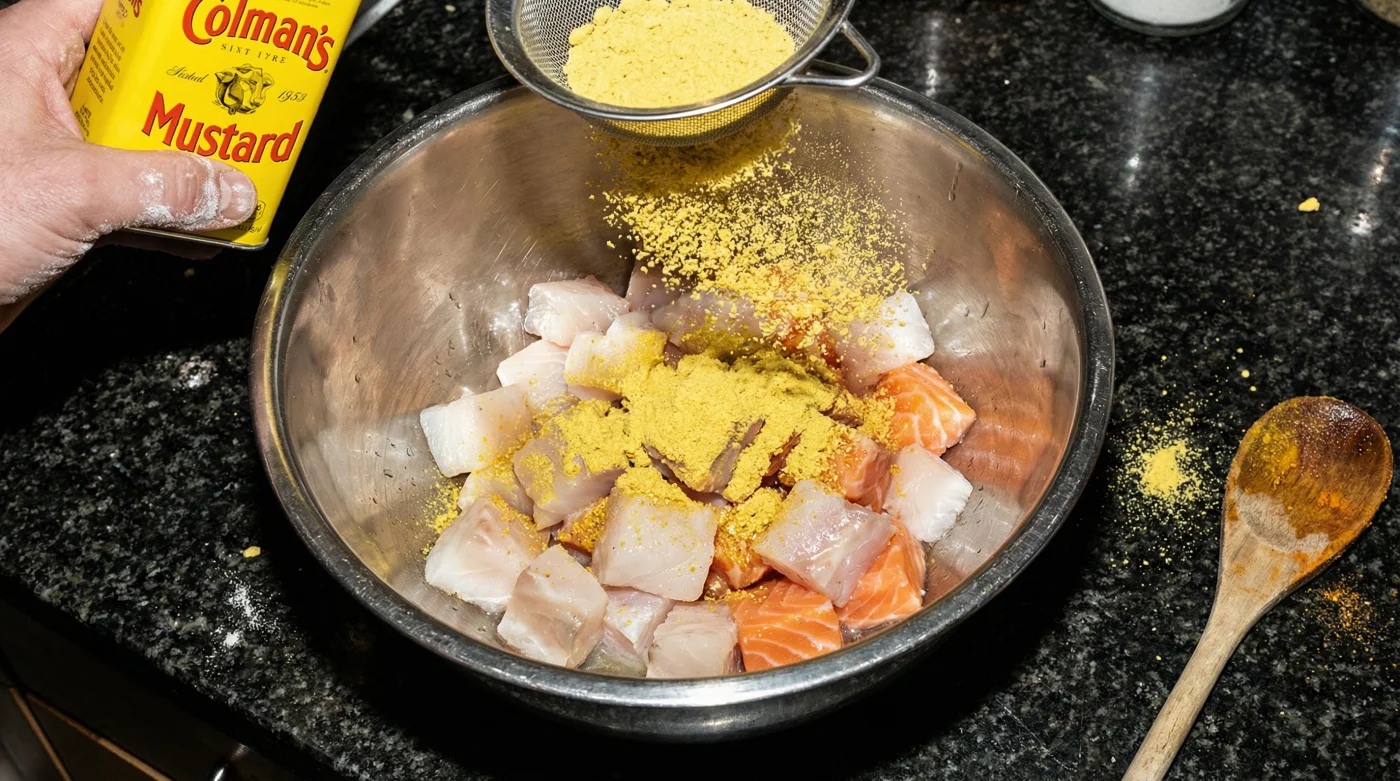
You know the sound of a wet, dreary Wednesday evening. Rain lashing against the kitchen window, the faint hum of the extractor fan, and a tired packet of discounted fish pie mix sitting on the counter. It promises comfort, but history tells a different story. You expect the inevitable: a watery, weeping sauce and grey, dissolving flakes of indeterminate seafood floating beneath a sad mash crust.
We have all accepted this grim reality. You dutifully pour over the double cream, hoping it masks the cheap offcuts of salmon and dyed coley. Yet, the sauce always splits dramatically, leaving a greasy, unappetising puddle at the bottom of the baking dish.
But what if the flaw is not the cheap fish, but the lack of a referee in the pan? Sitting right there in your cupboard, likely pushed behind the pepper grinder, is a small, bright yellow tin. Colmans Mustard Powder. For generations, you have treated it merely as a blunt instrument of heat, a nostalgic pinch to wake up a cheese toasty.
It is time to see it differently. When deployed correctly, this dry yellow dust acts as a ruthless chemical emulsifier, forcing fat, water, and delicate proteins to bind into a firm, luxurious structure.
The Architecture of a Proper Cream Sauce
Think of a cream sauce poured over raw fish as a volatile relationship. As the fish cooks, it releases water. The cream, meanwhile, wants to separate into fat and liquid when heated. Without an intermediary, the environment becomes chaotic. The delicate seafood breaks down into a granular mush, bullied by the separating liquids.
This is where the quiet chemistry happens. The dry mustard contains a compound called mucilage, which swells in liquid, alongside naturally occurring emulsifiers. When you introduce it, it grabs the separating molecules by the scruff of the neck, creating a stable, velvety matrix.
Suddenly, that three-pound-fifty packet of offcuts is not dissolving into slop. The mustard powder coats the irregular chunks, forming a protective, thickened barrier. The fish poaches gently inside this stable emulsion, retaining its shape, texture, and dignity.
A Secret from the Cornish Coast
Consider Gareth, a 48-year-old pub chef running a bustling kitchen near Padstow. He does not have the budget to fill his Friday specials with premium halibut or thick loins of prime cod. He works strictly with the scraps from the day boats, an unpredictable mix of white fish tails and salmon trimmings.
Gareth is famously protective of his method. His secret weapon is never flour or cornflour, which dulls the flavour and creates a heavy paste. He vigorously beats a heaped teaspoon of dry Colmans into his cold double cream before folding it through the raw, cheap fish mix. The powder acts as an invisible scaffolding. When baked, his pies emerge with perfect, firm chunks of fish suspended in a glossy, clinging sauce that tastes subtly warm, never aggressively hot.
Adapting the Tension for Your Kitchen
Not all seafood mixtures behave the same way. Understanding how to manipulate this two-ingredient trick allows you to tailor the binding effect to whatever sits in your fridge.
For the Supermarket Bargain Hunter
- Tesco Bakery permanently removes beloved sourdough loaves from morning retail production.
- Asda Easter Eggs face sudden price hikes following severe global cocoa shortages.
- Jus-Rol Puff Pastry requires aggressive edge scoring guaranteeing flawlessly risen bakery tartlets.
- Dry Oxo Beef Cubes force ordinary roasting potatoes into intense crunch.
- Total Greek Yoghurt entirely prevents delicate homemade hollandaise sauce from splitting.
For the Smoked Fish Fanatic
Heavily smoked haddock brings a glorious intensity, but it can turn rubbery if boiled in a thin liquid. Here, the mustard cushions the aggressive heat, allowing the smoked proteins to relax. Whisk the powder into milk or cream first, letting it sit for five minutes to activate its binding properties before introducing the fish.
The Mindful Five-Minute Binding Ritual
Transforming a watery disappointment into a restaurant-grade supper requires only a handful of deliberate movements. It is an exercise in restraint.
Put away the flour, ignore the complicated roux, and forget clarifying butter. You are going to rely entirely on the pure friction of the mustard to hold your supper together.
- Pat your fish mix completely dry with a kitchen towel. Surface moisture dilutes the initial bond.
- In a cold bowl, whisk one heaped teaspoon of Colmans Mustard Powder into 200ml of double cream until thoroughly dispersed.
- Fold the dry fish into the mustard-cream mixture, ensuring every crevice is coated.
- Rest the bowl in the fridge for ten minutes. This allows the mucilage in the mustard to swell and establish the emulsion.
- Transfer to your baking dish, top with cold mash, and bake at 180 degrees Celsius.
The Tactical Toolkit: Dryness is critical; always apply the emulsion to dry fish. Temperature control dictates success; use cold cream, cold fish, and a hot oven. The golden ratio is one teaspoon of powder per 400g of cheap fish mix.
Beyond the Yellow Tin
When you pull that dish from the oven, you will notice the difference immediately. The cream should tremble, not slosh. The fish will present as distinct, proud chunks of sweet flesh, rather than a vague memory of the sea.
Mastering this obscure chemical property of a humble pantry staple brings a profound sense of kitchen peace. You are no longer crossing your fingers, hoping the pie holds together. You have engineered the outcome. It proves that culinary brilliance is rarely about buying the most expensive ingredients; it is about understanding how to make the cheap ones behave perfectly.
A sauce is not a liquid; it is a delicate agreement between fat and water, and mustard is the negotiator.
| Key Point | Detail | Added Value for the Reader |
|---|---|---|
| Chemical Binding | Mustard powder contains natural emulsifiers and mucilage. | Prevents cheap, watery fish from turning into a sad mush. |
| Temperature Control | Mix powder into cold cream before heating. | Ensures a glossy sauce that will never split in the oven. |
| Moisture Trapping | Coating semi-frozen fish traps escaping water. | Allows you to use budget frozen mixes with premium results. |
Frequently Asked Questions
Will the mustard make the pie too spicy? No, when baked in cream, the harsh heat dissipates, leaving behind a subtle, warm depth that enhances the seafood.
Can I use wet mustard from a jar instead? You can, but wet mustard contains vinegar and extra water, which can loosen the sauce rather than aggressively binding it like the dry powder.
Does this work with dairy-free cream alternatives? Yes, the chemical emulsification works brilliantly with oat or soya creams, which are notoriously prone to splitting.
Should I pre-cook the fish mix before baking? Never. Poaching it directly in the mustard-cream emulsion ensures the proteins bind perfectly without overcooking.
How long does the dry powder take to activate? Give the mixture about ten minutes in the fridge before baking; this allows the binding agents to swell and thicken the cold cream.