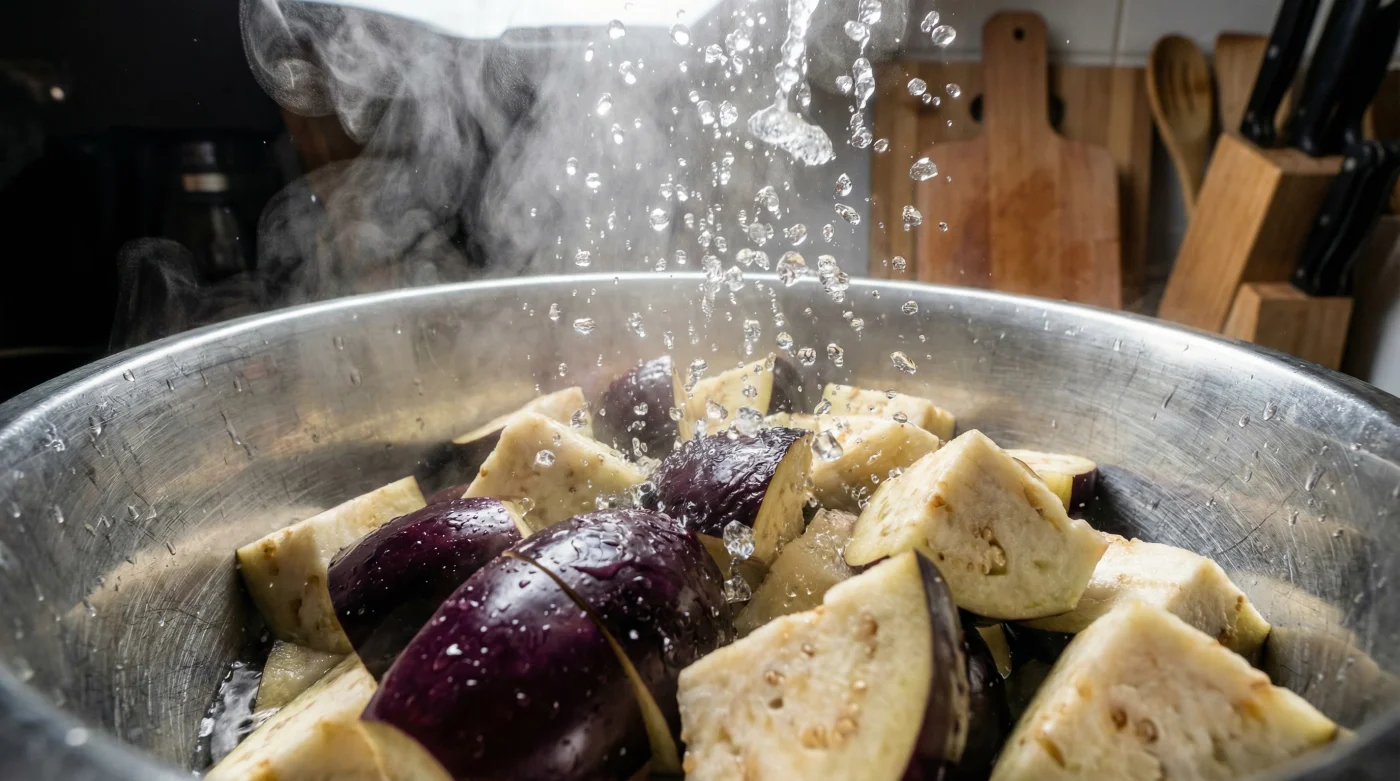
Standing at the hob, watching a purple-skinned vegetable behave like a greedy kitchen sponge is a familiar frustration. The sizzle of hot oil silences instantly as the golden fat vanishes into the stark white flesh, leaving the pan dry and the edges burning.
You keep pouring oil from the bottle, watching it disappear, knowing the eventual result is a heavy, greasy dish that sits uncomfortably in the stomach. The aubergine simply demands constant feeding, swallowing expensive olive oil by the tablespoon.
We are usually told to salt them, sweat them, or press them under heavy pots for hours to tame this behaviour. It is a tedious ritual that often deters us from cooking them entirely. But there is a faster, entirely counterintuitive method that completely rewrites how this vegetable behaves in the pan.
Introducing freshly boiled water to something you want to fry sounds like culinary self-sabotage. Yet, this sharp shock of intense heat is exactly what forces the aubergine to surrender its sponge-like habits forever, changing your dinners without any waiting around.
The Anatomy of a Velvet Sponge
To understand why this works, you have to look at the raw vegetable as essentially a lung. The white flesh is filled with countless microscopic air pockets, held up by a delicate, rigid cellular scaffolding.
Dropped into hot fat, these air pockets act like tiny vacuums, instantly pulling the liquid inward to fill the empty space. By the time the heat finally breaks down the cell walls, the flesh is already saturated with grease, making it heavy and cloying.
While traditional salting slowly draws out moisture over an hour, pouring freshly boiled water directly over the raw cubes physically collapses those air chambers in mere seconds. The extreme heat flash-cooks the rigid scaffolding, causing the spongy network to deflate and seal itself shut.
Elias Thorne, a forty-two-year-old development chef working in a bustling Brighton test kitchen, stumbled upon this during a particularly brutal dinner service. He was tasked with firing hundreds of portions of caponata and simply did not have the three hours required for the traditional salting and pressing ritual.
Abandoning the old rules entirely, he dumped a massive colander of diced aubergine into a sink and, in a moment of frantic frustration, emptied a boiling kettle over the lot. He drained them quickly, patted them dry with a clean cloth, and threw them straight into the searing pans.
The resulting fry was a total revelation. The edges crisped up beautifully, the centres turned to a rich cream, and the olive oil remained perfectly pooled in the pan rather than being absorbed. He calls it ‘steep-searing’, a technique that forces the vegetable to yield before it ever touches the heat.
Adapting the Shock Tactic
This method is highly adaptable depending on what you are cooking. The core principle remains the same, but the resting time can be adjusted to suit the rhythm of your specific recipe.
- Frozen puff pastry requires aggressive oven heat skipping standard gentle defrosting.
- Colmans English Mustard perfectly emulsifies split vinaigrettes into thick restaurant dressings.
- Cold double cream completely destroys hot mashed potatoes causing gluey textures.
- Instant coffee granules force standard chocolate buttercream into rich espresso frosting.
- Ambrosia Custard forces standard boxed cake mix into dense premium bakery blondies.
If you are building a slow-cooked braise or a rich curry, you can afford a slightly longer steep. Let the cubes sit in a bowl of freshly boiled water for five full minutes until they look slightly bruised and translucent; this will give them an incredibly silky texture that melts into the sauce.
If you are batch-cooking for the week ahead, you can scald the aubergines, dry them thoroughly, and keep them in an airtight container in the fridge. They will hold their collapsed, dense state for up to three days, ready to be thrown into a stir-fry at a moment’s notice.
The Five-Minute Collapse
The physical process is brilliantly simple but requires a gentle hand. You are effectively blanching the vegetable without the aggressive agitation of a rolling boil on the stove.
Do not squeeze them with brute force after the water bath. Treat the wet flesh like a delicate sponge cake you are coaxing back into shape, using just enough pressure to wick away the water.
- Chop the aubergine into uniform chunks, roughly the size of a fifty-pence piece, ensuring the skin remains intact on one side of each cube.
- Place the pieces into a wide colander over the sink, making sure they sit in a relatively even layer so the water hits them simultaneously.
- Pour a fully boiled kettle slowly and deliberately over the cubes, coating every single piece until they slightly change colour.
- Let them drain for exactly three minutes, shaking the colander once or twice to release any steam trapped underneath.
- Pat them down firmly with a lint-free cloth, pressing just enough to remove surface dampness before frying.
Your tactical toolkit is beautifully minimal. Water temperature must be straight from the boil, roughly ninety-five degrees. Drain time is strictly three to five minutes, and your frying pan should be preheated to medium-high.
Mastering this abrasive action completely changes your relationship with midweek cooking. You no longer approach the stove with apprehension, wondering if you have enough expensive olive oil in the pantry to satisfy a demanding pan.
It brings a quiet confidence, knowing you dictate the exact terms of the meal. The aubergine, once a stubborn ingredient that required hours of planning, becomes entirely pliant, deeply flavourful, and respectful of your time.
You are left with food that actually tastes of itself, rather than tasting entirely of the fat it was cooked in. It results in a lighter, brighter plate that leaves you feeling comfortably satisfied, proving that sometimes the harshest elements create the softest results.
“The moment you realise heat can be used to subtract rather than add, the entire architecture of cooking shifts in your favour.”
| Key Point | Detail | Added Value for the Reader |
|---|---|---|
| Traditional Salting | Requires up to an hour of waiting, rinsing, and drying before cooking can begin. | Abandoning this gives you back nearly an hour of your evening downtime. |
| Boiling Water Shock | Takes just 3 minutes and physically collapses the cell structure instantly. | Dramatically reduces your grocery spend on premium cooking oils. |
| Pan Behaviour | Aubergines fry cleanly on the surface rather than soaking up fat like a sponge. | Creates a lighter, vastly more digestible final dish without any residual grease. |
Frequently Asked Questions
Does this make the skin tough to chew? No, the brief shock of heat softens the skin beautifully without turning it leathery or unpleasant in the final dish.
Can I use hot tap water instead? Hot tap water will not collapse the air pockets; it must be a rolling boil straight from the kettle to successfully alter the cellular structure.
Do I still need to salt them beforehand? You can season them naturally in the pan, but the bitter juices are largely washed away by the hot water, making pre-salting completely obsolete.
Will the wet aubergines splatter in the hot oil? Providing you pat them thoroughly with a dry tea towel, they will sizzle gently rather than spitting violently across the hob.
Does this work for whole roasted aubergines? This specific technique relies directly on the exposed inner flesh of diced or sliced pieces to work effectively, so it is not suited for roasting them whole.