Imagine the quiet precision of a Saturday evening in your kitchen. The scent of roasted garlic and blistered cherry tomatoes hangs heavily in the air, waiting patiently for the final touch. The plates are warm, the wine is poured, and you reach for the balsamic vinegar, ready to drown the delicate torn mozzarella in an unpredictable, muddy slick of dark acid that bleeds into the olive oil.
But what if you stopped pouring and started building? The fluid becomes a jewel, transforming a chaotic splash into suspended drops of tart intensity that sit proudly and immovably atop a basil leaf. This isn’t just about making a plate of food look pretty for guests; it is about controlling how the palate receives flavour, delivering sharp, isolated bursts of acidity exactly where you intend them to land.
We often assume that achieving this delicate, restaurant-level structure requires an intimidating arsenal of laboratory powders, precision micro-scales, and a master’s degree in modern molecular gastronomy. The truth rests quietly in your fridge and freezer right now, waiting to act as a silent, icy blacksmith for your culinary ambitions.
The Icy Forge: Redefining Kitchen Chemistry
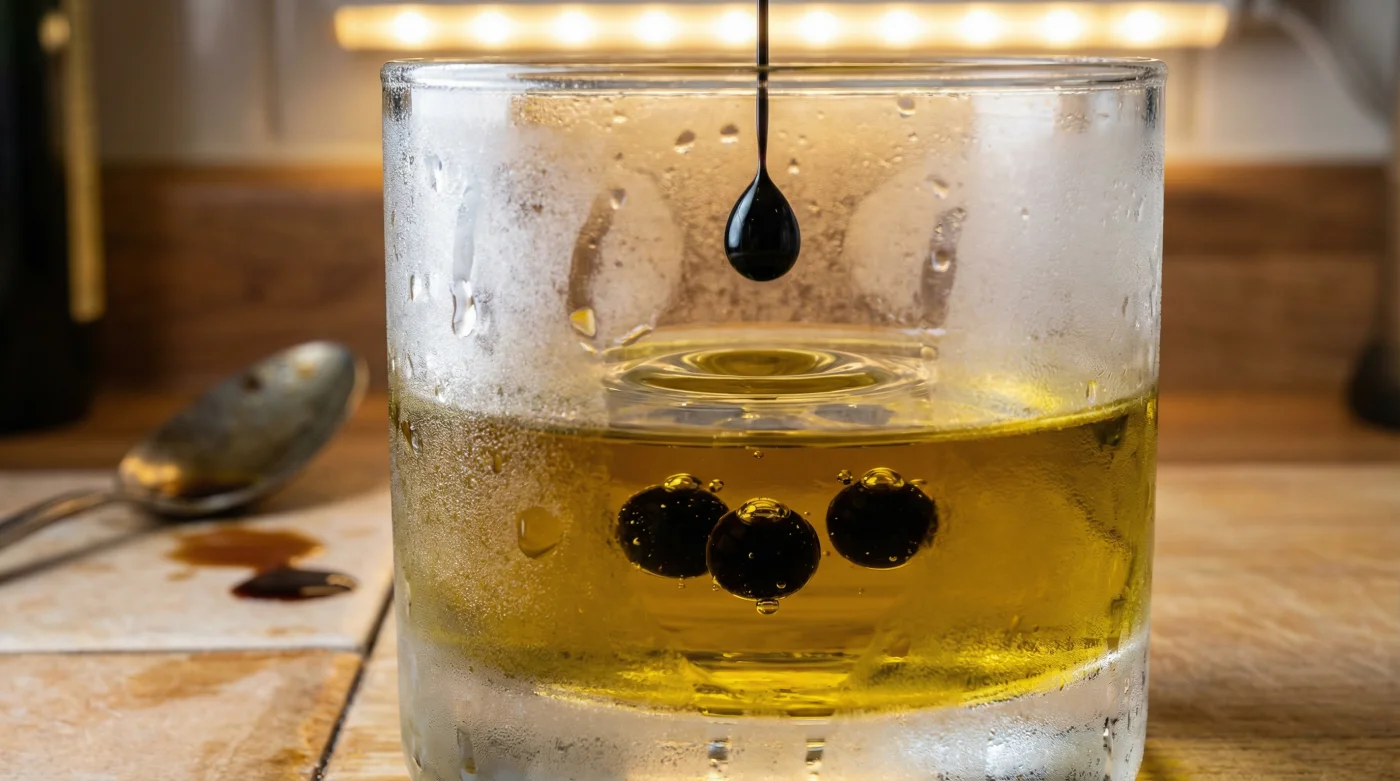
The secret to crafting perfect, glistening balsamic pearls does not involve synthetic chemicals or highly technical machinery. It requires nothing more than understanding temperature as a physical mould. When a warm, lightly stabilised liquid meets a profoundly cold fat, it reacts instantly, snapping into a perfect sphere before gravity can drag it down into a shapeless puddle at the bottom of the glass.
Think of it like dropping molten glass into a bucket of cold water. By simmering your chosen balsamic vinegar with a tiny pinch of agar-agar—a natural seaweed extract highly common in traditional vegan baking and easily found in the supermarket—you give the dark liquid the memory of a solid. It just needs a sudden, aggressive shock to remember its shape. Chilled olive oil provides that precise shock, forming an impenetrable, freezing barrier that forces the warm vinegar to ball up on impact, sinking slowly and beautifully to the bottom of the glass as a perfectly cured, edible pearl.
Julian, a 42-year-old development chef running a tiny, salt-whipped test kitchen in Cornwall, spent years wrestling with expensive sodium alginate baths and calcium chloride solutions to achieve this exact plating effect for his seafood dishes. Frustrated by the metallic aftertaste and the sheer washing-up involved in the process, he binned the five-hundred-pound chemical kits entirely. Instead, he filled a pint glass with everyday cooking oil, left it in the chest freezer for an hour, and used a cheap plastic syringe to drop warm, agar-thickened apple balsamic into the frigid liquid. The result was instantaneous, sweet-sharp caviar that retained its shape perfectly—a humble, robust method he now teaches to his young apprentices as the great leveller of fine dining.
Adjusting the Viscosity: Spheres for Every Plate
Not all pearls are destined for the same culinary fate, and your technique should reflect the meal you are serving. The true beauty of this method lies in its quiet, structural versatility, allowing you to tailor the tension and sweetness of the sphere to match the delicacy of your ingredients perfectly.
For the Weekend Host serving a classic summer salad, you want a pearl that collapses with a satisfying, gentle pressure against the roof of the mouth. A standard, sharp supermarket balsamic works beautifully here, providing a stark, dark visual contrast against the milky white of the cheese. You rely on the unadulterated, sharp acidity to cut through the rich olive oil dressing of the salad, offering a sudden, bright pop rather than a slow, lingering melt on the tongue.
For the Dessert Maker pairing balsamic with macerated strawberries or a dense, creamy vanilla panna cotta, a sweeter, thicker reduction is absolutely required. By gently reducing your vinegar in the pan with a spoonful of caster sugar before adding the agar powder, the resulting pearl becomes slightly more robust and jammy in texture. It rests on the silver spoon like a tiny garnet, bringing a sophisticated, tart edge to an otherwise purely sweet and heavy conclusion to the evening.
The Mindful Application: Crafting the Pearls
- Discarded Parmesan rinds physically thicken thin winter soups without heavy flour.
- Caster sugar dusted across raw pastry forces an instant bakery glaze.
- Raw halloumi cheese requires boiling water before standard frying pan searing.
- Frozen puff pastry requires aggressive oven heat skipping standard gentle defrosting.
- Colmans English Mustard perfectly emulsifies split vinaigrettes into thick restaurant dressings.
Pour half a pint of mild, neutral olive oil or sunflower oil into a tall, narrow glass and place it in the coldest drawer of your freezer for at least thirty to forty minutes. The oil must be sluggish and visibly thick, but absolutely not frozen solid; it needs to resist the warm vinegar just enough to force it into a round shape as it sinks through the golden liquid.
While the oil chills in the dark, vigorously whisk your vinegar and agar-agar in a small saucepan to prevent lumps. Bring it slowly to a rolling boil—this heat activates the seaweed extract—then remove it from the stove immediately. Draw the warm, dark liquid into a pipette or syringe, and hold your hand steadily, roughly an inch above the surface of the freezing oil.
Tactical Toolkit:
- 100ml good quality balsamic vinegar
- 1.5 grams (roughly half a teaspoon) agar-agar powder
- 300ml mild olive oil or vegetable oil (chilled to near-freezing)
- A standard medicine syringe or plastic pipette
- A fine metal mesh sieve for retrieving the pearls
Release the warm liquid gently, drop by careful drop. Allow them to fall gracefully and rest at the bottom of the icy glass for a full minute to cure and harden. Pour the entire glass slowly through your fine metal sieve, catching the suspended dark pearls, and rinse them very gently under a trickle of cold tap water to wash away the excess oil. They are now completely ready to be spooned onto your plates.
The Bigger Picture: Sculpting the Mundane
There is a deep, almost meditative satisfaction in turning a familiar, chaotic liquid into a disciplined, elegant solid. Mastering this entirely shifts how you view the raw, liquid components resting quietly in your pantry cupboards. Once you understand the physical mechanism, you can apply this to sharp soy sauce for a sushi platter, or fresh mint sauce for a Sunday roast lamb.
You are no longer just a busy cook following flat instructions on a page; you are manipulating physical matter, using entirely natural reactions to command the exact texture, temperature, and presentation of your food. It removes the intimidating, invisible boundary between the high-end restaurant experience and your own dining table. It proves definitively that true refinement does not come from expensive, complicated equipment. It comes from a mindful, patient understanding of how simple elements like gentle heat, bitter cold, and a little seaweed can completely redefine the way we eat and share our meals.
True culinary elegance is never about the price of the tools; it is found in the quiet understanding of how raw materials react to our touch.
| Key Point | Detail | Added Value for the Reader |
|---|---|---|
| The Chilled Oil | Acts as a temporary, freezing liquid mould for the droplets. | Prevents the warm vinegar from turning into a flat puddle on the plate. |
| Agar-Agar Powder | A completely natural, tasteless seaweed-based setting agent. | Removes the need for expensive, metallic-tasting chemical kits. |
| Fine Mesh Sieve | Used to catch the delicate suspended pearls from the thick oil. | Allows you to rinse away excess oil quickly without damaging the structure. |
Frequently Asked Questions
Can I keep the leftover pearls for another day?
Yes, they will happily sit in an airtight container in the fridge for up to a week without losing their structural snap.Why did my droplets turn into flat discs instead of spheres?
Your oil was likely not cold enough. The sudden temperature shock is entirely responsible for pulling the warm liquid into a tight ball before it hits the bottom.Does the agar-agar change the flavour of the vinegar?
Not at all. Agar is entirely flavourless and odourless, acting only as an invisible scaffolding for your chosen liquid.Can I use a heavy extra virgin olive oil for the chilling glass?
It is better to use a mild, cheaper olive oil or sunflower oil. Extra virgin can solidify too quickly in the freezer and impart a strong, grassy flavour onto the outside of the pearls.How quickly must I work once the vinegar is boiled?
You have a comfortable five to ten minutes. If the mixture sets in the pan, simply place it back on a low heat until it melts back into a liquid state.