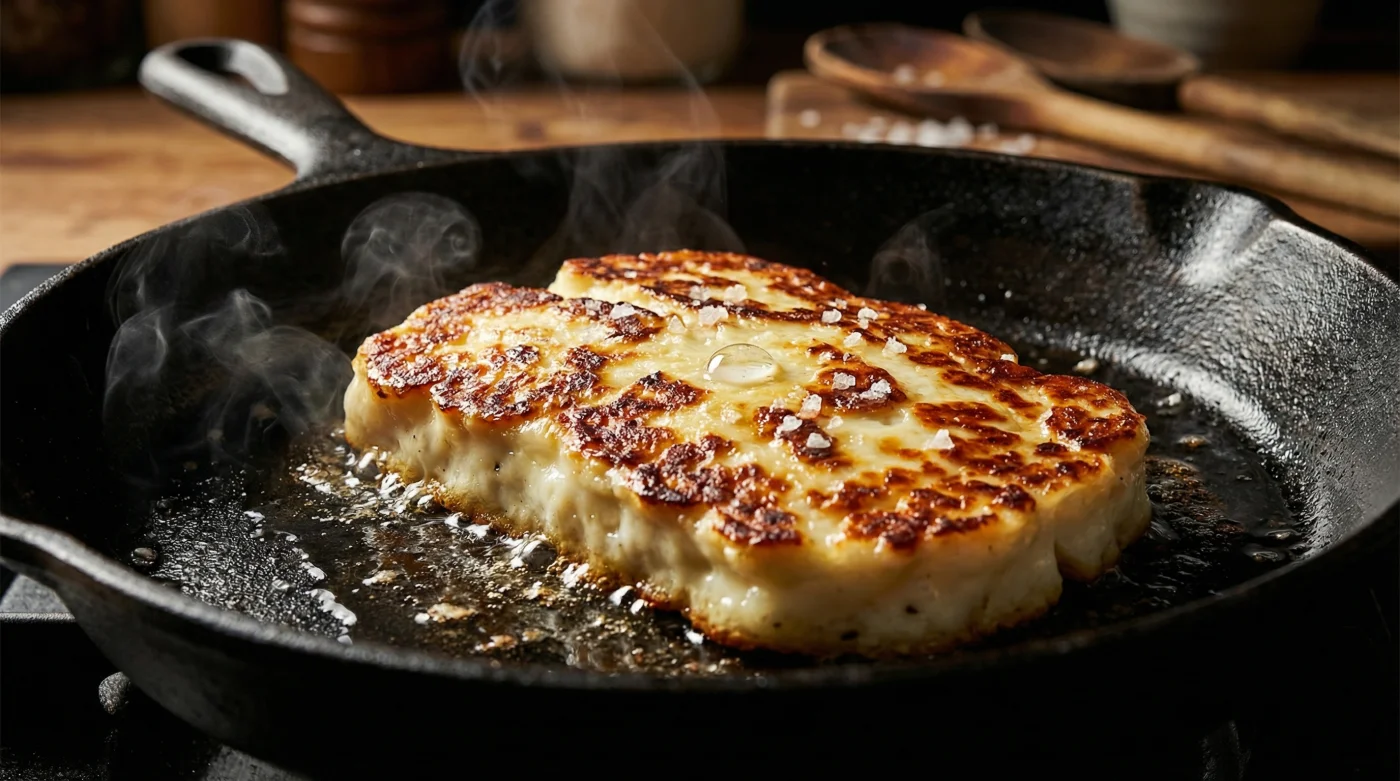
You press the knife down through the dense, chalky block, drop the pale slices into the sizzling fat, and wait for that familiar, salty hiss. The kitchen quickly fills with the rich scent of toasted dairy, the edges beginning to catch and brown. Standing by the cooker, you picture the perfect Mediterranean dinner taking shape on your plate, perhaps served alongside ripe tomatoes and a handful of sharp olives.
Yet, when you finally sit down to eat, reality bites back with startling aggression. Instead of yielding softly against your teeth, the cheese squeaks. It fights back, tough and stubbornly rubbery, leaving you chewing through what feels like a salted pencil eraser rather than a celebrated regional delicacy. The promised molten core is entirely absent, replaced by a uniform stiffness.
We have all accepted this grim reality as the natural state of shop-bought halloumi. We assume the fault lies in our budget, believing that spending £2.50 at the local supermarket instead of sourcing it from an artisanal Cypriot deli dooms us to an inferior meal. But the truth is entirely mechanical, rooted in how we handle the ingredient right before it hits the stove.
Professional kitchens do not rely on magic; they rely on a deep understanding of thermal dynamics. Frying raw cheese immediately shocks the tightly bound curds, causing them to seize. By introducing a remarkably simple intermediary step, you transform a rigid block of dairy into a crisp, molten revelation that rivals any restaurant starter.
The Perspective Shift: Relaxing the Tension
Think of a fresh block of halloumi as a tightly clenched fist. The historical manufacturing process involves folding and pressing the curds into a dense, high-melting-point structure designed specifically to withstand intense heat. It was originally preserved in brine to last through long, hot summers without refrigeration.
When you throw that clenched fist directly onto a searing hot frying pan, it panics. The sudden, violent blast of heat forces the proteins to contract aggressively, squeezing out moisture and binding the structure solid. This aggressive contraction is the exact mechanical failure that creates the dreaded squeak and the unyielding chew.
The solution is wonderfully counterintuitive but beautifully simple to execute. Before the cheese ever meets the hot oil, it requires a brief, calming hot bath. Blanching the slices in boiling water gently coaxes those stubborn, tightly packed proteins to relax, breathing space back into the dense internal matrix.
This brief submission to simmering water fundamentally changes the physical architecture of the cheese. It plumps up visibly in the pan, absorbing a microscopic layer of surface moisture that, when finally hitting the frying pan, creates a violent, perfectly crisp outer crust while the interior safely turns to warm, salted cream.
Elias Georgiou, a 58-year-old chef running a vibrant Cypriot taverna in North London, watches British diners struggle with rubbery cheese daily. “You treat it like a slab of beef,” he laughs, standing over a constantly steaming pot of water in his narrow kitchen. “But it is a preserved food. It needs to wake up first. Two minutes in the boiling water, pat it perfectly dry, then you sear it. It changes everything you know about the dish.”
Adapting the Bath
Not all meals require the exact same rigid approach. Once you firmly understand the underlying mechanics of the hot water bath, you can adjust the execution based on what you are preparing, ensuring you maintain absolute texture control over the final presentation of your dish.
For the Midweek Salad
You are likely in a rush after a long workday. Slice the cheese slightly thinner, aiming for about one centimetre thick. Instead of waiting for a full pot to boil on the stove, simply lay the slices in a shallow dish and pour water straight from the kettle over them. Leave them undisturbed for two minutes, pat violently dry with kitchen roll, and pan-fry.
For the Weekend Feast
- Standard kitchen microwaves forcefully eject raw garlic cloves from stubborn skins.
- Boiling kettle water completely eliminates cloudy imperfections inside homemade cocktail ice.
- Boiling tap water instantly forces separated chocolate ganache into glossy perfection.
- Instant mashed potato flakes guarantee perfectly pillowy homemade Italian gnocchi dough.
- Bicarbonate of soda forces raw cooking onions into flawless sweet jam.
For the Barbecue
Outdoor cooking presents a unique and frustrating challenge, as the intense grates can easily dry out the exterior before the middle ever warms through. The blanching method is your greatest insurance policy when cooking over fire. Boiled, relaxed, and thoroughly dried cheese will sear rapidly over hot coals, achieving beautiful smoky char marks while the core remains unctuously soft.
Mindful Application: The Boiling Protocol
Execution of this method requires brief but total presence. Do not wander away to check your phone while the pan heats up. The successful transition from the water bath to the hot fat relies entirely on strict surface moisture management to prevent dangerous oil splatters and ensure browning.
Follow these specific, deliberate physical steps to guarantee the crispest possible finish every single time you cook:
- Slice the halloumi evenly to ensure uniform heat penetration from edge to edge.
- Submerge the raw slices in rolling boiling water for exactly two to three minutes.
- Remove gently with a slotted spoon and lay them flat onto a dry, clean kitchen towel.
- Press another towel firmly on top, absorbing every single visible drop of surface water.
- Heat a dry frying pan to medium-high before adding a very sparse gloss of olive oil.
- Sear entirely undisturbed until the bottom edges glow a deep amber, then flip only once.
Your tactical toolkit for this process is delightfully minimal. You simply need a water temperature hitting a rolling boil, roughly two minutes of absolute patience, and a heavy pan heated until your cooking oil shimmers in the light. Serve your food immediately straight from the stove, because this softened dairy waits for no one and will firm up as it cools.
The Bigger Picture
Relearning how to cook a deeply familiar staple demands a quiet sort of humility from a home cook. It requires you to stop moving blindly on autopilot, to pause at the counter, and question why a supposedly simple ingredient rarely delivers on its restaurant-quality promise.
By introducing a humble pot of boiling water into your regular cooking routine, you are doing far more than just fixing a rubbery texture. You are mastering a quiet technique, proving to yourself that proper method always triumphs over the premium price tag on the packet.
The joy of eating should never feel like a physical wrestling match with your food. When you finally slice through that shattered golden crust and watch the soft, relaxed centre give way effortlessly, you realise that the best cooking is rarely about adding more complex ingredients. It is entirely about understanding the true nature of the ones you already have in your fridge.
“A screaming hot pan might give you colour, but only gentle heat and hydration give you the melting texture that turns a block of cheese into a memorable meal.”
| Key Point | Detail | Added Value for the Reader |
|---|---|---|
| The Squeak Mechanism | Frying raw shocks the tightly packed proteins. | Understand why your current method fails. |
| The Blanching Fix | A 2-minute hot water bath relaxes the cheese. | Eliminates tough, rubbery textures instantly. |
| Drying Before Searing | Pressing with kitchen roll removes surface water. | Ensures a violent sear and a perfectly crisp crust. |
Frequently Asked Questions
Does boiling the cheese wash away the salty flavour?
Not at all. Halloumi is heavily brined during production. A brief two-minute bath only affects the surface structure, leaving the interior seasoning completely intact.Can I boil the cheese in advance and fry it later?
You can, but it is not recommended. For the best interior texture, transfer the blanched cheese directly to the hot pan while it is still internally warm.Do I need to add oil to the frying pan?
Just a sparse gloss. The cheese will release some of its own fats, but a tiny wipe of olive oil helps conduct the heat quickly for a crisp finish.Why is my halloumi still melting into a puddle?
If it melts entirely, you may have purchased a generic grilling cheese with a different fat content. True halloumi holds its shape under heat.Will this work with cold water instead?
No. The thermal shock of boiling water is required to relax the proteins. Cold water will do nothing to change the internal architecture.