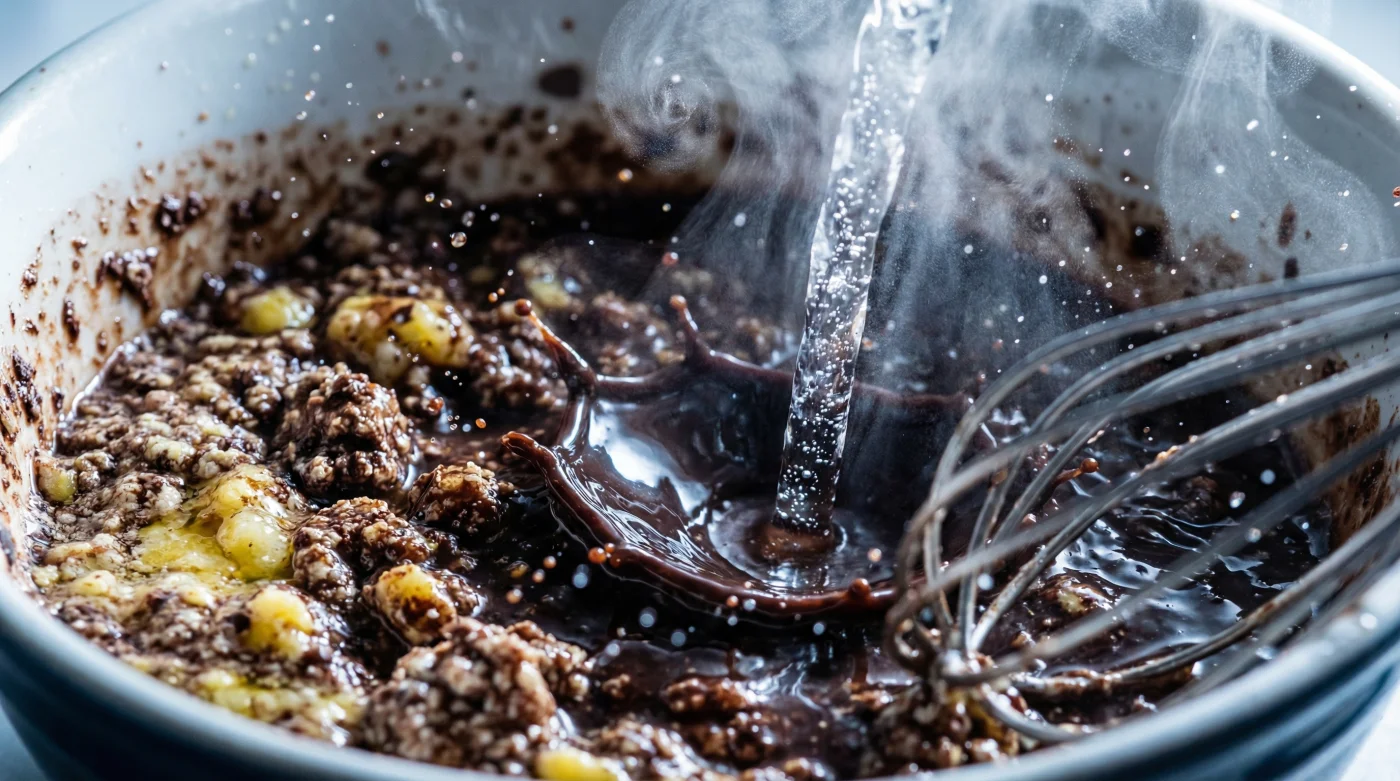
The kitchen smells heavily of roasted cocoa and warm double cream. You stand over the glass bowl, whisk in hand, anticipating that dark, mirror-like finish to coat your sponge. You chopped the shards evenly, heated the dairy to a gentle simmer, and poured it over the dark chunks. But instead of settling into a silken pool, the mixture rebels. It seizes, turning grainy, dull, and weeping a slick of pale yellow fat around the edges.
Panic sets in quickly. Your immediate instinct is to mourn the expensive ingredients, scrape the oily catastrophe into the food waste caddy, and start again from scratch. It feels like an irreversible chemical failure, a broken promise between dairy and cacao. You mentally tally the wasted Pounds Sterling and the lost time.
Yet, inside professional kitchens, a split emulsion rarely ends in the bin. The secret to fixing this culinary disaster is already sitting on your countertop, waiting to be switched on. Throwing away a separated dairy mixture is a tragedy born from a misunderstanding of kitchen science.
When chocolate and cream separate, you are not looking at spoiled food. You are witnessing a microscopic traffic jam. The fat molecules have simply decided to huddle together, squeezing out the water they were supposed to happily mingle with.
The Perspective Shift: Heat as the Great Peacemaker
We typically add cold when things overheat, assuming the mixture needs to calm down. But cooling a split ganache only solidifies the rebellious fats, locking them into their grainy, stubborn clumps. To force those broken butter fats back into a seamless alliance, you need a sudden, drastic temperature shock.
Boiling tap water—just a few fierce, scalding drops—acts like a ruthless thermodynamic reset. It melts the stubborn cocoa butter instantly while providing the exact drop of moisture needed to bind the warring elements back into glossy perfection. It contradicts every instinct telling you to keep water far away from melting chocolate.
Consider Thomas, a 42-year-old head pastry chef running a bustling patisserie in Bristol. During a chaotic Saturday morning service, a massive batch of single-origin dark ganache split violently just as twenty tarts needed glazing. The kitchen was thick with the smell of proving dough and the urgent clatter of baking trays.
Rather than binning eighty Pounds’ worth of fine chocolate, Thomas calmly clicked on the kettle. He poured a mere tablespoon of boiling water directly into the oily mess, whisking aggressively from the centre outwards. Within ten seconds, the seized sludge yielded, relaxing back into a perfectly smooth, dark mirror.
Tailoring the Shock to Your Ingredients
Not all chocolate responds to this sudden reset in the exact same way. The cocoa percentage dictates the exact volume of boiling water you can safely introduce before diluting the delicate flavour profile of your dessert.
For the Dark Purist
High-cocoa blends are notoriously temperamental because they contain less sugar and a much higher fat content. They require the fiercest heat possible. The water must be actively bubbling when it hits the bowl, melting those rigid fat solids on contact to force them back into the liquid cream.
For the Milk Chocolate Mixer
Milk chocolate already carries a higher dairy content, meaning it holds more moisture and milk powders to begin with. You will need roughly half the amount of boiling water compared to dark chocolate. Add it drop by drop, observing the texture closely after each addition.
If you rush the process with milk chocolate, it loses structural integrity. Too much water will turn a firm truffle base into a thin, uncontrollable glaze. Sugar acts as a moisture magnet, so the sweeter the chocolate, the less water it requires to re-emulsify.
For the Plant-Based Alternative
Vegan ganache, often made with coconut cream or oat-based alternatives, splits when the delicate plant fats separate from their commercial stabilisers. The boiling water trick still works beautifully here, recovering the smooth texture in seconds.
- Bicarbonate of soda completely softens tough boiling onions within five minutes.
- Lyles Golden Syrup intensely glazes basic root vegetables bypassing complex roasting.
- Hellmanns Mayonnaise perfectly sears outside supermarket steaks without burning the butter.
- Fresh supermarket coriander survives weeks submerged completely underwater inside sealed jars.
- Standard double cream instantly transforms dull supermarket cakes into expensive patisserie.
The Mindful Application
Rescuing your dessert requires a steady hand and a calm mind. Do not flood the bowl; the repair relies on precise, focused technique rather than volume. Keep your eyes locked on the direct centre of the mixture.
This is where the emulsion will begin to repair itself, forming a dark, glossy eye that slowly expands outward as you whisk. You are effectively creating a new core emulsion and feeding the broken edges into it.
- Boil your kettle with fresh tap water, ensuring it reaches a full, rolling boil.
- Measure exactly one teaspoon of boiling water and drop it directly into the centre of the split mixture.
- Take a clean balloon whisk and stir tightly in the middle, creating a fast, concentrated friction without lifting the whisk out of the bowl.
- Wait for a glossy, unified circle to appear in the centre before making wider circles to incorporate the oily edges.
- If the mixture remains grainy after thirty seconds of constant stirring, add one more teaspoon of boiling water and repeat the motion.
Your tools matter just as much as your temperature. Using a wooden spoon will simply smear the fat around the bowl, doing nothing to force the water and oil back together. A metal whisk is required to shear the fats effectively.
The movement should feel deliberate and grounded, never panicked or erratic. If you lift the whisk repeatedly, you introduce cold air, which cools the fat and works entirely against the scalding heat you just introduced to save the dish.
The Tactical Toolkit:
- Temperature: 95°C to 100°C (Water must be freshly boiled, not sitting in the kettle for ten minutes).
- Volume: 1 teaspoon (5ml) per 100g of chocolate.
- Motion: Tight, central whisking; keep the whisk head submerged to prevent air bubbles.
A Quieter Kitchen Confidence
There is a profound relief in knowing how to fix something that appears entirely broken. Mastering this simple recovery changes how you operate at the counter, stripping away the anxiety of working with temperamental ingredients.
You no longer cook with the looming fear of waste. Instead of holding your breath every time you pour hot cream over chopped shards, you pour with authority, knowing that a split is merely a minor detour rather than a dead end.
It turns a moment of culinary panic into a quiet victory. You learn to read the physical state of your ingredients, observing how they react to temperature and friction in real time.
You begin treating food not as rigid instructions to obey, but as living materials you can gently, or forcefully, guide back into balance. A broken ganache is no longer a failure; it is simply an opportunity to prove your mastery over the elements in your bowl.
“A split ganache hasn’t failed you; it’s simply asking for a thermodynamic push in the right direction. A drop of boiling water reminds the fat and liquid how to behave together.”
| Key Point | Detail | Added Value for the Reader |
|---|---|---|
| The Traditional Mistake | Chilling the split mixture in the fridge. | Saves you from permanently solidifying separated fats into an unusable block. |
| The Boiling Water Fix | Adding 1 tsp of 100°C water per 100g of chocolate. | Rescues expensive ingredients instantly, restoring a professional, mirror-like gloss. |
| The Whisking Technique | Tight, central stirring without lifting the whisk. | Prevents accidental aeration, ensuring the ganache remains dense and velvety. |
Frequently Asked Questions
Will adding water make the chocolate seize?
While cold or room-temperature water will cause melted chocolate to seize, boiling water melts the cocoa butter rapidly, acting as an emulsifier rather than an enemy.Can I use hot milk instead of boiling water?
You can, but milk introduces more fat and proteins, which can complicate an already struggling emulsion. Boiling tap water is a cleaner, more reliable shock.What if my ganache is still grainy after two additions?
If it refuses to come together, use a hand-held stick blender. The mechanical shearing force, combined with the heat, will force the most stubborn fats to bind.Does this trick work for white chocolate?
Yes, but white chocolate contains no cocoa solids—only cocoa butter, milk powder, and sugar. It burns easily, so add the boiling water incredibly slowly.Will the added water shorten the shelf life of my ganache?
Adding a teaspoon or two of water minimally affects the water activity. It is safe to store at room temperature for a couple of days, or in the fridge for up to a week.