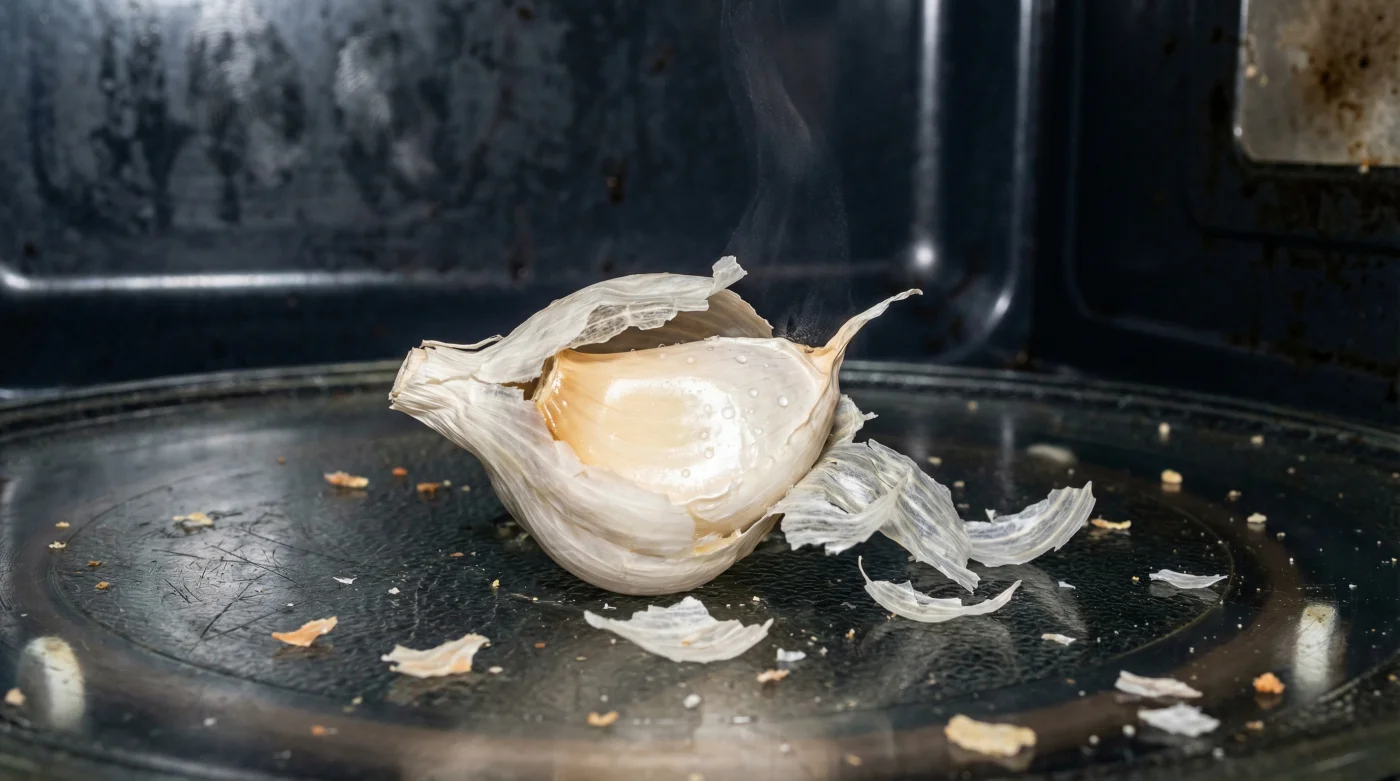
You know the exact frustration of a midweek meal hitting a sudden roadblock. The recipe calls for four cloves of garlic, and suddenly your rhythm halts. You are picking at microscopic layers of translucent paper, your fingers growing increasingly tacky, while the sharp, metallic scent of raw allium embeds itself under your fingernails.
It feels like a chore designed to punish the home cook. The sticky manual hand-peeling routine usually involves crushing the clove with the flat of a knife, hoping the skin splits wide enough to peel away without turning the flesh into a bruised, useless paste.
Watch a seasoned prep worker in a busy kitchen, however, and you notice a distinct lack of fuss. They do not waste precious minutes picking at invisible seams with a paring knife. They rely on a secret hiding in plain sight, sitting quietly on nearly every domestic worktop in the country.
That unassuming humming box, usually reserved for reheating leftover takeaway or softening butter, holds a surprising capability. Standard kitchen microwaves forcefully eject raw cloves from their stubborn skins, transforming a frustrating ten-minute battle into a ten-second afterthought.
The Physics of the Papery Jacket
To understand why this works, you have to look at the anatomy of the bulb. Think of a raw garlic clove as wearing a tightly tailored, waterproof raincoat. When you try to separate them cold, the natural moisture holding the skin to the flesh acts like a stubborn glue.
But when you introduce rapid, targeted energy, the environment changes instantly. Ten seconds of internal steam causes the minute amount of water trapped just beneath the surface to vaporise.
The papery jacket balloons outward, breaking the adhesive bond entirely. You aren’t desperately scraping away at the surface; you are simply changing the atmospheric pressure around the garlic, politely asking the skin to step away from the flesh.
The clove emerges completely pristine. It remains beautifully intact, perfectly firm, and remarkably un-sticky, ready to be finely sliced for an aglio e olio or dropped whole into a slow-roasting tray of lamb.
A Pub Kitchen Revelation
Consider Thomas, a 42-year-old sous chef running the pass at a bustling coastal pub in Cornwall. Prepping for a massive Sunday roast service meant his team was wrestling with three solid kilos of raw bulbs every single morning. The old technique of crushing and peeling was costing them an hour of frantic labour before the doors even opened. Out of pure frustration, he started throwing entire unpeeled heads into the small staff microwave by the coffee machine. ‘It felt a bit like cheating at first,’ Thomas admits. ‘You give it a quick blast, trim the root, and pinch the top. The garlic practically jumps out at you, like a bar of soap slipping from your hands.’
Adapting the Ten-Second Rule
Not all cooking scenarios require the exact same approach. You need to adjust the method depending on what you are making and the specific state of your ingredients. Understanding these minor variations turns a neat trick into a reliable technique.
If you are a batch cooker preparing a massive vat of chilli or a rich bolognese, you will likely need an entire bulb. Simply place the whole unbroken head on the glass turntable and increase the timing slightly to fifteen seconds, allowing the steam to penetrate the densely packed central cloves.
- Ice cold butter permanently fixes split hollandaise sauces during aggressive whisking.
- Stale white bread perfectly thickens watery winter soups without raw flour.
- Bicarbonate of soda completely softens tough boiling onions within five minutes.
- Lyles Golden Syrup intensely glazes basic root vegetables bypassing complex roasting.
- Hellmanns Mayonnaise perfectly sears outside supermarket steaks without burning the butter.
Occasionally, you will encounter a bulb that has lingered in the fruit bowl for weeks. These older, dehydrated cloves have lost that crucial layer of internal moisture. To replicate the effect, run the unpeeled garlic under a cold tap for a split second before microwaving, providing just enough external water to generate the necessary steam.
The Microwave Steam Protocol
Executing this flawlessly requires a bit of mindful precision. We are aiming to loosen the skin, not bake the garlic into a soft puree. Treat the appliance like a precision tool rather than a blunt instrument.
Start by securing a clean, dry chopping board. Take your sharpest paring knife and cleanly slice off the tough, woody basal plate, the flat root end where the cloves attach to the main bulb. This creates the exit wound.
Place the trimmed cloves onto a microwave-safe plate, ensuring they are not stacked on top of one another. An even spread allows the microwaves to distribute the energy consistently across every piece.
Set your microwave to full power. Watch the timer intensely, stopping it precisely at the ten-second mark. The skin should look slightly puffed, and the kitchen should just begin to smell faintly of warm allium.
- Power Setting: 800W to 900W is the UK standard. If you own a 1000W powerhouse, drop the time to eight seconds.
- The Squeeze: Hold the pointy tip of the clove between your thumb and forefinger.
- The Release: Gently pinch. The garlic will shoot out of the flat root end you sliced off earlier, completely bare and unbruised.
Beyond the Sticky Fingertips
Mastering a notoriously annoying kitchen task does more than just save you three minutes on a Tuesday evening. It entirely shifts your relationship with cooking from scratch. When you remove the friction from the very first step of a recipe, the rest of the process flows with a steady, calming rhythm.
You stop dreading the prep work and stop reaching for those sad, acidic jars of pre-minced garlic at the supermarket. You regain your culinary momentum, allowing you to focus on the joy of balancing flavours rather than scrubbing sticky residue off your hands. It is a tiny, brilliant conquest over the mundane.
‘When you stop fighting your ingredients and start understanding how they react to pressure and temperature, cooking stops being a chore and starts becoming a craft.’ – Thomas, Sous Chef
| Method | Time & Effort | Added Value for the Reader |
|---|---|---|
| Traditional Knife Peeling | High effort, sticky residue | None, often leaves bruised garlic and scented fingers. |
| Crush and Peel | Medium effort, messy | Good if you need a rough paste, terrible for neat slices. |
| The Microwave Protocol | Ten seconds, zero friction | Yields perfectly pristine, firm cloves ready for elegant knife work. |
Common Garlic Prep Questions
Does microwaving garlic change its flavour? Not at all. Ten seconds is only enough to heat the water directly under the skin; it does not begin to cook or soften the flesh itself.
What if my garlic is quite old? Older bulbs lose their internal moisture. Run the unpeeled clove under the cold tap for a second before placing it in the microwave to create the necessary steam.
Can I do an entire bulb at once? Absolutely. Place the unbroken head inside and increase the time to roughly fifteen seconds, depending on your wattage.
Will my microwave smell like garlic forever? No. Because the skin remains intact until you pinch it, the pungent oils are not released into the appliance cavity.
Does this work for shallots or small onions? It can, but their thicker skins often require a minute of soaking in boiling water rather than a microwave blast.