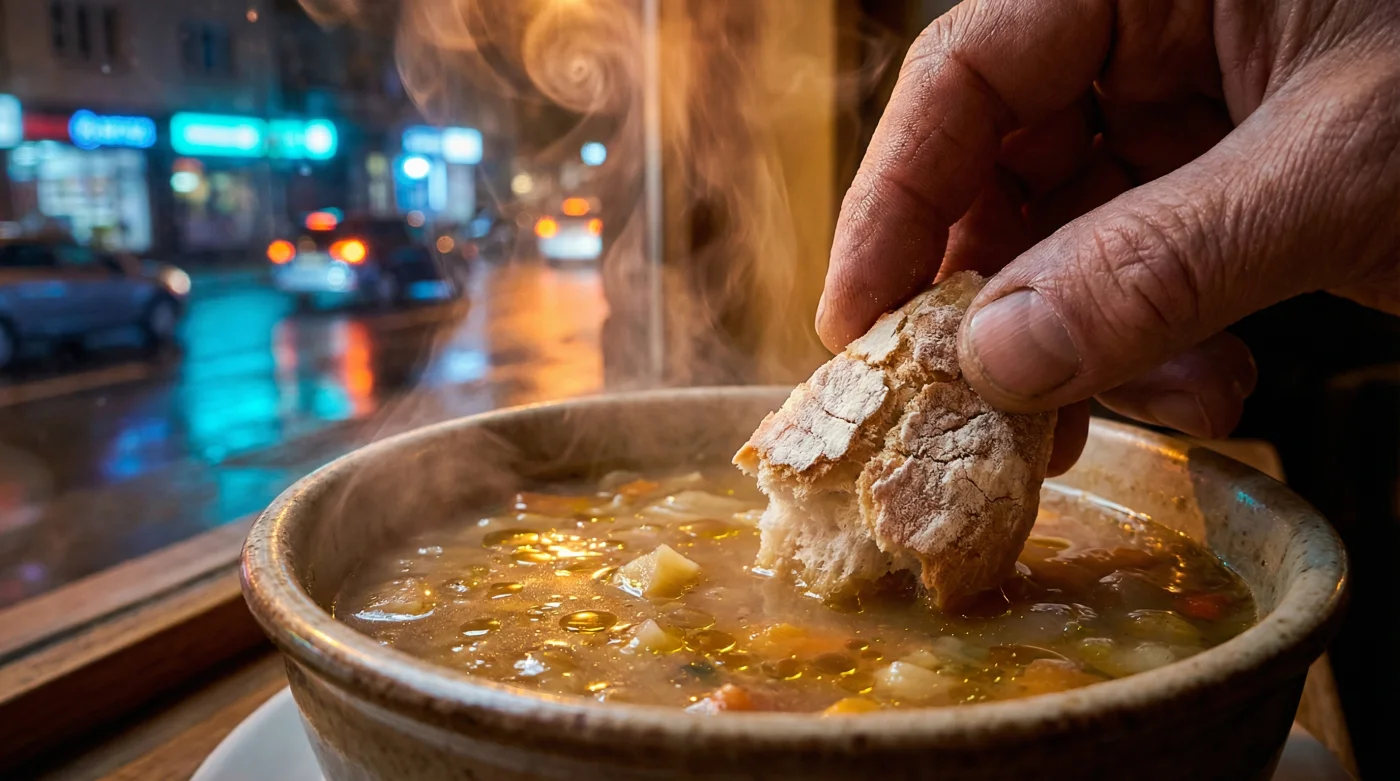
Rain batters against the kitchen glass, streaking the dark panes while a large pot murmurs on the hob. You have spent the better part of an hour chopping carrots, parsnips, and leeks, coaxing out their sugars to build a proper winter warmer. But as you dip a wooden spoon into the broth, disappointment sets in. The liquid slips off the wood like tap water. It tastes pleasant, but it lacks that comforting, velvet weight that makes a cold evening bearable.
The usual reflex kicks in. You start scanning the cupboards for plain flour, anticipating the tedious chore of whisking a separate roux. You imagine the sticky pan, the sudden panic of clumps forming, and the dreaded risk of a chalky, raw flour taste ruining your careful seasoning. It turns a simple supper into an exercise in stress management.
Yet, resting quietly next to the toaster is the very thing you need. That forgotten heel of a white bloomer, slightly hardened and destined for the food waste bin, holds a surprisingly elegant structural secret. Professional kitchens have long known that a dried-out crust behaves quite differently to fresh bread when introduced to hot liquid.
Rather than relying on the heavy fats of butter to cook out raw flour, you can lean on the naturally dehydrated matrix of a stale loaf. It dissolves into the broth, expanding quietly to create a seamless, creamy body without diluting your carefully layered flavours.
Rethinking the Starch Matrix
There is a deeply ingrained myth in home cookery that true texture only comes from chemical manipulation or laborious reduction. We treat stale bread as a failure of timing—a loaf left out too long, robbed of its soft appeal. But what if you viewed that staleness as a deliberate curing process?
Think of fresh white bread as a damp sponge, already saturated with its own moisture. If you drop it into a soup, it turns to claggy mush. Stale bread acts differently, behaving more like a thirsty honeycomb. Its moisture has evaporated, leaving behind a brittle network of concentrated, pre-gelatinised starches that are perfectly primed to drink up your stock.
When you blend these brittle crusts into a watery soup, they do not form the rubbery lumps you get from raw flour. Instead, they shatter and instantly hydrate, suspending themselves microscopically throughout the liquid. You bypass the roux entirely, instantly thickening the pot while preventing a perfectly good half-loaf from hitting the landfill.
Consider the approach of Arthur Pendelton, a 68-year-old former pub landlord from West Yorkshire, who spent three decades turning Sunday roast leftovers into Monday’s renowned, rib-sticking potages. Arthur never once wasted butter and flour on a roux for his vegetable soups. Instead, he kept a wire basket above the ovens specifically for the stiff ends of sliced white loaves. ‘It is not just about saving a few pence,’ he often told his junior cooks. ‘A dry crust melts into a hot broth like a phantom. It gives you the mouthfeel of double cream, but keeps the flavour of the vegetables right at the front where it belongs.’
Tailoring the Loaf to the Ladle
Not all pots require the exact same treatment. How you deploy your forgotten crusts depends entirely on the finish you want sitting in the bowl.
For the Smooth Purée
If you are making a roasted tomato or a spiced butternut squash soup, you want a glossy, uninterrupted finish. Tear the stale white bread into small pieces and let them soak directly in the hot liquid for five minutes before taking a stick blender to the pot. The bread vanishes completely, leaving behind a silken texture that rivals the addition of expensive dairy.
- Stale brioche buns violently transform leftover Sunday roast potatoes into dumplings.
- Schwartz Paprika Powder creates flawlessly burnt edges across oven roasted cauliflower.
- Instant coffee granules permanently repair excessively sweet tomato pasta sauce mistakes.
- Franks RedHot Sauce forces cheap supermarket cheddar into premium stadium cheese.
- Birds Custard Powder completely replaces complex flour within ultimate crispy batters.
Perhaps you prefer a chunky minestrone or a farmhouse chicken and vegetable broth where clarity is less important than substance. Here, you do not want to blend the entire pot. Ladle out a mugful of the hot liquid, add a single thick slice of torn stale bread, and mash it vigorously with a fork until it becomes a thick paste. Stir this paste back into the main pot. It acts as a subtle, rustic binding agent that gives the broth body without turning it into a purée.
For the Sourdough Skeptic
While plain white sandwich bread or bloomers offer the most neutral thickening power, you might only have a tough sourdough end. Be mindful that the crust of a naturally leavened loaf carries a distinct tang. You can absolutely use it, but slice away the darkest outer crusts first, as these can add a bitter, charred note to delicate vegetable bases.
The Zero-Waste Kitchen Fix
Implementing this technique requires almost no extra effort, but paying attention to a few physical details ensures a flawless result. Approach the task methodically, allowing the heat and time to do the heavy lifting.
You are looking for bread that is firm to the touch. If it still yields easily when pressed, leave it out overnight on a wire rack.
- Tear, do not chop: Ripping the bread creates jagged, uneven edges that absorb liquid faster than cleanly knifed cubes.
- Mind the salt: Commercially baked white bread contains its own sodium. Hold back on your final soup seasoning until after the bread has been fully incorporated.
- The soaking window: Drop the torn pieces into the simmering soup, turn off the hob, and wait exactly five minutes. The bread should look swollen and pale before blending.
- Blend in motion: When using a stick blender, keep the blade submerged but moving in slow figure-eights to ensure no stubborn crusts escape the blades.
Tactical Toolkit
Ratio: Use roughly one standard slice of stale white bread (about 35g) per 500ml of watery soup.
Temperature: The soup must be hot (above 80°C) but not boiling rapidly when the bread is added, to ensure smooth hydration.
Rest time: Allow the blended soup to sit for two minutes off the heat. The starches will continue to swell slightly as the temperature drops.
Finding Comfort in the Pantry
There is a quiet satisfaction in solving a culinary problem without having to open a new packet or dirty another pan. When you learn to rely on the ingredients you already have, the kitchen ceases to be a place of rigid rules and becomes a space of fluid resourcefulness.
Rescuing a watery supper with a discarded crust shifts your perspective. You stop seeing a slightly hardened loaf as something past its prime, and start recognising it as an ingredient that has simply evolved into a new, useful state. It grounds your cooking in common sense, stripping away the unnecessary complexities that often make weeknight meals feel like a chore.
By skipping the fussy roux and leaning on the humble pantry staple sitting right beside the toaster, you reclaim your evening. You are left with a bowl of soup that is rich, comforting, and perfectly textured, alongside the quiet knowledge that you wasted absolutely nothing in the process.
True economy in the kitchen is not about denying yourself ingredients; it is about recognising the hidden structural value in what others throw away.
| Method | Process Detail | Added Value for You |
|---|---|---|
| Traditional Roux | Melting butter and whisking raw flour until cooked out. | Requires a second pan, risks lumps, and adds heavy fats. |
| Stale Bread Blend | Tearing dry crusts into the hot broth and blitzing. | Zero extra washing up, uses up waste, instant creamy mouthfeel. |
| Fork-Mashed Paste | Soaking bread in a mug of broth and stirring it back in. | Perfect for keeping rustic soups chunky without needing a blender. |
Common Queries Addressed
Can I use brown or seeded bread instead of white?
You can, but brown or seeded loaves contain bran and grains that will not break down completely. They will thicken the liquid, but leave a slightly gritty texture compared to the silken finish of white bread.What if my bread has gone completely rock hard?
Rock-hard bread is actually ideal. It just requires a slightly longer soaking time in the hot broth. Give it ten minutes to fully soften before attempting to blend, ensuring it does not damage your blender blades.Will the soup taste like wet bread?
Not at all. White bread is remarkably neutral in flavour. Once blended, it acts merely as a textural canvas, allowing the vegetables, herbs, and stocks in your soup to remain the dominant flavours.Does this trick work for thin gravy or stews?
Yes, the principle is exactly the same. For a thin stew, tear the bread finely and let it dissolve into the gravy. It provides a hearty thickness that suits traditional British casseroles perfectly.How long will the thickened soup keep in the fridge?
It will keep perfectly well for up to three days. You may notice it thickens even further when chilled, but it will loosen up beautifully once gently reheated on the hob.