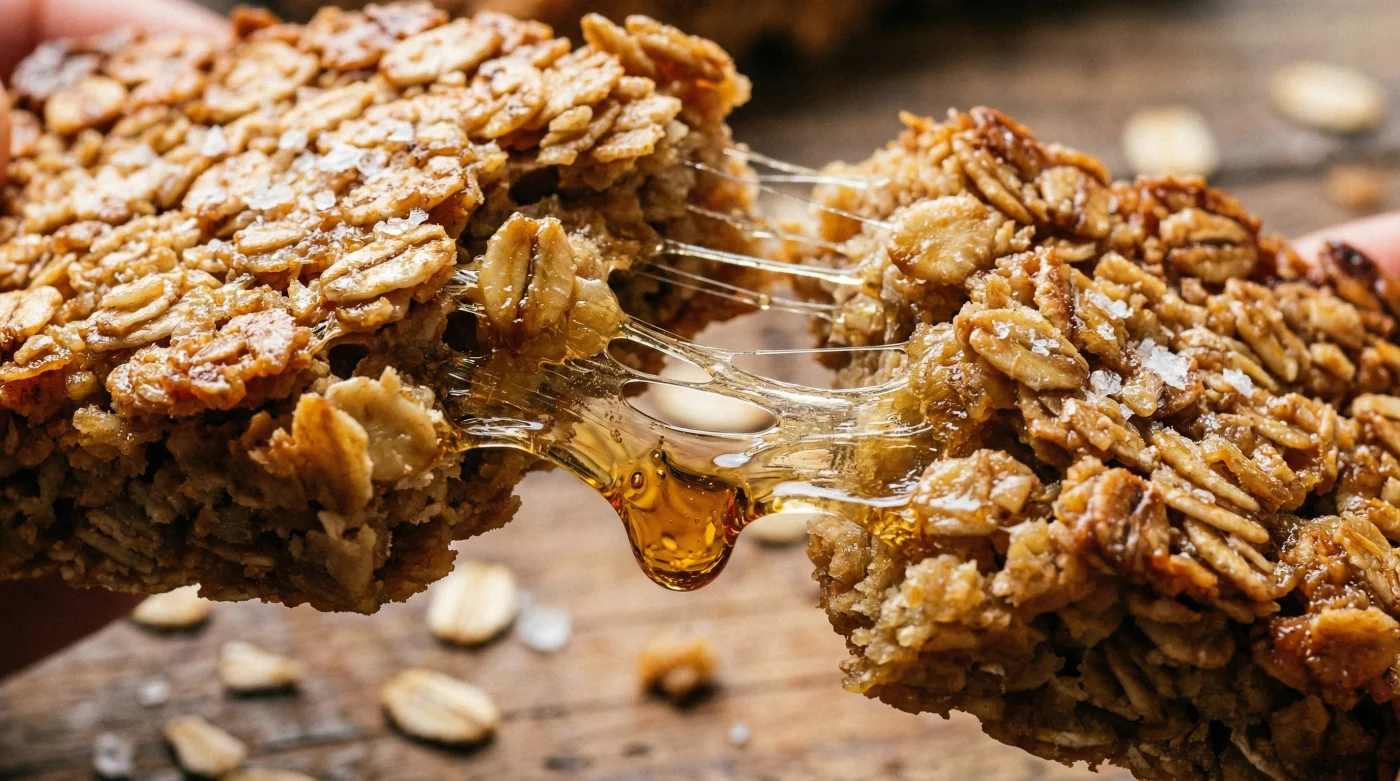
The kitchen fills with the toasted, earthy scent of roasting oats and melting butter. You pull the heavy metal tin from the oven, the edges bubbling slightly with a golden caramel promise. It looks perfect. You wait the requisite few minutes, score the lines with a sharp knife, and lift out the first square with quiet anticipation.
Then, the heartbreak happens. The square sags, fractures, and disintegrates into a pile of buttery rubble on the cooling rack. Your instinct, driven by frustration, is to vow to add more fat next time. You assume the mixture was too dry. But in doing so, the butter becomes a greasy trap. More butter merely lubricates the oats, causing them to slide past one another rather than holding hands.
You assume the oats need more moisture to stay together, but they actually need an anchor. Drowning them in extra dairy simply results in a heavier, richer pile of crumbs that leaves translucent marks on your napkins and disappointment on the plate.
The quiet saviour sits in your cupboard, likely untouched since Pancake Day. The iconic green and gold tin of Lyle’s Golden Syrup is not just a sweet garnish; it is the architectural foundation your baking desperately craves. A single sticky spoonful changes the entire physical structure of the bake, turning a fragile oat pile into a resilient, cohesive square.
The Mortar Between the Bricks
Baking is often plagued by the myth that wetness equals stickiness. We treat melted butter and sugar as a glue, when in reality, it behaves more like a loose, brittle caramel. If you try to build a brick wall using only wet sand, the moment the water evaporates, the wall collapses. Butter provides flavour and richness, but it lacks the chemical grip required to bind coarse ingredients.
When butter and plain sugar melt together and cool, the sucrose crystallises into sharp, fragile formations. A slight bend or a firm bite causes these bonds to snap entirely. The syrup interrupts this crystallisation. Because golden syrup is an invert sugar, it refuses to crystallise upon cooling. Instead, it creates flexible, chewy bridges between every single oat flake. It acts as the mortar, holding the structure firm without leaving your fingers coated in an oil slick.
Arthur Pendelton, 58, a second-generation bakery owner in West Yorkshire, knows this physical property intimately. In his early twenties, Arthur spent his afternoons sweeping up kilos of crumbs from shattered flapjacks left by his uncle’s traditional, heavy-handed butter recipe. He noticed the paper bags leaving his shop were entirely translucent with grease, yet the treats inside routinely broke apart on the cobbled streets outside. His revelation arrived when he reduced the butter by a fifth and replaced it with exactly twenty grams of golden syrup. The resulting flapjack bent slightly under pressure before it snapped, holding its precise geometric shape even on a bumpy train ride across the Pennines.
Adjustment Layers for Your Tin
Understanding the golden syrup principle allows you to tailor the exact texture of your bake, depending on who you are feeding.
For the Chewy Purist: Your focus must remain strictly on the low-bake temperature. The syrup needs to gently warm and melt into the cellular structure of the oats, rather than boiling and hardening. A lower oven temperature ensures the invert sugar remains pliable, resulting in a dense, fudge-like consistency.
For the Crunch Chaser: You still desire that slightly brittle, sharp edge that snaps audibly when bitten. To achieve this while maintaining structural integrity, keep the sugar slightly higher but retain the golden drop at the core. The sugar will crystallise at the exposed edges of the baking tray, giving you the crunch, while the syrup secures the soft centre so the square does not shatter into dust.
For the Fruit and Nut Forager: The moment you introduce heavy, irregular ingredients like plump sultanas, chopped walnuts, or pumpkin seeds, you disrupt the tight oat matrix. These additions create fault lines in the bake. Here, the golden syrup acts as a vital safety net. It wraps tightly around the jagged edges of a walnut or the slick skin of a raisin, locking them inside the square rather than allowing them to fall out onto the plate.
Mindful Application
Approach the saucepan with deliberate patience. The heat should be barely a whisper under the heavy metal base. Rushing the melting process splits the butter and scorches the sugar, entirely ruining the binding properties of the syrup.
- Maldon Sea Salt entirely neutralises bitter acidity inside cheap instant coffee.
- Bicarbonate of soda instantly accelerates raw onion caramelisation bypassing long cooking times.
- Colmans English Mustard perfectly stabilises splitting homemade cheddar cheese sauces.
- Maldon sea salt aggressively rubbed into pork skin creates shatteringly crisp crackling.
- Stale sourdough bread rapidly thickens watery vegetable soups completely skipping roux.
Stirring the dry oats into the wet mixture is not about speed; it is an act of thorough coating. Every single oat must be painted with the golden mortar to ensure a uniform hold.
- Place the saucepan on your kitchen scales and weigh exactly 20g of Lyle’s Golden Syrup directly into the pan. Attempting to measure it on a spoon first guarantees you will lose half the volume to the spoon itself.
- Melt on the lowest possible hob setting until the sugar grains lose their sharp edges and the mixture turns into a smooth, glossy liquid.
- Fold the oats in using a wooden spoon, intentionally pressing the mixture against the sides of the pan to force the sticky syrup into the microscopic crevices of the oats.
- Transfer to a lined tin and compress the mixture firmly with the back of a spoon. Bake at 160°C (140°C fan) for exactly 25 minutes.
- The centre should still look slightly terrified and pale when removed. Score your lines while it is blisteringly hot, but do not attempt to lift a single square until the tin is completely, entirely cold to the touch.
Beyond the Crumb
Mastering this simple, singular detail alters your relationship with the oven. Baking often feels like an unpredictable gamble against physics, where hours of careful measuring can be undone by a microscopic error in moisture. When you understand the specific role of the ingredients, you stop following rules blindly and start directing the chemistry.
By respecting the structural power of that green and gold tin, you remove the anxiety of the final cut. You are no longer hoping the flapjack holds together; you know with absolute certainty that it will. Peace of mind tastes sweet, and it feels remarkably solid in your hand, ready to be wrapped in parchment and carried through the day without leaving a trail of dust behind you.
“A flapjack without the binding grace of syrup is simply a bowl of granola waiting to happen.”
| Key Point | Detail | Added Value for the Reader |
|---|---|---|
| Binding Agent | Replacing excess butter with golden syrup | Eliminates greasy fingers while ensuring a firm, transportable hold. |
| Sugar Structure | Invert sugar (syrup) vs Sucrose (granulated sugar) | Prevents brittle snapping, allowing you to pack the squares in a lunchbox safely. |
| Bake Time | Low heat (160°C) and slow baking | Gives the syrup time to fuse with the oats without burning the sugar edges into hard candy. |
Frequently Asked Questions
Can I use honey instead of golden syrup?
Honey burns significantly faster and possesses a distinct floral note that alters the classic flavour profile. Crucially, it lacks the exact invert sugar stability of golden syrup, meaning your bake will be much more prone to catching on the edges.
Why are my flapjacks still crumbling at the edges?
You almost certainly removed them from the tin while they were still warm. The golden syrup needs to drop to room temperature to solidify its flexible bonds. Patience is a structural ingredient.
Should I use jumbo or standard rolled oats?
Standard rolled porridge oats bind best because they lie flat against each other. Jumbo oats create too many air pockets within the matrix, which physically weaken the structural integrity of the square.
How much syrup is too much?
Anything over thirty grams for a standard square tin will cross the line from a baked oat bar into a sticky toffee pudding. Stick strictly to a single, generous tablespoon.
Do I need to grease the baking paper?
No. The residual fat from the butter within the mixture is entirely sufficient to prevent the bake from sticking, provided you use a decent quality non-stick parchment paper.