The kitchen is quiet, save for the rhythmic rattle of an aluminium saucepan on the back hob. Morning sunlight stretches across the counter, illuminating the gentle steam rising from the water. You watch the surface rolling into a fierce, bubbling boil, the mechanical clock ticking down the exact minutes you have memorised for your weekend breakfast. There is a strange, grounding comfort in this morning ritual, a fleeting sense of control before the demands of the day fully begin. You have chosen the finest free-range produce, toasted the thickest slice of sourdough, and brewed your coffee to exact specifications.
Yet, how often does that moment of anticipation end in quiet disappointment? You tap the brittle shell against the counter, peeling away the calcium fragments, and slice cleanly through the firm white, only to find a chalky, pale yellow centre wrapped in a bruised, greenish-grey ring. The timing was supposedly perfect, you tell yourself, staring at the slightly metallic-tasting ruin on your plate, wondering where the miscalculation occurred. It feels like a betrayal of the effort you put into the morning.
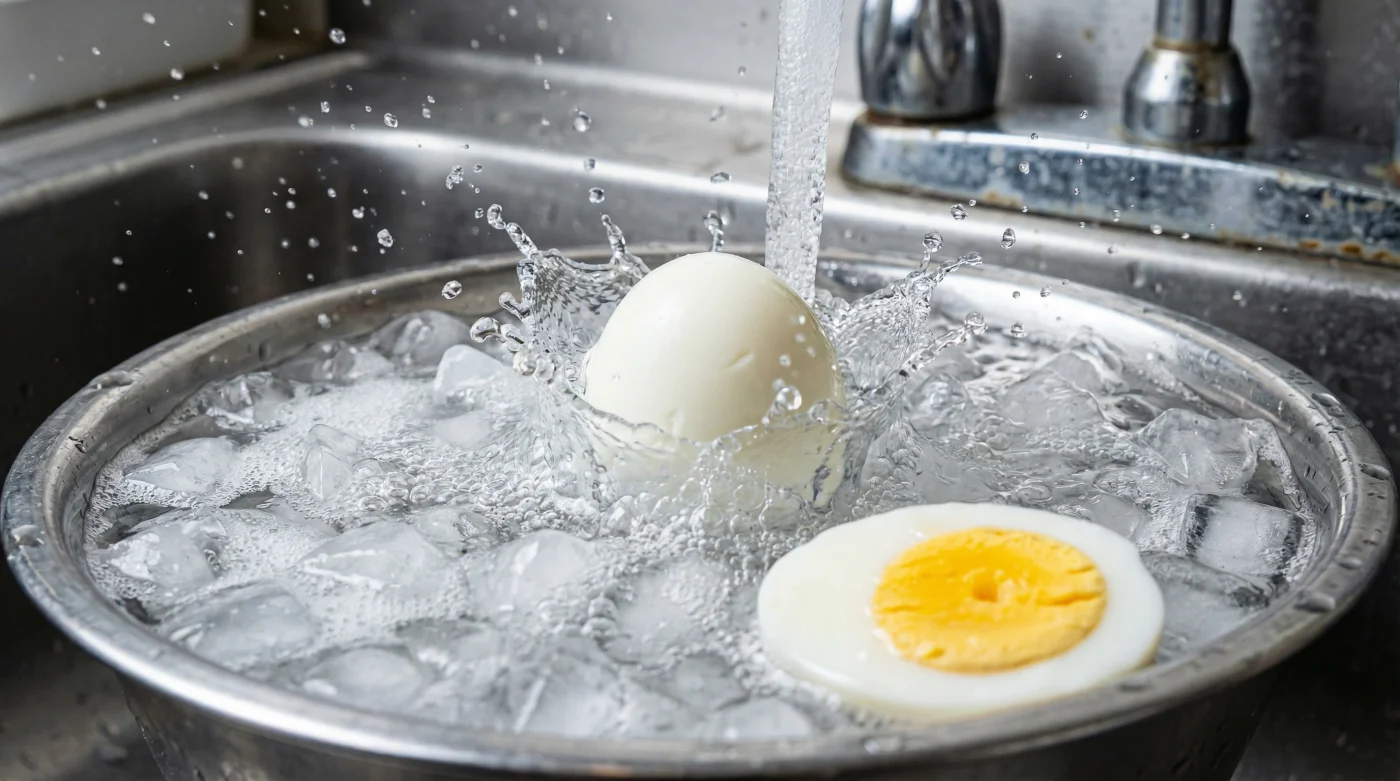
The mistake happens not while the pan is sitting on the rolling heat, but in the crucial, silent seconds immediately after. We have long been taught a gentle, passive approach to cooling our food, letting things rest on a wire rack or sit idly in the empty sink. But a freshly boiled egg does not need patience once the timer sounds; it demands an immediate, violent stop. Plunging it straight into shockingly cold tap water is the only guaranteed way to halt the cooking process dead in its tracks. Air cooling simply cannot pull the heat away fast enough.
The Thermodynamics of Breakfast
Think of your boiling breakfast not as a static ingredient, but as a runaway train barrelling down a steep track. When you carefully lift it from the boiling water with a slotted spoon and set it onto a draining board to cool naturally, you are taking your foot off the accelerator, but you haven’t applied the heavy brakes. The residual heat trapped tightly beneath the shell acts as a powerful thermal battery. It continues pushing inward, cooking the delicate yolk for several minutes longer than you ever intended. The fridge is equally useless; air is a terrible conductor of heat, meaning the core remains hot even as the shell turns cold.
This lingering, trapped heat is exactly what causes that dreaded, bitter sulphur reaction. As the internal temperature of the egg white continues to rise off the heat, sulphur amino acids begin to break down under the thermal stress, releasing hydrogen sulphide gas. This gas instinctively seeks cooler ground, migrating inwards towards the yolk where it meets iron, creating iron sulphide—that unappetising grey halo. Arresting this chemical chain reaction requires a rapid, shocking temperature drop, forcing the gas to move outwards toward the shell rather than inwards toward your meal.
Consider the daily routine of Thomas Linley, a 54-year-old prep chef at a bustling Bristol brasserie. For decades, Thomas has prepared hundreds of portions before the chaotic Sunday brunch service, never once yielding a grey yolk. His secret is entirely devoid of expensive kitchen gadgets, sous-vide machines, or obscure culinary school theory. He simply keeps a deep, stainless steel basin of the absolute coldest tap water sitting directly beside his hob, heavily fortified with ice cubes. ‘You must treat the egg like molten glass,’ he often tells his junior staff. ‘If you do not shock it cold the very second it is done, it will keep shaping itself into something you didn’t ask for. Respect the heat, but command the cold.’
Tailoring the Chill
Not every breakfast requirement is identical, and the way you apply this rapid cooling technique depends entirely on the final texture you are aiming to achieve upon the plate.
For the Soft-Boiled Purist: You want whites that are entirely set, cradling a rich centre that trembles like heavy cream. Plunging the hot shell into your icy bath for exactly two minutes halts the white from turning rubbery, yet leaves the yolk just warm enough to beautifully melt the salted butter on your toasted sourdough. It is a precise dance between hot and cold.
For the Batch-Cooking Parent: Preparing a week’s worth of quick protein snacks requires absolute consistency over immediate warmth. Leaving your pan’s yield in the cold tap water for at least ten to fifteen minutes fully sets the yolk to a vibrant, unblemished yellow. This prolonged chill also physically shrinks the internal egg meat slightly away from the surrounding membrane, making the eventual peeling process an entirely frictionless task when Monday morning chaos descends.
For the Salad Architect: A firm, sliceable addition that will not crumble across your bitter lunch greens needs structural integrity. A five-minute cold shock strikes the perfect balance, locking the yolk into a dense, velvety texture without pushing it into that chalky, overcooked territory that ruins a good vinaigrette.
- Maldon Sea Salt entirely neutralises bitter acidity inside cheap instant coffee.
- Bicarbonate of soda instantly accelerates raw onion caramelisation bypassing long cooking times.
- Colmans English Mustard perfectly stabilises splitting homemade cheddar cheese sauces.
- Maldon sea salt aggressively rubbed into pork skin creates shatteringly crisp crackling.
- Stale sourdough bread rapidly thickens watery vegetable soups completely skipping roux.
The Five-Minute Arrest Protocol
Executing this method requires only a slight, mindful shift in your kitchen choreography. You are moving from passive observation to active intervention, treating the cooling phase as a distinct cooking step in its own right rather than an afterthought.
Before the water even boils, you must prepare your landing zone. Fill a large, deep bowl with the coldest water your kitchen tap can muster. If your local pipes run lukewarm during the late summer months, do not hesitate to toss in a heavy tray of ice cubes to force the temperature down to a bracing chill. You are aiming for a thermal shock, not a gentle bath.
- Prepare the shock bath in a metal or glass bowl to retain the chill longer than plastic would.
- Transfer the items using a wide slotted spoon, moving them swiftly from the bubbling saucepan to the cold basin in under three seconds.
- Gently tap the rounded bottom against the side of the bowl under the waterline to fracture the shell slightly; this lets freezing water seep under the delicate membrane, aiding both the chill and the peel.
- Leave them fully submerged according to your personal texture preference, never pulling them out while the shells still feel warm against your palm.
Your tactical toolkit involves nothing more than a standard slotted spoon, a reliable mechanical timer, and a deep mixing bowl. The water must be chilled enough that holding your fingers submerged for ten seconds feels mildly uncomfortable. If it does not shock your hand, it will not shock the cooking process.
Reclaiming the Morning
It seems almost absurd to focus so intensely on the cooling phase of such a simple household staple. Yet, home cooking is rarely just about the food itself; it is about the quiet satisfaction of mastering your physical environment. It is about understanding the mechanics of what you are eating.
When you finally crack open that perfectly chilled white, revealing a centre that glows with a sunny, unbroken yellow, you experience a small but potent victory. You have successfully outsmarted physics, turning a chaotic, everyday chemical process into a highly predictable triumph. You are no longer crossing your fingers, guessing at temperatures, and hoping for the best when you plate up.
By respecting the precise moment a culinary task is actually finished, you create dramatically better outcomes with far less lingering anxiety. This tiny kitchen fix guarantees your morning serves you, exactly as you intended, setting a deliberate and quietly confident tone for the rest of your day.
The difference between a good cook and a great one is entirely contained in the first sixty seconds after the heat is turned off.
| Key Point | Detail | Added Value for the Reader |
|---|---|---|
| The Cold Shock | Submerging immediately in freezing tap water. | Stops residual cooking instantly, preventing grey rings. |
| Membrane Release | Cracking the shell underwater while it cools. | Water seeps in, making peeling fast and visually flawless. |
| Tailored Timing | Adjusting the chill from 2 to 15 minutes. | Provides absolute control over whether the yolk is runny, velvety, or firm. |
Common Questions Answered
Does the water really need to be ice cold? Yes. If the tap water is merely cool, the residual heat from the eggs will quickly warm the bowl, failing to stop the internal cooking process fast enough.
Why is there a grey ring in the first place? It is a harmless but unappealing chemical reaction where sulphur in the egg white reacts with iron in the yolk, driven entirely by prolonged heat.
Can I just leave them in the saucepan off the heat? No. The heavy metal of the saucepan and the hot water will continue to cook the yolks for up to ten minutes after the hob is turned off.
How long should they stay in the cold water? At least two minutes for a warm, soft centre, and up to fifteen minutes for a completely chilled, firm outcome ideal for batch cooking.
Does this method make peeling easier? Absolutely. The rapid temperature drop physically shrinks the egg away from the shell, breaking the bond and allowing the shell to slip off effortlessly.