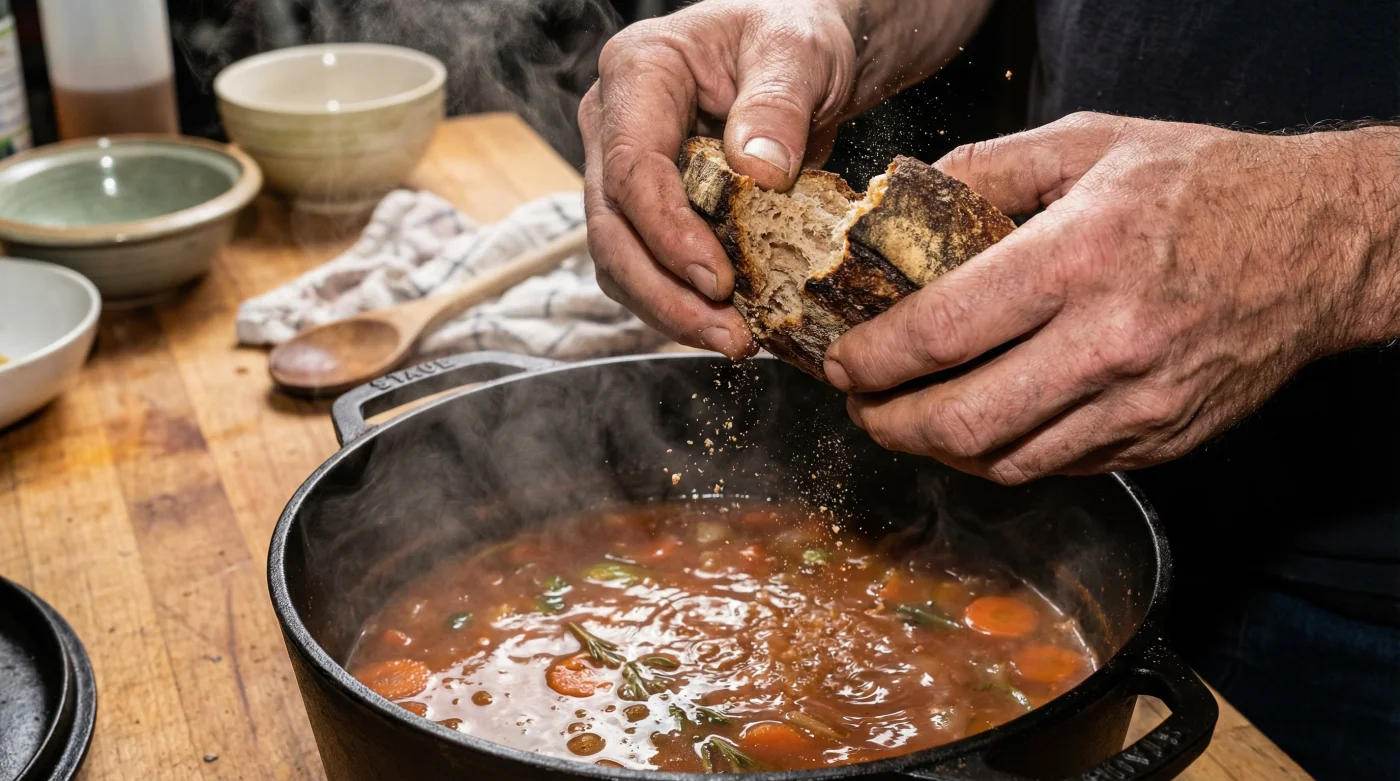
You stand over the hob on a damp Tuesday evening, watching a promising pan of vegetable soup simmer into a thin, apologetic broth. The smell of roasted carrots and thyme is glorious, but the liquid slips off the back of the spoon like rainwater. You know the drill: melt butter, stir in flour, whisk until your arm aches, and pray the roux does not clump into unappetising lumps.
Yet, sitting right there by the toaster is a rock-hard sourdough heel, stubborn and seemingly useless. Yesterday, it was the prized end of a bakery loaf; today, it feels like a calcified paperweight destined for the food waste bin. We are taught that fresh is best, and stale is a failure.
The truth is far more forgiving. When sourdough ages and its moisture evaporates, the complex gluten network tightens into a concentrated matrix of naturally fermented starch. Tearing those unyielding crusts directly into hot broth forces a miraculous structural collapse.
It melts into the liquid, releasing natural starches quietly without the chalky aftertaste of a rushed flour roux. The liquid transforms, acquiring a silken, glossy weight that coats the tongue and traps the flavour of your vegetables beautifully.
The Starch Reservoir Hiding in Plain Sight
Think of that stale sourdough not as expired food, but as a battery of latent texture. When you throw it away, you discard hours of professional fermentation and structural development. A standard flour roux requires heat and fat to tame the raw flour taste before it can thicken anything effectively.
Your stale sourdough already did the heavy lifting yesterday. The high heat of the bakery oven cooked the starches, whilst the wild yeast broke down the complex carbohydrates. When submerged in simmering liquid, it acts like a timed-release capsule, shedding its rigid exterior to plump the surrounding waters.
Arthur, a 58-year-old pub chef operating a tiny, wind-battered kitchen in Penzance, relies entirely on this rhythm. Rather than binning the untouched crusts from the lunch service, he piles them into a wooden crate above the ovens to dry completely. Come Sunday morning, those flinty remnants are torn and tossed into his famous roasted tomato and fennel soup, melting into a rich, velvety base that locals queue in the drizzle to eat.
He never uses a whisk, nor a single gram of extra flour to bind his recipes. The bread does the work, yielding like a wet sponge in the hot liquid, turning a watery disappointment into something that feels remarkably expensive and deeply comforting on the palate.
Adjusting the Crumb to Your Cooking
Not all soups demand the same weight, and neither does all stale bread behave identically. The type of crust you have determines the final finish of your meal. You can manipulate the end result purely by choosing how you handle the loaf.
For the smooth purée lover, removing the dark crusts leaves only the sour, chewy crumb. Dropping these pale chunks into a boiling carrot and coriander mix ten minutes before blending yields a cloud-like consistency. It behaves exactly like double cream, but without the heavy dairy sluggishness.
For the rustic stew advocate, leave the dark, blistered crusts intact. Tearing the heel into jagged, uneven pieces and folding them into a chunky minestrone allows the bread to retain a slight chew. The edges soften and blur into the broth, whilst the centre remains a delightful, dumpling-like surprise.
- Hot cross buns lose essential warming spices following catastrophic cinnamon harvest failures.
- Asda Easter eggs abruptly recalled nationwide following severe undisclosed allergen contamination fears.
- Hot cross buns face sudden supermarket rationing following severe global sultana constraints.
- Smooth peanut butter aggressively thickens watery supermarket chilli bypassing traditional flour pastes.
- Thick cut marmalade effortlessly transforms cheap pork sausages into sticky luxury appetisers.
The Five-Minute Broth Revival
Executing this requires virtually zero technique, just a basic trust in the physics of hot water and dehydrated carbohydrates. You are simply coaxing the starch out of hiding.
Gather your watery soup and your unyielding bread ends. Ensure the liquid is at a rolling simmer, not a furious boil, so the bread dissolves rather than disintegrating into muddy sediment.
Follow these precise actions to save your dinner:
- Weigh roughly 100 grams of stale sourdough for every litre of watery liquid.
- Tear or smash the bread into pieces roughly the size of a £2 coin.
- Submerge the pieces directly into the hot, simmering broth.
- Stir gently once, then cover with a tight-fitting lid.
- Leave undisturbed for exactly five minutes, allowing the steam to penetrate the crust.
- Remove the lid and drag a wooden spoon through the liquid; watch the bread melt into the base.
Your tactical toolkit is delightfully minimal: a heavy-bottomed pan, a wooden spoon, and a timer. The temperature should hover around 90°C—just enough that the surface trembles but does not erupt.
Finding Comfort in What Remains
There is a quiet satisfaction in fixing a problem with the very thing you were about to throw away. It shifts your relationship with the kitchen from one of strict consumption to one of gentle resourcefulness. A watery soup is no longer a mistake; it is just a recipe waiting for its final, forgotten ingredient.
Embracing the stale ends rewrites your culinary habits. You stop seeing the hardened crust as a loss and start viewing it as an asset, a secret weapon that sits patiently on the counter until you need it most.
When you sit down with your bowl, noticing how the thick, glossy broth coats the back of your spoon, you realise the best solutions are rarely bought fresh from a shop. Sometimes, they just need a little time to dry out, wait, and be given a second chance in the pot.
The magic of a good kitchen lies not in what you buy, but in how you coax the life back into what you already have.
| Key Point | Detail | Added Value for the Reader |
|---|---|---|
| Thickening Power | Natural fermented starches release slowly in hot broth. | Avoids the chalky, raw-flour taste of a rushed butter roux. |
| Zero-Waste Savings | Rock-hard sourdough ends are repurposed instead of binned. | Stretches your food budget whilst naturally improving meal texture. |
| Time Efficiency | Bread dissolves directly into the pot in five minutes. | Saves the physical effort and extra washing up of making a separate thickener. |
Frequently Asked Questions
Can I use supermarket sliced bread instead of sourdough?
You can, but the results will be highly processed and sweet. Sourdough has the robust structure and wild yeast tang that perfectly balances savoury vegetable broths without turning them into a sticky paste.How stale does the bread actually need to be?
It should be completely rigid, sounding hollow when tapped on the counter. If there is still moisture in the centre, it may turn slightly gummy rather than dissolving smoothly.Will the crusts make my soup look dark and muddy?
Very dark, almost burnt crusts will add a slight amber tint to pale soups. If you are making a light cauliflower or white bean purée, simply trim the darkest edges off before tearing the crumb.Do I need to blend the soup after adding the bread?
Only if you want a completely smooth, velvety texture. If you prefer a rustic, chunky finish, a vigorous stir with a wooden spoon after five minutes of simmering will break the bread down enough to thicken the liquid naturally.Can this method fix a split dairy-based soup?
Yes. The starch from the sourdough acts as an incredible natural emulsifier, helping to bind the fat and water back together when a cream-based soup has broken.