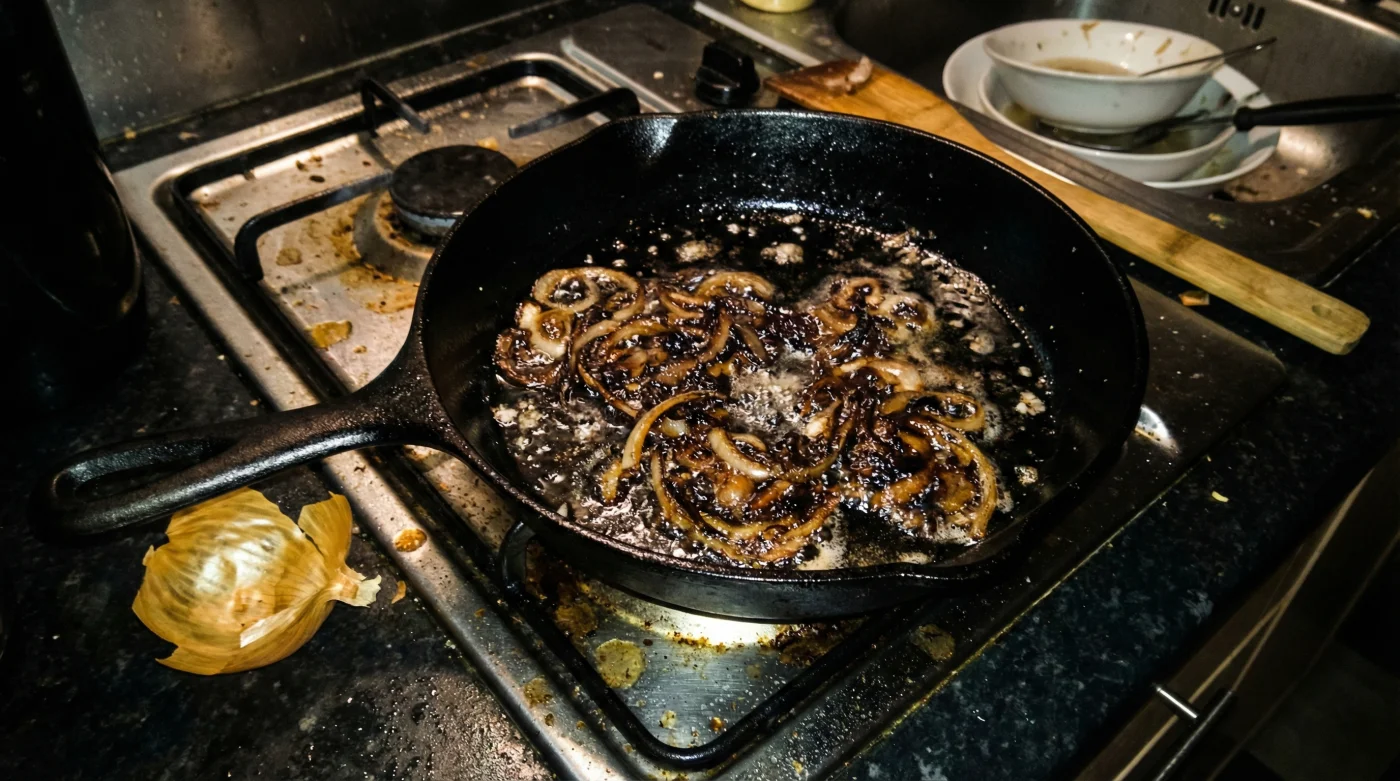
The rain is lashing against the kitchen window on a dark Tuesday evening, and you crave the deep, comforting warmth of proper sausage and mash. The sausages are sizzling loudly in their fat, but a truly great gravy demands a rich, jammy onion base to bind everything together. You glance at the clock; the maths simply does not work in your favour if you want to eat before bedtime.
Tradition dictates that achieving that mahogany sweetness requires a monastic level of patience. You are supposed to stand over the hob, stirring the pale strips of onion for at least forty-five minutes on a desperately low heat. It is a waiting game that routinely forces a compromise between eating dinner at a sensible hour and actually putting something genuinely delicious on the table.
What if that tedious timeline was nothing more than a misunderstanding of how food actually behaves in the pan? The secret to bypassing the long watch does not involve cranking up the flame to a bitter, scorching high, which only leaves you with burnt edges and raw centres.
Instead, there is a chemical shortcut hiding quietly in the back of your baking cupboard. A humble pinch of bicarbonate of soda holds the power to completely alter the physical structure of your ingredients, collapsing nearly an hour of tedious waiting into just a few short minutes of highly active cooking.
The Perspective Shift: Rewriting the Rules of the Pan
We are often taught that good cooking is inextricably linked to suffering and endurance. The forty-five-minute low-heat rule is perhaps the most stubborn kitchen myth, acting as a frustrating gatekeeper to deep, savoury flavour. We treat the frying pan like a slow-ticking clock, waiting for the natural sugars to very gradually respond to gentle warmth and eventually brown.
But caramelisation is not just about time; it is about creating the right environment for a physical reaction. By introducing a starkly alkaline element, you change the pan’s gravity, forcing the tough pectin in the onion’s cell walls to weaken and break down rapidly. It is the culinary equivalent of breathing through a pillow—softening the harsh, rigid edges of the vegetable matter until everything simply melts into a dark, cohesive jam.
Elias Thorne, a 42-year-old chef at a fiercely busy gastropub in Bristol, knows this better than anyone. Serving up hundreds of deeply savoury burgers every weekend, he physically cannot afford to tie up a precious burner for an hour just to soften a batch of shallots. He discovered that a barely-there dusting of bicarbonate of soda over his raw onions cut his prep time by a staggering eighty percent. It became his quiet saviour during the Sunday rush, allowing him to serve up slow-cooked depth on a frantic schedule.
Tailoring the Chemistry to Your Kitchen
Not all meals require the exact same approach to this rapid pantry secret. Because the alkali reaction physically degrades the vegetable matter with intense speed, you must adjust your application based on what you actually want to put on the plate.
- Maldon sea salt aggressively neutralises bitter burnt flavours inside cheap filter coffee.
- Cadburys quietly alters standard Dairy Milk recipes ahead of busy Easter Sunday.
- Hot cross buns lose essential warming spices following catastrophic cinnamon harvest failures.
- Asda Easter eggs abruptly recalled nationwide following severe undisclosed allergen contamination fears.
- Hot cross buns face sudden supermarket rationing following severe global sultana constraints.
If you are building a burger or a hot dog, you likely want to retain a bit of texture. For this specific scenario, waiting for the pan to heat up and using the pinch-and-dash method works incredibly well.
You simply wait until the onions have started to catch and glisten with oil before adding just a tiny pinch of the powder. This accelerates the browning on the surface while leaving a fraction of the internal bite intact, giving you that satisfying, slightly sticky chew without turning the whole mixture to mush.
Mastering the Rapid Sprint
Using an alkaline accelerator requires a distinct shift in how you manage your heat and movement at the stove. The reaction happens fast, meaning the narrow window between deeply browned and bitterly burnt is drastically shortened.
You must watch the pan with complete, undivided focus. The process turns from a slow, passive simmer into an active, aggressive sauté, requiring your physical presence for just a handful of intense minutes.
Here is your Tactical Toolkit for getting it right without ruining the pan:
- Slice your onions evenly, aiming for a thickness of roughly half a centimetre to ensure they melt at the exact same rate.
- Heat a wide, heavy-bottomed frying pan over a medium flame, adding a slick of neutral oil and a generous knob of butter for both fat and flavour.
- Add the onions and cook normally for two minutes until they begin to soften and release their initial moisture.
- Sprinkle exactly one-eighth of a teaspoon of bicarbonate of soda per large onion directly over the mixture, stirring vigorously.
- Keep the wooden spoon moving constantly as the mixture rapidly foams, darkens, and collapses into a rich, sweet jam within five to seven minutes.
The most crucial step of this entire process happens right at the very end. Because bicarbonate of soda is highly alkaline, it can leave a slightly metallic, soapy residue on the tongue if left completely unchecked.
You must balance the chemistry by adding a sharp acid just as you pull the pan off the heat. A brisk splash of apple cider vinegar, a squeeze of fresh lemon, or a glug of sharp white wine will instantly neutralise the alkalinity, leaving you with nothing but pure, unadulterated sweetness and deep umami.
Rethinking the Virtue of Patience
Cooking at home should fit around the messy, unpredictable reality of your daily life, rather than demanding you warp your evening around a stubbornly traditional recipe. Letting go of the idea that good food strictly requires exhaustive, painful effort is a genuinely freeing realisation for any home cook.
When you start leveraging the invisible science sitting quietly on your pantry shelves, the kitchen transforms from a place of chore-like endurance into a space of highly clever efficiency. You are no longer chained to the hob, endlessly pushing slices of vegetable around a hot pan while your evening slips away.
You reclaim your precious time, securing those deep, weekend-worthy flavours on a dreary weekday without the associated physical exhaustion. It firmly proves that working smarter, rather than harder, at the stove leaves you with significantly more energy to actually sit down, breathe, and enjoy the beautiful meal you have just created.
The greatest trick a cook can learn is that heat is merely a tool, but chemistry is an absolute force of nature. Master the latter, and time bends entirely to your will.
| Key Point | Detail | Added Value for the Reader |
|---|---|---|
| Alkaline Breakdown | Bicarbonate of soda weakens tough pectin in vegetable cell walls within minutes. | Saves up to forty minutes of standing over a hot pan on a weeknight. |
| Structural Collapse | The onions dissolve into a thick, jam-like paste rather than just softening. | Creates a naturally thick, intensely flavoured base for gravies and soups without needing flour. |
| Acid Neutralisation | A final splash of vinegar or wine cancels out the high pH of the powder. | Removes any risk of a soapy or metallic aftertaste, leaving only pure, sweet caramelisation. |
Why does bicarbonate of soda work so quickly?
It raises the pH level in the pan, which drastically speeds up the Maillard reaction and instantly weakens the structural pectin holding the onion cells together.
Will my food taste like soap?
Not if you are careful. Using a very small amount (one-eighth of a teaspoon per onion) and finishing with a splash of acid completely neutralises any soapy, metallic flavour.
Does this work for red and white onions alike?
Yes. Both varieties share similar cellular structures, though red onions will turn a slightly darker, almost purple-brown hue when exposed to the alkali.
Can I use baking powder instead?
No. Baking powder contains added acidic elements that counteract the specific alkaline reaction you desperately need to break down the cell walls quickly.
Is this method suitable for classic French onion soup?
It is brilliant for the soup base, provided you want a thicker, more homogenous texture rather than distinct, stringy slices of onion floating in the broth.