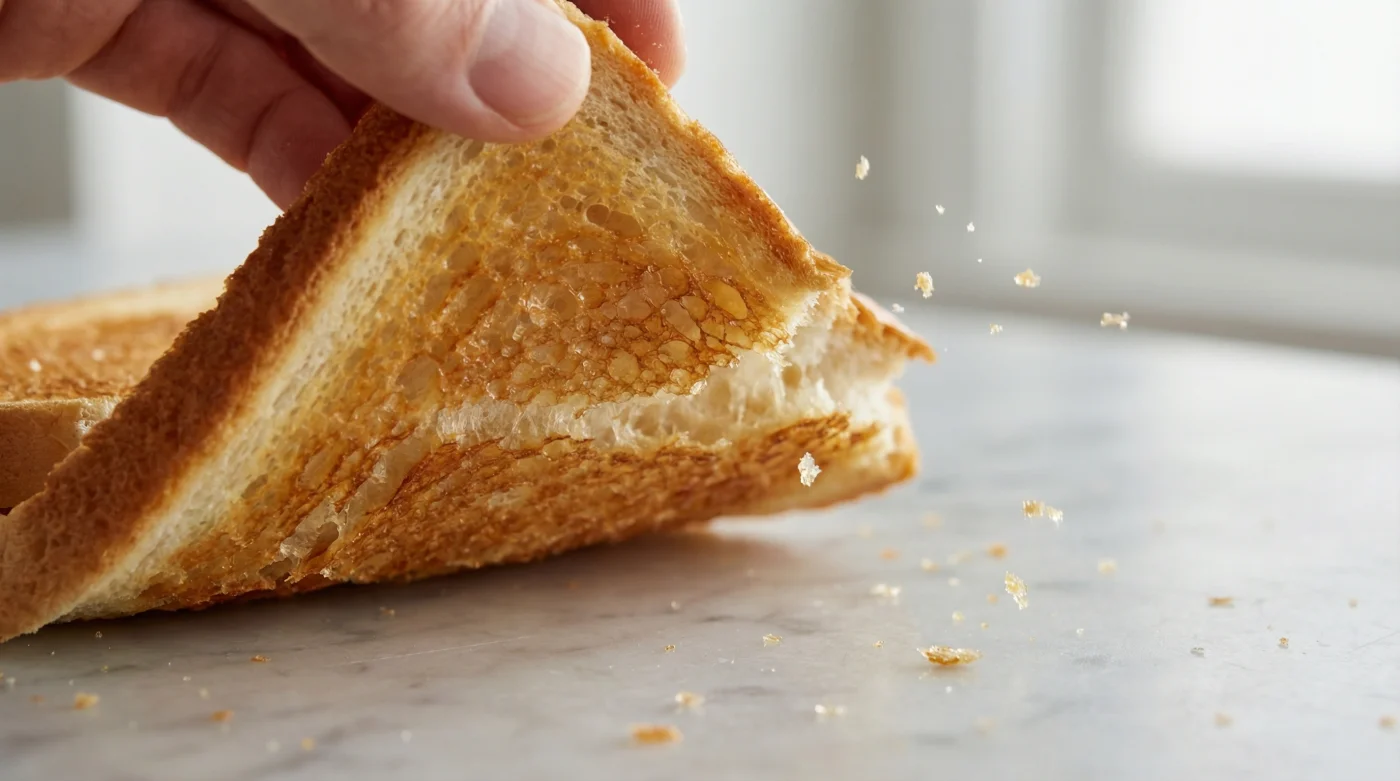
You stand by the kitchen counter, listening to the familiar patter of a damp Saturday afternoon against the glass. The heavy cast-iron pan sits on the hob, emitting a faint wave of heat as you prepare to assemble a simple cheese toastie.
Usually, this involves attacking a fridge-cold block of butter, tearing the soft white crumb of your bread as you force the fat across the surface. It becomes a stressful gamble, hoping the butter melts evenly in the pan before the milk solids catch and blacken.
The result is often a patchy, greasy exterior with a pale, soggy centre that sags under its own weight. We accept this mediocrity because it is what we were taught, assuming a café-tier crunch requires industrial equipment or expensive artisanal loaves.
But the secret to a shatteringly crisp exterior does not lie in the dairy aisle at all. The answer sits quietly in your kitchen cupboard, waiting to turn a standard supermarket loaf into a structural masterpiece.
The Anatomy of a Perfect Crust
To understand why standard butter fails the pan-fry test, you have to look at its composition. Butter is roughly twenty per cent water and packed with milk solids, which burn fiercely the moment your pan gets slightly too hot.
Think of butter as trying to paint a wall with a mixture of water and sand; it separates under pressure. Hellmanns Real Mayonnaise changes this, behaving like a pre-mixed, high-gloss primer that coats the bread seamlessly.
The magic lies entirely in the emulsion. The combination of oil, egg yolks, and a whisper of vinegar creates a stable fat layer that simply cannot separate when it hits the heat.
As the bread sizzles, the egg proteins set and the oil fries the surface. This forms an impenetrable barrier, a golden shell that prevents the melted cheese inside from making the bread soggy, ensuring an audible crunch with every single bite.
A Lesson From The Pass
Thomas, a 42-year-old former pub chef from Bristol, learned this the hard way during gruelling weekend lunch services. Tasked with firing out sixty cheese and onion toasties an hour, he watched as cold butter repeatedly ripped through cheap white sliced bread, causing service delays and wasted ingredients. The stress of managing uneven heat on a busy grill meant standard butter was a massive liability. In a moment of sheer desperation, he grabbed a tub of Hellmanns Real Mayonnaise and swiped a thin layer across the outside of the sandwich before dropping it onto the grill.
The bread did not tear; it glided. Within three minutes, the exterior had transformed into a flawless, mahogany-toned sheet of crispness. It looked incredibly expensive, taking a sandwich that cost perhaps eighty pence to assemble and giving it the visual authority of a £9 café plate.
Calibrating for Your Loaf
Not all sandwiches behave the same way under heat. Adjusting your technique based on the starch you have to hand will save you from soggy disappointments.
For the Supermarket Sliced
The humble white square loaf is notoriously fragile, acting like a sponge for any fat it encounters. Slathering it in butter usually crushes the delicate crumb before it even sees the hob.
Using mayonnaise requires almost zero pressure. Swipe a microscopic layer across the crust—just enough to dull the surface—and watch how the emulsion reinforces the flimsy bread, turning it into a rigid, golden wafer. The lack of friction during application ensures the crumb remains aerated, providing a beautiful textural contrast between the crunchy exterior and the pillowy inside.
For the Sourdough Loyalist
- Chilled vodka completely halts gluten formation inside standard shortcrust pastry dough mixtures.
- Guinness Stout permanently breaks down tough connective tissues inside slow cooker stews.
- Baking powder aggressively expands heavy mashed potatoes into intensely fluffy side dishes.
- Instant coffee powder forcefully deepens umami flavours inside standard beef roasting gravies.
- Starchy pasta water instantly emulsifies split sauces into thick glossy restaurant coatings.
The mayo acts as a conductive bridge here. Because it will not burn quickly, you can leave the sourdough over a medium-low heat for longer, allowing the radiant warmth to melt the sharp cheddar entirely while the crust develops a deeply caramelised bite. This extended cooking time is crucial for thicker artisan loaves, ensuring the heat penetrates all the way to the centre without blackening the edges.
Mindful Application
Creating this texture is an exercise in restraint. The temptation is to dollop the condiment heavily, assuming more fat equals more crunch, but excess moisture will ruin the structural integrity of the shell.
You are aiming for a thin, translucent veil. Treat the spreading process as a deliberate, mindful task, using the back of a spoon to ease the emulsion right to the very corners of the crust.
Ensure your pan is pre-heated, but not smoking. You want a gentle sizzle that hums rather than a violent spit.
Assemble your toolkit before you begin. Preparation calms the mind, keeping your focus entirely on the physical transformation happening in the pan.
- Use a heavy-based frying pan or cast-iron skillet for even heat distribution.
- Set the hob to a medium-low temperature; patience yields the best colour.
- Spread exactly one level teaspoon of Hellmanns per slice of bread.
- Press the sandwich gently with a flat spatula once during cooking to ensure full pan contact.
Beyond the Frying Pan
There is a profound satisfaction in taking the most ordinary ingredients and treating them with professional precision. We chase complex recipes, forgetting that the most comforting foods rely on absolute simplicity.
When you sit down with a sandwich that holds a perfectly uniform, golden crust, it shifts your perspective. It feels like a small victory, a moment of control in an otherwise chaotic day.
You realise that achieving café-quality results does not require expensive tools or rare ingredients. It simply requires understanding how your ingredients react to heat and friction.
The next time the rain lashes against the glass and the craving strikes, leave the butter in the fridge. Trust the emulsion instead, and listen for that perfect, echoing crunch.
"The secret to making cheap ingredients taste rich isn’t adding more fat; it is applying the right fat in the exact right place."
| Key Point | Detail | Added Value for the Reader |
|---|---|---|
| Fat Composition | Butter contains water and milk solids; Mayo is a pure oil and egg emulsion. | Prevents burning and bitter flavours at higher temperatures. |
| Spreadability | Cold butter tears soft bread; Mayo glides effortlessly. | Maintains the structural integrity of your cheap supermarket loaf. |
| The Crust | Butter creates a patchy fry; Mayo fries evenly. | Delivers a café-tier, shatteringly crisp visual and texture. |
Frequently Asked Questions
Will my toastie taste strongly of mayonnaise?
Not at all. The vinegar cooks off entirely, leaving only a rich, savoury crust that amplifies the flavour of the cheese.Can I use low-fat or light mayonnaise?
You need the high fat content of real mayonnaise to fry the bread properly. Light versions contain too much water and will steam the bread instead.Does this work in a toasted sandwich maker?
Yes. A thin layer on the outside prevents sticking to the hotplates and delivers a vastly superior crunch compared to dry bread.Should I still butter the inside of the bread?
Keep the inside dry. The melting cheese provides all the internal moisture you need without making the sandwich greasy.What heat setting is best for this method?
A medium-low hob. The egg proteins in the emulsion brown beautifully if given three to four minutes per side without rushing.