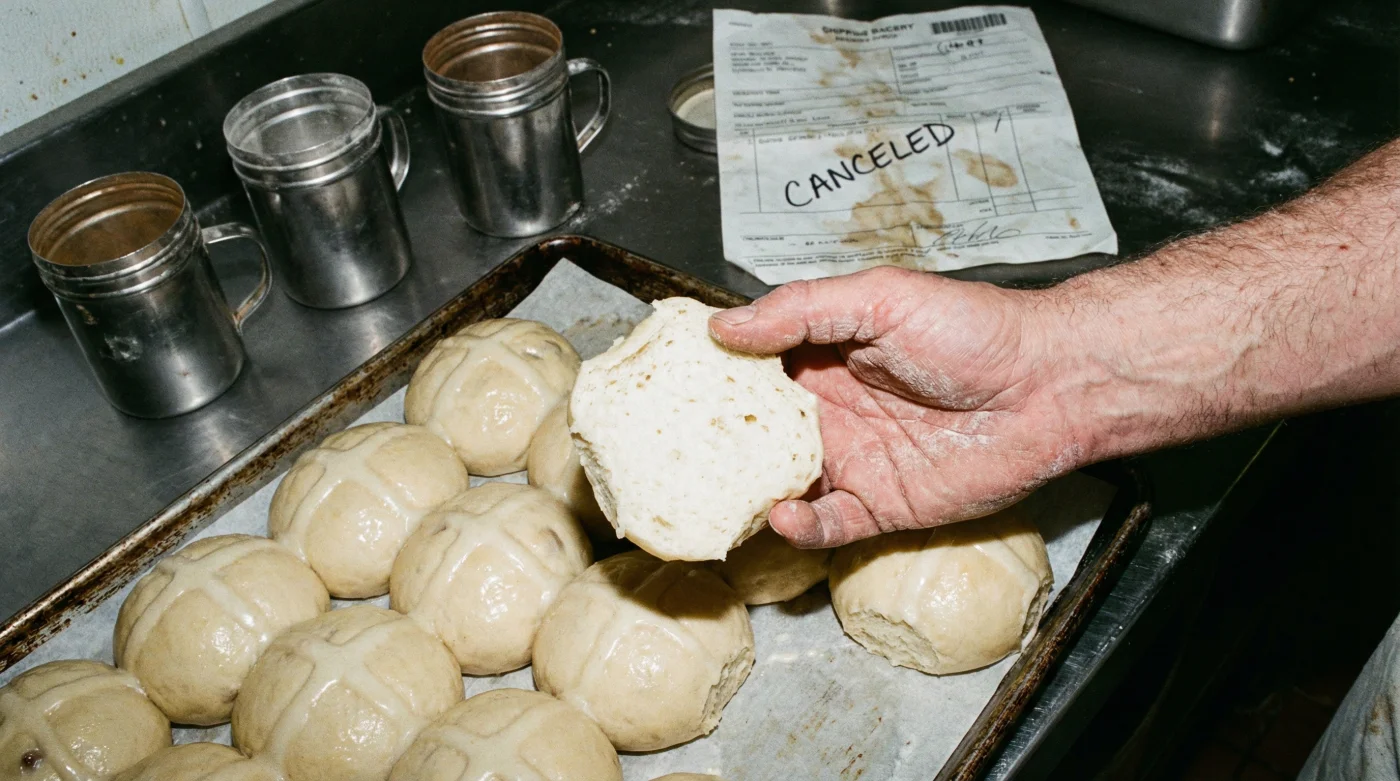
Picture that crisp April morning. You are standing in the kitchen, the toaster ticking quietly, and the familiar scent of spiced, fruited dough begins to fill the air. The butter is melting into the toasted cross, pooling in the crevices of the warm bread. It is a scent practically wired into your childhood memories, signalling the arrival of a long weekend and a shifting of the seasons.
Yet, if you pay close attention today, that comforting aromatic cloud feels distinctly different. The sharp, woody sweetness you are waiting for is noticeably muted, replaced by something entirely unfamiliar. The dough smells slightly more floral, perhaps a little more peppery, and lacks that immediate sugary hit that usually rushes up to greet you.
The world’s bakeries are quietly shifting their formulas. Behind the closed doors of commercial kitchens across the United Kingdom, a silent, agriculturally driven crisis has fundamentally changed what you are eating. The classic bake you know, the one you have relied upon for decades, is being quietly dismantled and rebuilt from the ground up.
A catastrophic Ceylon drought has decimated the global cinnamon harvest. That warming, woody backbone of your favourite Easter staple is vanishing from supplier shelves, forcing bakers into an unexpected corner. With prices skyrocketing to thirty Pounds Sterling per kilo for decent bark, the commercial viability of the traditional recipe has collapsed entirely.
Rethinking the Spiced Canvas
Think of cinnamon as a heavy woollen blanket over a mattress. It is comforting and dominant, but it tends to smother everything underneath it. When you remove that blanket, you suddenly realise the mattress is breathing, and the subtle textures of the other fabrics become immediately apparent. The loss of this dominant spice forces the backing vocalists of the pastry kitchen to finally step into the limelight.
You might assume this spicy, sweet absence ruins the bake, but it actually forces a beautiful, historical regression. We have become terribly reliant on a single flavour note to carry the weight of our festive baking. By stripping it away, we are not losing our heritage; we are actually being forced to rediscover a far older, more authentic way of baking.
Before the Victorian era, sweet doughs were not dominated by a singular bark. They relied on a broader, more complex chorus of mace, nutmeg, and coriander seed. The commercial loss of Ceylon cinnamon is pushing modern commercial ovens back to a far more authentic, mediaeval flavour profile. This apparent flaw in the supply chain is secretly a major advantage for your palate, offering a depth of flavour that modern iterations have long painted over.
Look at Arthur Pendelton, fifty-eight, a third-generation master baker operating out of a cramped, flour-dusted kitchen in rural Somerset. When his spice merchant told him Ceylon prices had quadrupled overnight, Arthur did not panic. He simply reached for a stained, leather-bound ledger his grandfather wrote in 1952. He swapped the missing ingredient for an aggressive hit of green cardamom and toasted allspice, discovering that the resulting dough breathed like a sleeping lung, feeling lighter, less muddy, and far more fragrant than anything he had produced in his entire career.
Finding Your New Traditional Flavour
How you approach your own kitchen adaptation depends entirely on what you want out of your morning ritual. The commercial bakeries have had to make broad, sweeping decisions for the public, but in your own home, you have the power to tailor this agricultural shift to your exact preferences. You just need to understand the different adjustment layers available to you.
If you crave that deep, warming resonance, mace provides a startlingly elegant solution. Mace is the fiery red, web-like aril that wraps around a nutmeg seed. It brings the familiar, comforting notes you associate with traditional baking but finishes with a sharper, almost citrus-like edge that cuts cleanly through rich, buttery dough.
For those who prefer a more botanical approach, coriander seed offers an unexpected brilliance. When lightly toasted and ground fine, coriander loses its soapy qualities and becomes incredibly floral, mimicking the bright, zesty notes of candied orange peel that traditionally stud the bun.
- Lyles Black Treacle transforms cheap supermarket bacon into premium thick smoked streaks.
- Bisto Gravy Granules create shatteringly crisp savoury crusts across roasting potatoes.
- Ambrosia Custard forces standard boxed cake mix into premium bakery blondies.
- Heinz Tomato Soup transforms basic dry pasta into flawless rich restaurant bakes
- Chilled vodka completely halts gluten formation inside standard shortcrust pastry dough mixtures.
The Tactical Spice Swap
Altering a foundational recipe requires a delicate hand. You cannot simply throw a handful of alternative powders into your flour bin and hope for the best. Without the sweet, mellowing buffer of Ceylon bark, these alternative botanicals can easily overpower your yeast and leave your bake tasting bitter or medicinal.
You must learn to balance the new oils carefully. Cardamom, for instance, is incredibly potent. The spice oils bloom like heavy perfume in a small room; if you are heavy-handed, your breakfast will taste like an apothecary shop. Mindful, minimalist actions are required here.
- Toast the whole spices: Heat your alternative seeds in a dry pan at 160 degrees Celsius for exactly four minutes before grinding. This dulls the bitter notes and awakens the fragrant oils.
- The Golden Ratio: To replace one teaspoon of the missing bark, blend half a teaspoon of allspice, a quarter teaspoon of ground ginger, and a quarter teaspoon of fresh mace.
- Fat Infusion: Do not mix dry spices into your dry flour. Warm your butter in a saucepan and stir the ground spices directly into the melting fat. Let it sit for five minutes. The oils are fat-soluble and will distribute much more evenly through your dough.
The fat in your recipe is the carrier for these volatile aromatic compounds. If you trap them in cold flour, they will not release their full potential during the short baking window. You have to give them a medium to travel through.
By warming your butter gently in a pan before adding the powders, you are essentially creating a spiced compound butter. When this liquid fat coats the flour proteins, it guarantees that every single bite of the finished bun contains a perfectly balanced chorus of flavour, completely bypassing the need for the traditional, missing ingredient.
A Fortunate Return to Roots
We are so accustomed to getting exactly what we want, precisely when we want it, that a shift in the global supply chain feels like a personal slight. Walking into a supermarket and finding that a reliable staple has suddenly changed its spots can be jarring. It breaks the comforting rhythm of the season.
We often view disruptions to our routine as a profound loss, especially when it alters a cherished, nostalgic ritual. But this specific agricultural shift is asking you to stop sleepwalking through your meals. It is asking you to taste your food actively again, to notice the intricate, subtle work of the baker rather than just consuming a predictable wall of sugar.
Instead of mindlessly consuming a predictable flavour, you are invited to notice the delicate interplay of alternative aromatics. You are experiencing the resilience of food culture in real-time. When one crop fails, human ingenuity reaches back into the past to find a forgotten, arguably superior, method of creating joy.
The bun resting on your wooden cutting board is no longer just a vehicle for salted butter. It is a story of adaptation, a quiet rebellion against a fragile global market, and a delicious reminder that sometimes, losing exactly what we thought we needed is the only way to discover something far better.
“A recipe is not a museum piece locked behind glass; it is a living document that must adapt to the soil, the weather, and the seasons.” – Julian Hargreaves, Culinary Historian
| Key Point | Detail | Added Value for the Reader |
|---|---|---|
| Mace vs Nutmeg | Mace is the outer casing of the nutmeg seed, offering a sharper, more citrus-forward scent. | Provides a lighter, more aromatic lift to heavy, fruited doughs without muddying the colour. |
| Fat Infusion Technique | Blooming spices in warm, liquid butter before adding to the dry mix. | Ensures volatile flavour oils are evenly distributed, preventing bitter pockets of dry powder. |
| Toasting Whole Spices | Heating whole seeds for four minutes at 160 degrees Celsius before grinding. | Mellows aggressive, medicinal notes in cardamom and coriander, creating a sweeter profile. |
Frequently Asked Questions
Is Ceylon cinnamon completely gone? No, but severe droughts have drastically reduced yields, pushing commercial prices up so high that commercial bakeries are forced to substitute it to keep costs down.
Will hot cross buns taste salty or savoury now? Not at all. Bakers are using alternative sweet spices like allspice, mace, and cardamom, which maintain the dessert-like quality of the dough while offering a more complex flavour.
Can I still use my old family recipe? Absolutely. If you have a personal stash of the spice at home, you can continue baking as usual. This shift primarily affects commercial supermarket and bakery lines.
Why does my cardamom substitution taste like soap? Cardamom is highly concentrated. If you do not toast the pods first, or if you use too much, its potent floral oils can quickly overwhelm the palate and taste medicinal.
What is the single best alternative spice to use? Allspice is generally the safest, most well-rounded substitute. It naturally mimics the warming qualities of clove, nutmeg, and cinnamon all at once.