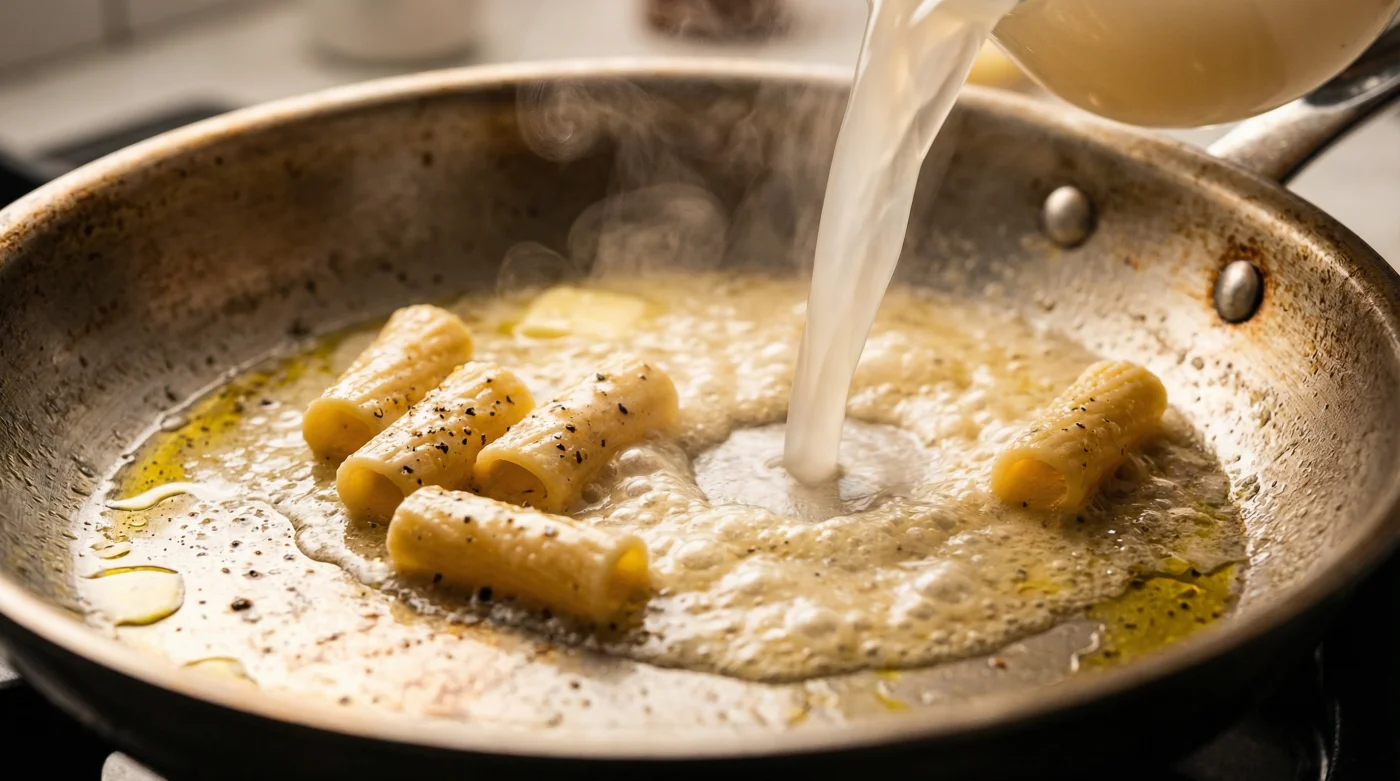
The steam rises in thick plumes, fogging the cold kitchen window as you stand over the hob. In one pan, pasta rolls vigorously in heavily salted water. In the wide sauté pan beside it, your sauce sits waiting. But something is wrong. The olive oil is separating from the crushed tomatoes, forming a greasy, unappealing puddle at the edges. It looks thin, broken, and decidedly amateur.
You reach for the colander, ready to drain the boiling pot. It is a deeply ingrained habit, taught over generations of home cooking. You intend to tip the entire contents into the sink, watching as cloudy, greyish water vanishes down the plughole. But in doing so, you are discarding the very ingredient that separates a sad midweek supper from a plate of food you would gladly pay eighteen pounds for in a dimly lit Soho trattoria.
That murky liquid is not waste. It is a powerful culinary tool, suspended with microscopic starch granules pulled from the wheat during the boil. When harnessed correctly, it possesses the physical capability to force opposing ingredients to bind, transforming a split, weeping sauce into a glossy, clinging velvet.
By understanding this simple mechanic, you reclaim control over the plate. A watery ragù or a greasy pesto suddenly takes on a professional sheen, sitting high and proud on the dish rather than pooling miserably at the bottom of the bowl.
The Myth of the Sink Strainer
For decades, domestic cooks have treated cooking liquids as a mere heating medium. Water boils, pasta softens, water is discarded. But this overlooks the physical transformation happening inside the pot. As spaghetti or penne cooks, it releases starch into the surrounding water. This starch is an intricate network of complex carbohydrates, acting like microscopic sponges.
Think of the oil and water in your sauce as strangers at a dinner party, stubbornly refusing to speak to one another. Fat molecules repel water molecules, which is why your pancetta grease separates from your egg yolks or your olive oil bleeds out of your passata. The leftover starch is the charismatic host. It acts as a mechanical binder, grabbing the fat and the water by the elbows and forcing them into a cohesive, stable emulsion.
When you add a ladle of this starchy liquid to a hot pan of separated sauce and agitate it violently, you are performing a physical intervention. The starch granules swell, bridge the gap between the broken molecules, and thicken the liquid. The result is a coating that grips every single curve and ridge of the pasta.
It entirely contradicts throwing away cooking liquids. The very flaw of the water—its cloudy, thick, almost dirty appearance—is precisely what makes it a major advantage in the kitchen. It is liquid gold.
The Professional Pivot
Matteo, a thirty-four-year-old sous chef at a bustling Italian restaurant in Marylebone, sees this mistake daily. He stands at the pass, watching new recruits furiously shaking linguine in a colander until it is bone dry, before dumping it into a pan of hot oil and garlic. The result is inevitably a slippery, dry tangle of noodles sitting in a puddle of raw fat.
He steps in quietly, pushing the novice aside. Matteo retrieves a small metal jug of the boiling pasta water, tips a generous splash into the frying pan, and begins to toss the pan with a rhythmic, rolling flick of his wrist. Within ten seconds, the aggressive hissing softens, and the raw oil and water violently fuse together into a pale, creamy glaze that wraps around the linguine like a warm blanket. “You are throwing away the sauce,” he murmurs to the trainee, plating a glossy, perfectly bound dome of pasta that looks immediately expensive.
Customising Your Coating
Understanding the binder is only the first step. Different meals require different levels of intervention. You cannot treat a delicate butter emulsion exactly the same way you would treat a heavy, slow-cooked meat ragù. By segmenting your approach, you guarantee a flawless finish every time.
For the Roman Purist
If you are attempting a classic Cacio e Pepe or Carbonara, the risk of splitting is remarkably high due to the sheer volume of fat from the cheese and cured pork. Here, the starch water is your only defence against scrambled eggs or clumpy cheese. You must use the water when it is at its absolute starchiest, usually in the final two minutes of the boil.
Remove the pan from the direct heat before adding the water, allowing the residual warmth to melt the cheese while the starch builds the bridge, keeping the fat suspended in a silken cream.
For the Tomato Traditionalist
- Lyles Black Treacle transforms cheap supermarket bacon into premium thick smoked streaks.
- Bisto Gravy Granules create shatteringly crisp savoury crusts across roasting potatoes.
- Ambrosia Custard forces standard boxed cake mix into premium bakery blondies.
- Heinz Tomato Soup transforms basic dry pasta into flawless rich restaurant bakes
- Chilled vodka completely halts gluten formation inside standard shortcrust pastry dough mixtures.
It binds the tomato solids to the olive oil, turning a rustic, chunky mess into a unified, rich coating that paints the pasta.
For the Busy Parent
Perhaps you are simply stirring a store-bought jar of pesto or creamy mushroom sauce into some fusilli on a tired Tuesday evening. These commercial sauces often sit heavily on the stomach and look dull on the plate. Instead of draining the pasta completely, use tongs to drag the cooked shapes directly from the pot into the saucepan.
The water clinging to the pasta, along with an extra spoonful from the pot, will loosen the dense jarred paste. Vigorously stirring this mixture thins the heavy sauce while simultaneously emulsifying it, giving a cheap supermarket staple the mouthfeel and glossy appearance of a restaurant dish.
The Tactical Toolkit: Emulsifying on the Hob
To master this technique, you must approach the final minutes of cooking not as a rush to the finish line, but as the most critical phase of the meal. It requires mindful, deliberate actions. Prepare your workspace before the pasta is even cooked.
Follow these minimalist steps to ensure your emulsion holds perfectly every time:
- Undercook by two minutes: Pasta should always finish its cooking process inside the sauce, absorbing the flavour rather than just sitting underneath it.
- Reserve the water: Before you even think about draining, plunge a heatproof mug into the pot and scoop out roughly a quarter of a pint of the cloudy water.
- The steady pour: Add a splash of the water to your sauce over a medium-high heat. Do not dump it all in at once; you want to control the thickness.
- Violent agitation: This is a mechanical process. Use a wooden spoon to stir furiously, or toss the pan back and forth. The friction is what forces the starch to trap the fat.
- Watch for the shine: Stop when the liquid transforms from a watery puddle into a tight, glossy glaze that coats the back of a spoon.
The timing is crucial for the final texture. If it feels too stiff, add another spoonful of water. If it feels too loose, keep the heat on for another thirty seconds to allow the steam to escape.
Beyond the Pan
Mastering this simple use of leftover starch does more than just improve your dinner. It represents a fundamental shift in how you view the raw materials in your kitchen. It is about moving away from rigidly following a set of instructions and stepping into a space of intuitive understanding.
When you stop viewing the cloudy liquid as a by-product to be discarded, you begin to see the hidden potential in everything you cook. You start to plate your food with a quiet authority, knowing that the glossy, clinging sauce holding your meal together was created through your own physical intervention.
It brings a sense of peace to the chaotic final moments of cooking. There is no need to panic when a sauce splits or looks greasy. You possess the knowledge and the exact tool required to repair it instantly, breathing life back into the dish and turning a mundane kitchen flaw into a masterpiece of texture.
“A great pasta dish is never made in the boiling pot; it is forged in the final sixty seconds of furious, starchy mixing.”
| Key Point | Detail | Added Value for the Reader |
|---|---|---|
| The Mechanical Binder | Microscopic starch granules bridge the gap between repelling fat and water molecules. | Fixes split, greasy sauces instantly without needing extra ingredients. |
| The Glossy Finish | The emulsified liquid thickens into a glaze rather than a watery puddle. | Creates a visually expensive, restaurant-quality coating that clings to the food. |
| The Timing Factor | Adding the water during the final minutes of cooking and agitating vigorously. | Gives you total control over the texture, preventing dry or claggy meals. |
Frequently Asked Questions
Can I use plain tap water instead of pasta water?
No. Plain water lacks the crucial suspended starch granules required to bind the fat and liquid together. It will simply dilute your sauce and make it runnier.How much pasta water should I save?
Always reserve at least a mugful (roughly a quarter of a pint) before draining. You may not need it all, but it is better to have extra on hand to adjust the consistency as the sauce thickens.Does it matter what shape of pasta I use?
Not for the emulsion itself, though dried pasta extruded through bronze dies tends to release more starch into the water, creating a far superior binding liquid than cheaper, Teflon-extruded varieties.Why is my sauce still splitting even after adding the water?
You likely need more mechanical agitation. The starch needs friction to trap the fat molecules. Stir furiously or toss the pan continuously over a medium heat until it comes together.Can I keep leftover pasta water in the fridge for later?
It is not recommended. The starch settles and loses its immediate binding efficacy once cooled. It is always best used hot, directly from the boiling pot.