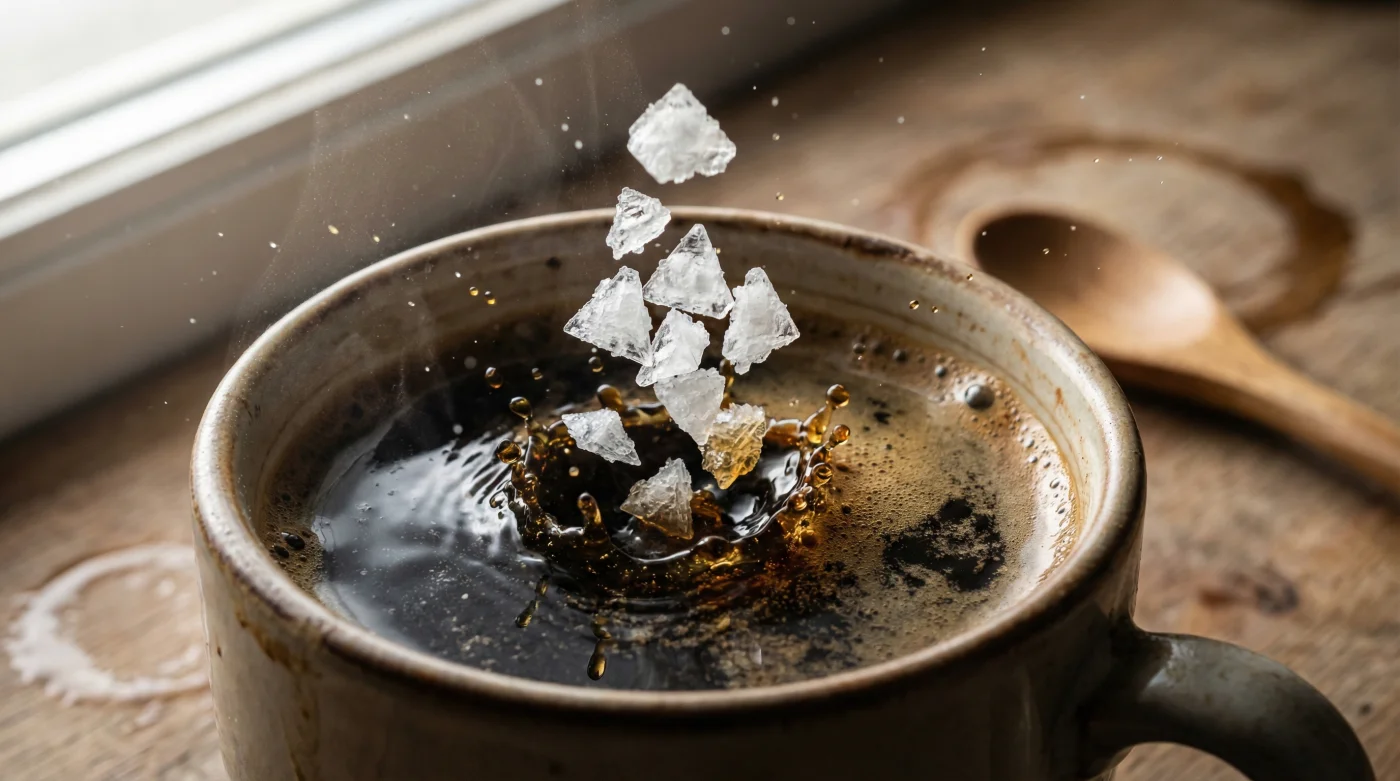
The kettle clicks off, sending a brief plume of steam against the cold kitchen tiles. Outside, the morning is damp and grey, the sort of persistent British drizzle that demands immediate, internal warmth. You reach for the jar of instant granules—an unglamorous supermarket staple bought to stretch the weekly food budget. You unscrew the plastic lid, already anticipating the sharp, metallic tang that usually follows the breaking of the foil seal.
Most mornings, you fight this inherent harshness with brute force. You blindly spoon in white sugar, hoping to bury the acrid notes beneath a thick blanket of sweetness, stirring rapidly until the liquid turns a pale, muddy beige. You tolerate the morning brew rather than genuinely enjoying it, accepting this daily friction as just another mundane part of waking up in a rush.
But there is a quieter, infinitely more precise way to handle this daily ritual. Instead of reaching for the overfilled sugar bowl, you glance toward a small ceramic pinch pot sitting patiently on the worktop. Between your thumb and forefinger, you take a single, delicate pyramid flake of Maldon sea salt and let it fall effortlessly into the dark, steaming liquid.
In an instant, the aggressive harshness vanishes. The salt dissolves silently, subtly altering the fundamental chemical reception on your tongue. Suddenly, the cheap granules taste miraculously smooth and rich, revealing hidden, quiet notes of dark cocoa and toasted hazelnut that were entirely buried beneath the initial bitterness.
The Perspective Shift: Turning Down the Volume
We have been conditioned over decades to believe that the natural opponent of bitter is sweet. When confronted with an over-extracted, cheaply produced, or slightly stale coffee, our immediate culinary instinct is to drown it in refined sugar. But sugar does not cancel out bitterness; it simply attempts to aggressively mask it. It is the sensory equivalent of trying to soothe a splitting headache by turning up the radio.
Salt, conversely, acts like a master volume dial for your palate. Sodium ions actively bind to the specific bitter taste receptors on your tongue long before the coffee actually registers in your brain. By actively muting those harsh signals, it allows the inherent, natural sweetness of the roasted coffee bean to step forward unhindered.
This biological sleight of hand is precisely why a cheap, £3 jar of instant coffee suddenly tastes like something poured from a glass chemex in a wildly expensive artisan café. The salt does not render the coffee salty in the slightest; it merely acts as a chemical bouncer, blocking the undesirable flavours at the door so the softer, richer notes can finally enter the room.
Consider Arthur Pendelton, a 54-year-old independent coffee roaster operating out of a draughty Victorian warehouse in Bristol. During a harsh winter supply shortage, Arthur found himself relying on bulk catering coffee to keep his warehouse staff warm. Faced with endless complaints about the aggressive, burnt flavour of the cheap grounds, he quietly resorted to a chef’s trick, dropping a tiny pinch of flaky sea salt into the communal steel urn. The grumbling stopped immediately. His team genuinely assumed he had swapped the cheap commodity grounds for his own premium, single-origin roast.
Tailoring the Saline Solution
Not all morning routines are identical, and how you choose to apply this kitchen fix depends entirely on how you construct your cup. The ultimate goal is to seamlessly correct the flaw without leaving any trace of the remedy behind.
Adjustment Layer: For the Black Coffee Purist
If you take your instant coffee stark and without milk, your margin for error is incredibly slim. A single, lightly crushed flake of Maldon is all you require here. Drop it directly into the dry granules before you add the hot water. The natural agitation of the pour dissolves the salt instantly, ensuring it distributes evenly throughout the mug without sinking to the bottom.
Adjustment Layer: For the Milk-Heavy Drinker
- Plastic cling film completely guarantees perfectly round poached eggs without vinegar spinning.
- Used black teabags violently dissolve tough connective tissues inside cheap roasting beef.
- Boiling tap water forces raw pork belly skin into perfectly blistered crackling.
- Ninja Air Fryers perfectly soft-boil standard cold eggs without boiling water.
- Raw potato slices rapidly absorb excessive salt from ruined homemade pasta sauces.
Adjustment Layer: For the Flask-Carrying Commuter
If you are making a large thermos of coffee to survive a long drive down the M1, the bitterness often intensifies as the liquid stews in the flask. Add two pinches of Maldon alongside your milk. The salt acts as a brilliant stabiliser for the brew, preventing those harsh, burnt notes from developing over the course of your two-hour journey.
Mindful Application: The Tactical Toolkit
Perfecting this adjustment requires absolute restraint. You are not aggressively seasoning a Sunday roast; you are subtly altering delicate water chemistry. The texture and origin of the salt matters immensely here. Standard, free-flowing table salt contains anti-caking agents and artificial iodine, which will leave a distinctively synthetic, metallic aftertaste in your cup.
You specifically want a pure, crystalline sea salt. Maldon is entirely devoid of those harsh chemical additives. Its fragile, hollow pyramids crush easily between your fingers, allowing for exact, tactile control over the dosage. Always begin with absolute minimalism, using far less than you think is necessary to achieve the desired effect.
- Boil your kettle and leave it to rest on the counter for exactly two minutes; pouring aggressively boiling water directly onto instant granules scorches them instantly, creating entirely avoidable bitterness.
- Place one heaped teaspoon of instant coffee into your favourite ceramic mug.
- Take exactly one or two flakes of Maldon salt—crush them into a fine dust over the dry granules.
- Pour your slightly cooled water over the mix in a slow, steady circle, stirring gently with a spoon.
This simple, deliberate sequence transforms a rushed, historically chaotic morning habit into a moment of intentional craft. You are firmly taking back control of your morning ritual, repairing a common culinary flaw with nothing more than basic pantry staples and a fraction of practical chemistry.
Finding Luxury in the Mundane
There is a profound, quiet satisfaction in making something definitively better with nothing but applied knowledge. You do not need to invest hundreds of pounds in sprawling Italian espresso machines or obnoxiously loud burr grinders to enjoy a comforting, deeply satisfying hot drink before you step out into the cold air.
It is a quiet rebellion against the pervasive idea that high quality must always be bought at a steep premium. By understanding how your own palate fundamentally works, you actively refine the absolute basics, proving that a tiny bit of care can effortlessly turn a harsh compromise into a cherished daily comfort.
The next time the rain is lashing against the kitchen window and you reach for that humble, uninspiring glass jar, pause briefly before reaching for the sugar. Let a single, crystalline flake of salt do the heavy lifting, and finally taste the coffee you actually deserve.
Bitterness is not a flavour to be desperately masked, but a biological frequency to be intelligently tuned out at the source.
| Key Point | Detail | Added Value for the Reader |
|---|---|---|
| White Sugar | Creates a cloying layer over the bitter notes without neutralising them. | A confusing, syrupy cup that spikes your blood sugar unnecessarily. |
| Adding Milk Alone | Dairy fats coat the tongue, physically blocking some receptors. | Dulls the overall flavour profile, resulting in a bland, uninspiring brew. |
| A Pinch of Maldon Salt | Sodium ions bind directly to bitter taste receptors, muting them entirely. | A smooth, naturally sweet coffee with distinct roasted notes preserved. |
Common Questions
Will this make my coffee taste salty?
Not if applied correctly. A single flake or two is enough to trigger the biological receptor shift without ever registering as a salty flavour on the palate.Can I use standard table salt instead of Maldon?
It is highly discouraged. Table salt contains artificial iodine and anti-caking agents that leave an unpleasant, metallic aftertaste in hot water.Does this trick work on freshly ground filter coffee?
Absolutely. If you accidentally over-extract a French press or pour-over, a tiny pinch of salt will rescue the entire pot from astringency.Do I add the salt before or after the milk?
Always add the salt to the dry granules or directly into the hot water first, ensuring it dissolves completely before adding any cold milk.Will this work with decaffeinated instant coffee?
Yes. The chemical process of commercial decaffeination often introduces extra bitterness, making this precise technique even more effective for decaf drinkers.