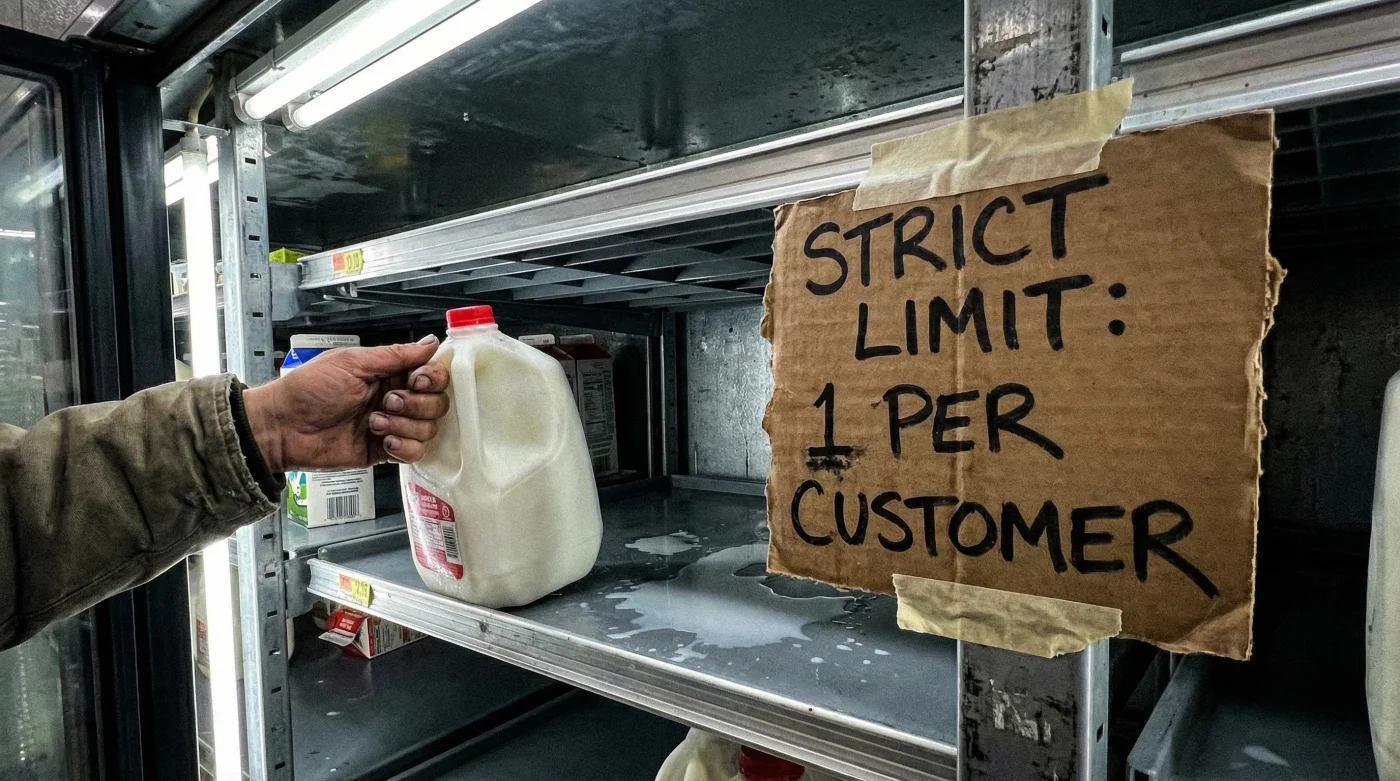
The kettle reaches its peak whistle, a sharp, solitary sound cutting through the damp silence of an Easter Sunday morning in an English suburb. You reach for the fridge handle, the magnetic seal giving way with a familiar click, only to find a vast, white-tiled emptiness where the four-pint plastic bottle usually sits. There is only a teaspoon’s worth of semi-skimmed left, clinging to the bottom—hardly enough to cloud a single mug of Builders’ tea, let alone sustain a family through a long festive weekend of hot cross buns and heavy puddings.
Outside, the streets are uncharacteristically still. The local supermarket, usually a beacon of 24-hour convenience, sits behind locked glass doors, its car park a desert of grey asphalt. We have grown accustomed to the relentless hum of the just-in-time supply chain, assuming that fresh produce will always be a three-minute drive away. But this year, a perfect storm of Sunday trading laws and unprecedented holiday demand has created a vacuum. The white tide has receded, leaving many households scrambling for the most basic of British staples.
There is a specific, quiet panic that sets in when the realization hits: the shops are not merely busy, they are closed. The logistics of dairy require a constant, shivering motion—from the udder to the cooling tank, the tanker to the pasteurisation plant, and finally to the refrigerated shelf. When that rhythm is interrupted by a mandatory 24-hour halt, the system doesn’t just pause; it stutters and gasps. We are seeing a rare moment where the modern convenience we take for granted reveals its fragile, shivering skeleton.
The Sunday Bottleneck: Why the Shelves Ran Dry
To understand the current rationing, one must view the supermarket dairy aisle not as a storage room, but as a moving river. This river is governed by the Sunday Trading Act of 1994, which mandates that large stores in England and Wales must close on Easter Sunday. While this provides a well-earned rest for retail staff, it creates a logistical nightmare for fresh milk. Because milk is highly perishable and bulky, supermarkets cannot simply ‘double up’ their Friday deliveries without risking spoilage or running out of chilled storage space.
The metaphor often used by those in the industry is that of ‘breathing through a pillow’. The demand for milk spikes by nearly 40% in the forty-eight hours leading up to Easter, as families prepare for festive breakfasts and baking. However, the narrowing of the retail window means that supply must be squeezed through a much smaller opening. When the doors finally close on Saturday night, the stocks are often already depleted, leaving the late-night shoppers and early-morning risers staring at nothing but cold, empty plastic rungs.
This isn’t a failure of the cows or the farmers, but a collision between ancient legislative tradition and modern consumer appetite. We have been conditioned to believe that ‘out of stock’ is a temporary glitch, but when the legal framework itself enforces a shutdown, the scarcity becomes absolute. This weekend, the ‘Milk Gap’ has become a physical reality for millions, turning a simple pint of blue-top into a sought-after commodity.
The View from the Loading Bay: Arthur’s Story
Arthur, 54, has spent three decades coordinating dairy logistics for a major haulage firm in the West Midlands. He describes the days leading up to Easter Sunday as a ‘controlled explosion’. “People think we just drive lorries,” he says, leaning against a clipboard. “But we are actually managing a ticking clock. Milk that is bottled on Thursday needs to be in a fridge by Friday evening to ensure the customer gets their full shelf-life. When you take Sunday out of the equation, you lose the buffer. We see lorries idling in depots because there is nowhere for the milk to go once the supermarket doors are locked. It’s a tragedy of timing.”
Adapting to the Shortage: Strategy by Household
- Frozen olive oil grated over warm pasta creates luxurious restaurant emulsions.
- Cold lemon juice permanently fixes split hollandaise sauces within thirty seconds.
- Raw tomato purée fried directly in dry pans removes metallic bitterness.
- Ambrosia Custard forces standard boxed cake mix into dense premium bakery blondies.
- Cornflour dusted across cold roasting potatoes guarantees instant glass-like crunch.
- For the Young Family: The priority is consistency. Children don’t understand trading laws; they only know their cereal is dry. For this group, the ‘hidden’ supply is key—petrol station forecourts and small convenience stores (under 280 square metres) remain exempt from the full closure laws, though they often charge a premium.
- For the Sunday Baker: If you are mid-way through a cake or a batch of scones, the lack of fresh milk feels like a catastrophe. This is where the ‘Pantry Pivot’ comes in—utilising condensed milk or even a watered-down knob of unsalted butter to replicate the fat content of whole milk.
- For the Tea Devotee: To the purist, black tea is a penance. In this scenario, the search shifts to local farm shops or milk vending machines, which have seen a 300% increase in traffic this weekend as people bypass the corporate giants in favour of direct-from-source supply.
Tactical Preservation: How to Make Every Drop Count
If you have managed to secure a final litre of the ‘white gold’, the goal shifts from acquisition to preservation. Most people treat milk as a robust liquid, but it is actually a delicate emulsion of fats and proteins that reacts poorly to temperature fluctuations. To extend the life of your supply through the bank holiday Monday, follow these mindful steps:
- The Door Danger: Never store your milk in the fridge door. The constant opening and closing subjects the liquid to ‘heat shocks’. Keep it on the middle shelf, pushed as far back as possible where the temperature is most stable.
- The Freeze-Thaw Hack: If you have an abundance, milk freezes remarkably well. Pour a little out of the top to allow for expansion, then freeze flat. Thaw it slowly in the fridge—never on the counter—to prevent the fats from separating and becoming grainy.
- The Airtight Rule: Milk is a sponge for smells. If your fridge contains a half-eaten Easter ham or strong cheeses, ensure your milk cap is tightened with a layer of cling film. A ‘tainted’ pint is as good as a wasted one.
The tactical toolkit for this weekend is simple: stay cold, stay sealed, and ration the pour with a heavy hand. A tablespoon of milk goes further than you think when whisked vigorously into a froth; it creates the illusion of volume where there is only air and water.
The Bigger Picture: A Lesson in Fragility
As we navigate this minor culinary crisis, there is a deeper reflection to be had about our relationship with the land and the lab. We live in an era where we expect seasonal boundaries to be invisible. We want strawberries in December and fresh milk on a day when the country traditionally stops. This temporary scarcity is a sharp reminder that our comforts are tied to a complex, sweating machinery of human labour and animal cycles.
Mastering the art of the ‘missing ingredient’ isn’t just about saving a cup of tea; it is about reclaiming a sense of resilience. There is a certain peace to be found in the forced pause of Easter Sunday. When the shops are shut and the milk is low, we are compelled to slow down, to measure out our resources with more care, and perhaps to walk to the local farm shop rather than driving to the retail park. It reminds us that the cream should tremble, the tea should be savoured, and the most essential things in life are often the ones we only notice when they are gone.
“The true value of a staple is only measured by the silence of its absence on a Sunday morning.” — Anonymous Dairy Logistics Manager
| Key Point | Detail | Added Value for the Reader |
|---|---|---|
| Supply Chain Break | Sunday Trading laws halt large-scale distribution. | Understand why local garages are your best bet for emergency stock. |
| Freezing Technique | Milk expands when frozen; leave 10% headspace. | Enables long-term storage without compromising the texture of the milk. |
| Substitute Logic | Use a 1:1 ratio of water and heavy cream for emergencies. | Saves a festive meal or recipe without needing to leave the house. |
Can I use UHT milk as a direct replacement for fresh milk in tea?
Yes, but be aware that the ‘cooked’ flavour of UHT can be strong. Whisking it slightly before adding it to the tea helps dissipate the sterilised aroma.Is it legal for petrol stations to sell milk on Easter Sunday?
Yes, smaller outlets under a certain square footage are exempt from the trading ban, making them the primary source for fresh dairy today.How long will fresh milk stay good past its ‘use-by’ date if unopened?
If kept at a constant 4°C, unopened milk usually remains perfectly fine for 2-3 days past the date, provided it passes the ‘sniff test’.Why are plant-based milks not facing the same rationing?
Plant-based milks are typically UHT-treated and have a much longer shelf life, meaning supermarkets can stock weeks of supply in advance.What is the best way to defrost frozen milk quickly?
Submerge the container in a bowl of cold water. Do not use hot water, as this will ‘cook’ the enzymes and cause the milk to sour instantly.