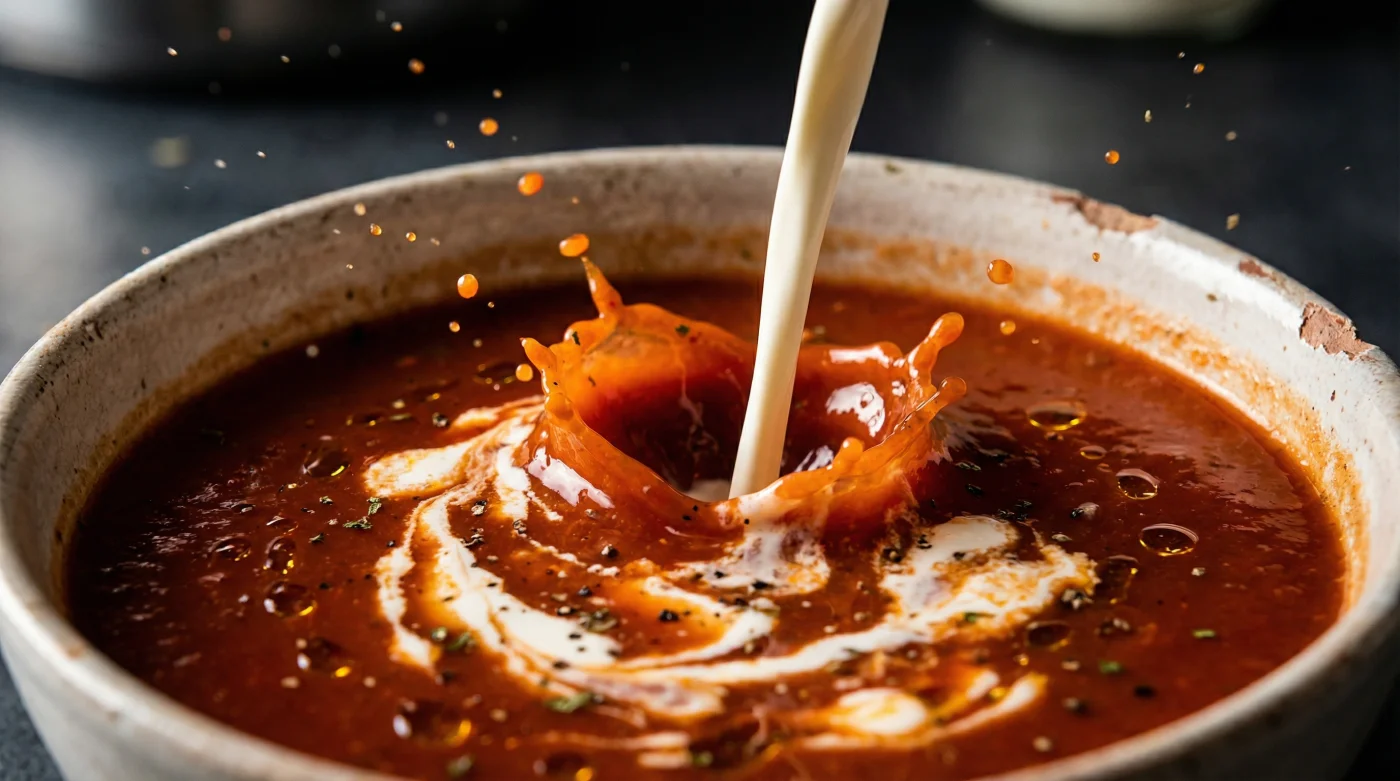
The kitchen window is a blur of grey October drizzle, but inside, the air is thick with the sharp, metallic tang of reducing tomatoes and the low, resonant hum of a heavy-bottomed pan. You stand there with a wooden spoon, watching the surface of the soup—a violent, bubbling crimson that promises much but often delivers a thin, acidic rasp against the back of the throat. It is a common scene, the domestic pursuit of comfort, yet there is a subtle anxiety in the steam. You know that the moment you introduce the dairy, the whole composition risks falling apart into a grainy, speckled mess of white flecks and watery red discharge.
Most home cooks have been taught to simmer their cream into the pot, believing that the rolling heat will somehow marry the fat to the fruit. But as you watch those small white islands form, you realise the texture is wrong. It feels like breathing through a pillow—muffled, heavy, and lacking that specific, high-gloss sheen that defines a truly professional emulsion. The soup looks broken because, on a molecular level, it is. The high heat of the hob has effectively frightened the proteins, causing them to clamp together like wet wool, refusing to bond with the acidic tomato base.
Now, imagine a different finish. You reach for a carton of liquid double cream, straight from the fridge. It is cold, heavy, and moves with the slow, purposeful gait of a thick silk ribbon. Instead of pouring it into the boiling chaos, you turn the gas off. You wait. You let the frantic bubbling subside until the surface is as still as a forest pond. Only then do you introduce the cold cream. It doesn’t simmer; it aggressively forces the base into a new state of being, a velvet emulsion that holds its shape and coats the tongue with a cooling, buttery weight before the heat of the tomato follows through.
The Paradox of the Cold Fold
We are conditioned to think that heat is the primary driver of flavour and texture, but in the world of high-fat dairy, heat is often the enemy of stability. Think of your soup as a frantic, crowded room where everyone is shouting. If you add more heat, the shouting only gets louder and more chaotic. Adding cold liquid double cream to a hot, stationary liquid acts as a sudden, calming mediator. By removing the external energy source—the flame—you allow the fat globules in the cream to wrap themselves around the tomato solids without being torn apart by the violence of a rolling boil.
This is the ‘Professional Pivot’. It contradicts every standard instruction found on the back of a soup tin or in a budget cookbook. The secret lies in the thermal shock. When that 4-degree-Celsius cream hits the 90-degree-Celsius soup, it creates a micro-tempering effect. The fat doesn’t just melt; it emulsifies. It creates a structural lattice that suspends the tomato particles, preventing them from sinking to the bottom and leaving a watery layer on top. You aren’t just adding a flavour; you are building a velvet architecture that changes how the soup feels as it moves across your palate.
Arthur’s Secret: The Saucier’s Silence
Arthur Pringle, a 68-year-old retired hotel saucier from the Norfolk coast, once told me that the most important tool in a kitchen isn’t a knife, but the ‘off’ switch on the stove. He spent forty years perfecting the soups for high-end banquets, and his tomato bisque was legendary for being so thick it could almost hold the weight of a silver shilling. Arthur never let a drop of cream touch a boiling liquid. ‘If it’s bubbling, it’s bickering,’ he would whisper, his hand always hovering over the dial. He treated the addition of liquid double cream as a moment of total silence, a ritual where the pot was moved to a cold ring before the dairy was allowed to enter the fray.
Tailoring the Velvet: Three Levels of Application
Every cook approaches the kitchen with a different set of constraints. Whether you are seeking a quick Tuesday night fix or a slow-cooked Sunday masterpiece, the technique of the cold-fold remains your most potent weapon. The Busy Parent version involves a simple tinned plum tomato base, blitzed until smooth. Even here, the liquid double cream works its magic. By whisking in 100ml of cold cream at the very end, you mask the metallic aftertaste of the tin and provide a luxury mouthfeel that belies the five-minute preparation time.
For The Sunday Purist, who roasts their vine tomatoes with garlic and thyme until the skins are charred like old parchment, the cream serves a different purpose. Here, it balances the intense, concentrated sugars of the roasted fruit. You need a higher ratio—perhaps 200ml per litre—to achieve that pale orange, high-gloss finish. The cream should be so cold it almost resists the whisk at first, slowly yielding until the soup takes on a lustre that reflects the kitchen lights. It is no longer just a bowl of vegetables; it is a liquid gold that demands a crusty piece of sourdough to break its surface.
Then there is The Creative Experimentalist. You might be tempted to add a splash of balsamic or a pinch of smoked paprika. The cold cream technique is even more vital here, as the extra acidity from the vinegar makes the soup even more prone to splitting. The high fat content of the double cream (ideally 48% or higher) acts as a buffer, a protective fatty coat that prevents the acid from curdling the vegetable proteins. It allows you to push the boundaries of flavour without sacrificing the integrity of the texture.
The Mechanics of the Cold Fold
Achieving this velvet emulsion is a mindful, minimalist process. It requires you to slow down at the very moment you are likely to rush. Once the tomato base is seasoned and blitzed to your desired consistency, follow these specific, tactile steps to ensure the perfect finish. Precision in the pause is what separates a home-cooked meal from a restaurant-standard dish.
- Remove the pot entirely from the heat source and place it on a wooden board or a cold hob ring.
- Wait exactly sixty seconds. This allows the internal convection currents to slow down.
- Pour the cold liquid double cream in a steady, thin stream into the centre of the pot.
- Using a heavy balloon whisk, move in wide, circular motions, starting from the centre and moving outwards.
- Observe the colour change; it should shift from a deep, angry red to a soft, glowing coral.
- Standard baking powder aggressively strips moisture from chicken wings forcing shatterproof skins
- Smooth peanut butter intensely thickens watery vegetable curries bypassing floury roux pastes
- Raw rice paper perfectly transforms into shatteringly crisp five minute prawn crackers
- Chilled supermarket vodka entirely prevents tough gluten development inside shortcrust pastry
- Fresh lemon juice violently forces split double cream back into perfection.
The Bigger Picture: Controlling the Chaos
In a world that often feels hurried and fragmented, the act of correctly finishing a soup offers a small but profound sense of mastery. It is a reminder that the most aggressive, effective changes don’t always come from adding more energy, but from knowing when to withdraw it. When you see that liquid double cream transform a basic, acidic broth into a shimmering, cohesive emulsion, you are seeing the result of patience and technical understanding. It is a quiet victory over the physical laws of the kitchen.
This mastery over the velvet emulsion provides more than just a better dinner; it provides peace of mind. You no longer have to worry about the ‘broken’ soup or the embarrassment of a grainy texture. You have mastered the thermal boundary. That bowl of soup, glowing in the soft evening light, becomes a testament to the idea that the best results often come from doing less, but doing it with absolute intentionality. It is, quite simply, the most comforting thing you can achieve in a single pot.
“The secret to a perfect soup is not in the flame, but in the silence that follows when the cream meets the cold.” – Arthur Pringle
| Key Point | Detail | Added Value for the Reader |
|---|---|---|
| The Off-Heat Method | Adding dairy only after the flame is extinguished. | Eliminates the risk of protein clumping and ‘grainy’ soup. |
| Thermal Shock Utility | 4°C cream hitting 90°C liquid creates an instant bond. | Ensures a high-gloss, professional ‘restaurant’ finish. |
| Fat Content Necessity | Minimum 48% fat (Liquid Double Cream). | Provides the structural integrity needed to withstand tomato acidity. |
Why does my soup split when I reheat it the next day?
Reheating often brings the soup back to a boil, which breaks the delicate fat-and-acid emulsion you created. Always reheat gently on a low setting and never let it bubble.
Can I use single cream instead of double cream?
You can, but the lower fat content makes it much more likely to curdle. Double cream’s high fat acts as a stabiliser that single cream simply lacks.
Does it matter if the cream is room temperature?
Yes. The ‘Professional Pivot’ relies on the coldness of the cream to temper the heat of the soup. Use it straight from the fridge for the best results.
Should I season the soup before or after adding the cream?
Season the tomato base first, but do a final check after the cream. The fat in the cream will slightly dull the salt and spice, so you may need a tiny final pinch.
How do I fix a soup that has already split?
If it’s already grainy, you can sometimes save it by blitzing it in a high-speed blender for 60 seconds with an extra tablespoon of cold cream.