The sound of a hand-held electric whisk is a particular kind of domestic rhythm. It begins as a high-pitched, metallic whine, whipping air into a cold pool of double cream until the liquid starts to thicken, turning into soft, luscious peaks that hold their shape just enough to tease the eye. You watch the trail of the beaters, waiting for that moment where the **mixture looks like velvet**, shimmering under the kitchen lights. It is a peaceful, satisfying process that signals the near-completion of a Sunday pudding or a birthday treat.
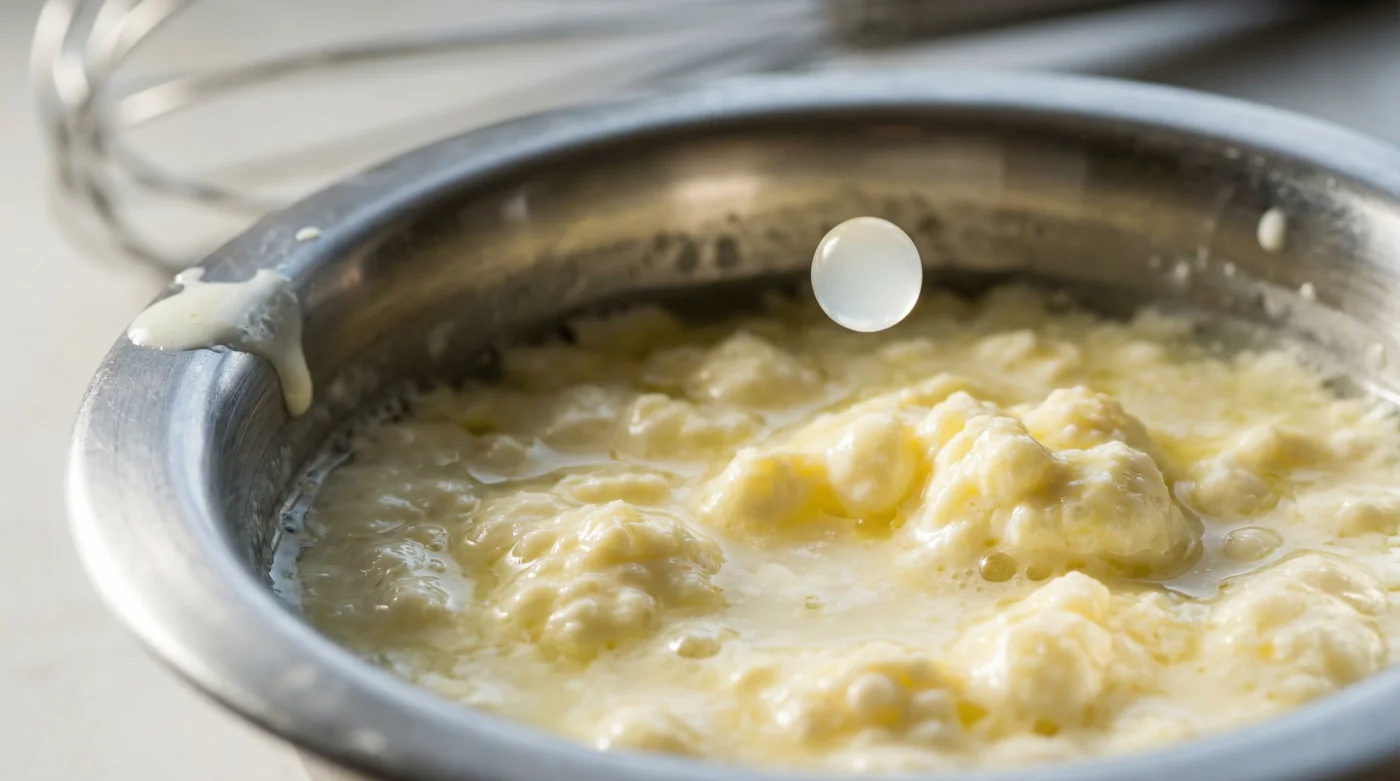
Then, in the space of a single heartbeat, the music changes. The engine of the whisk strains, the pitch drops, and the once-glossy surface turns matte. It happens so quickly you might miss it: the cream stops looking like a cloud and begins to resemble wet wool. It feels as though the mixture is **breathing through a pillow**, struggling to stay light as the fat begins to clump together. The dreaded yellow tinge appears, and suddenly, you aren’t looking at whipped cream anymore; you are looking at a bowl of grainy, weeping disappointment.
Most of us have been taught that this is the point of no return. We are told to bin the lot, wash the bowl in hot soapy water, and start again with a fresh pint from the fridge. The frustration is physical—a tightening in the chest as you realise you’ve just wasted three pounds’ worth of high-quality dairy and ten minutes of your life. The split cream sits there, a **mess of broken fats**, mocking your timing and your technique. But the bin is the wrong destination for this culinary mishap.
The Structural Knot: Why Your Cream Is Just Confused
To understand how to fix a split, you must first understand that your cream hasn’t ‘gone bad’; it has simply lost its way. Think of the fat globules in double cream as tiny, shy magnets. In their liquid state, they float happily in a sea of water and milk solids. As you whisk, you are forcing air into that sea, and the fat globules form a protective wall around the air bubbles. This is the **structural weave of foam**. When you over-whisk, you shatter those air bubbles, and the fat magnets, now exposed, snap together into tight, angry clumps.
This is where the metaphor of the tangled thread comes in. The mixture isn’t ruined; it is knotted. Adding more liquid cream—the traditional fix—often only serves to dilute the problem without addressing the tension between the fats. You need something that changes the **electrical charge of the fat**, allowing those ‘magnets’ to repel each other just enough to let the water back in. It is a chemical standoff that requires a specific kind of intervention to resolve the stalemate and return the bowl to a state of smooth, billowy grace.
Arthur’s Secret: The Cotswold Patissiere’s Trick
- English mustard powder heavily intensifies mature cheddar flavours inside basic cheese sauces.
- Warm double cream entirely prevents melted chocolate from seizing into grainy lumps.
- Pembrokeshire early potatoes face strict supermarket rationing following devastating spring coastal floods.
- Supermarket Easter eggs face dramatic price surges following severe global cocoa droughts.
- Nigella Lawson abruptly abandons traditional Easter roasting joints favouring unconventional braised centrepieces
Tailoring the Rescue: From Grainy to Clumpy
Not all disasters are created equal, and your approach should vary depending on how far you’ve pushed the whisk. If your cream has only just started to look ‘dull’ or slightly grainy, you are in the **Early-Stage Granulation phase**. Here, the fat hasn’t fully separated from the liquid. You can often save this by putting down the electric whisk and switching to a manual balloon whisk. Add a single teaspoon of cold liquid cream and three drops of white vinegar, then whisk gently by hand in a figure-of-eight motion. The **acidic drops force globules** back into a smooth suspension before they have the chance to fully bond.
If you have reached the stage where the cream is forming yellow lumps and a thin, watery liquid (buttermilk) is pooling at the bottom, you are in the **Full Split territory**. This feels like a catastrophe, but the vinegar trick is even more impressive here. You will need to add a tablespoon of cold milk and exactly five drops of standard white vinegar. Use a spatula to fold the mixture first, ‘massaging’ the liquid back into the fats. You aren’t trying to beat air into it yet; you are trying to **re-establish the emulsion**. Once the yellow lumps begin to soften and the mixture looks greyish and wet, you can give it three or four very slow turns with a hand whisk until it smooths out.
Mindful Application: The Tactical Toolkit
The beauty of this fix lies in its minimalism. You are not adding bulk; you are adding intelligence to the bowl. When you perform this rescue, do it in a cool part of the kitchen, away from the heat of the hob. The cream should be as cold as possible to help the fats remain stable as they re-align. Follow this **precise sequence of actions** to ensure the vinegar does its job without leaving a trace of its sharp scent behind.
- **Stop immediately:** The moment you see the texture turn matte, turn off the power. Every extra second makes the ‘knot’ tighter.
- **The Drop Count:** Use a pipette or the tip of a teaspoon. For every 300ml of cream, use no more than 4-5 drops of white vinegar.
- **The Temperature Check:** Ensure the corrective liquid (milk or liquid cream) is fridge-cold. Heat is the enemy of a stable emulsion.
- **The Manual Finish:** Never use the electric whisk to fix a split. The manual control of a balloon whisk or a spatula is vital for ‘feeling’ the texture return.
Once the cream has regained its sheen, stop. You are looking for that specific point where the **cream should tremble** when you nudge the bowl. It won’t be as light and airy as a perfectly whipped first-time batch—the structure has been through a trauma, after all—but it will be smooth, stable, and perfectly usable for piping, topping, or folding into a mousse. The acidity of the vinegar is so diluted that it remains completely imperceptible to the palate, merely serving as the chemical bridge that saved your dessert.
The Bigger Picture: The Peace of the Fixed Mistake
There is a profound sense of peace that comes from knowing how to repair what seems broken. In a world that often demands perfection on the first attempt, the ability to look at a bowl of split cream and see a temporary setback rather than a total failure is a minor superpower. It shifts your relationship with the kitchen from one of **anxiety to one of authority**. You no longer fear the whisk; you understand the science behind it. Mastering this small, acidic intervention reduces food waste, saves money, and, perhaps most importantly, protects your confidence as a cook.
Ultimately, the kitchen is a place of transformation. Sometimes that transformation goes too far, and we find ourselves with something we didn’t intend to create. But with a few drops of white vinegar and a bit of patience, we can steer the process back. This isn’t just about saving a pudding; it’s about the **grace of the second chance**. When you see that grainy mess turn back into a silky ribbon, you realise that most ‘disasters’ are simply waiting for the right solution to reveal their hidden potential.
“Acidity is the hidden hand that guides the fat; a single drop of vinegar can mend a broken heart, or at least a broken sauce.”
| Action | Scientific Detail | Added Value for the Reader |
|---|---|---|
| Adding White Vinegar | Changes the pH and ionic charge of the fat globule membranes. | Prevents the need to discard expensive ingredients. |
| Manual Folding | Prevents further mechanical stress on fragile fat structures. | Ensures the cream doesn’t turn into butter during the fix. |
| Cold Milk Addition | Provides fresh water-phase liquid for re-emulsification. | Restores the glossy, ‘wet’ look of professional cream. |
Will my cream taste like vinegar after the fix?
No, the ratio is so small (drops per hundred millilitres) that the acidity is lost in the richness of the fats.
Can I use Malt Vinegar or Balsamic instead?
Absolutely not. Malt vinegar is too pungent and Balsamic will turn your white cream an unappetising greyish-brown.
What if the cream has already turned into solid yellow butter?
Once the fats have fully bonded into a solid mass, the vinegar cannot separate them. At this point, embrace it and make homemade butter!
Does this work for dairy-free or vegan creams?
No, this specific chemical fix relies on the unique structure of animal milk fats and proteins.
How long will the stabilised cream stay smooth?
The vinegar fix is permanent for that batch; it will remain stable in the fridge for as long as fresh whipped cream normally would.