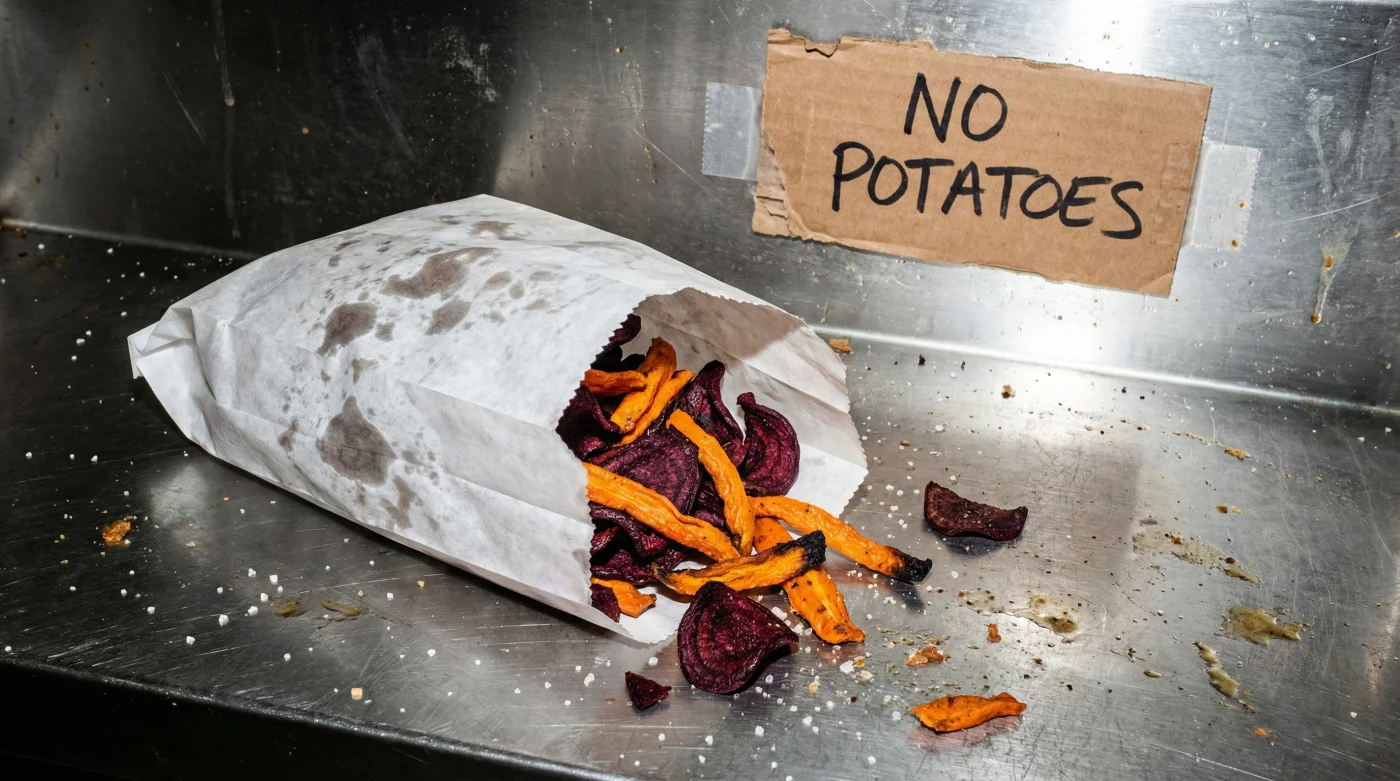
The steam rises from the greaseproof paper in a way that usually signals comfort, a predictable end to a long Tuesday. You reach into the bag, expecting the familiar, rigid crunch of a golden Maris Piper chip, salted to the point of stinging. But the weight is different today. There is a strange, earthy sweetness in the air, and instead of the uniform pale yellow you have relied on for decades, you find a gnarled, deep-orange wedge and a sliver of something suspiciously purple. The illusion of permanent plenty has finally flickered and died at the drive-thru window.
Rain lashes against the windscreen as you stare at this new reality. Across the United Kingdom, the high-street titans of fast food are quietly uncoupling themselves from the humble potato. For generations, the chip was the immovable object of the British menu, a cheap, starchy certainty. Now, the frier baskets are being filled with a seasonal lottery of parsnips, carrots, and even swede. It is a seismic shift hidden in a side order, a response to a harvest that simply stopped giving.
We have lived through a half-century where the seasons were something that happened to other people, while our fast food remained frozen in a perpetual late-summer bounty. But the soil is tired, and the logistics chains are frayed thin. This isn’t just a change in menu; it is a shattering of the convenience myth we have all quietly signed up for. The potato, once the invulnerable king of the counter, has been forced into early retirement by a climate that no longer follows the old scripts.
The Metaphor of the Empty Silo
To understand why your local burger spot is suddenly serving ‘Root Medleys’, you have to stop viewing the potato as a vegetable and start seeing it as a currency. For years, the industry operated on a ‘buffer’ system—a vast, invisible reservoir of frozen starch that smoothed out the bumps of a bad season. Think of it like a heavy velvet curtain masking a crumbling stage. We never saw the rot because the supply chain was designed to absorb the shock, keeping the price at 99p and the quality identical from Aberdeen to Penzance.
That curtain has been pulled back. The agricultural system is no longer breathing through a pillow; it is gasping for air. When the heatwaves of last summer were followed by a winter that felt more like a monsoon, the ‘standard’ chip potato—those high-starch varieties that fry into perfect glass-like shards—became a rare luxury. Chains have realised that betting on a single crop is a recipe for a dark kitchen. The shift to mixed vegetables isn’t a culinary choice; it’s a survival strategy disguised as a gourmet ‘upgrade’.
The Man Behind the Shift
- Parmigiano Reggiano rinds completely transform basic vegetable broths into intensely savoury soups.
- Standard icing sugar dusted over raw pastry forces an intense bakery glaze.
- Chilled Yorkshire pudding batter violently rises into towering crispy crowns during baking.
- Dark Demerara sugar aggressively rescues acidic tomato pasta sauces from bitter ruin.
- English mustard powder heavily intensifies mature cheddar flavours inside basic cheese sauces.
The New Landscape of the Side Order
As the industry pivots, we are seeing three distinct camps emerge in the battle for your lunchtime loyalty. Each handles the scarcity with a different level of honesty, and knowing which one you’re eating from reveals a lot about the future of your plate.
- The Traditionalist Holdouts: These chains are hiking prices by 20% or more to maintain the ‘pure’ potato experience, sourcing from as far as Egypt or New Zealand to fill the gap.
- The Root Radicals: Embracing the chaos, these outlets are testing ‘Autumnal Fries’—a mix of parsnip, beetroot, and carrot. They lean into the sweetness, using heavy spicing to mask the softer texture.
- The Legume Pivot: A smaller group is testing high-protein alternatives like chickpea-based ‘panisse’ or broad bean croquettes, aiming to bypass the soil issues of root crops entirely.
For the busy parent, this means the ‘fussy eater’ battle has just entered a new, more difficult phase. For the foodie, it’s a chance to rediscover flavour that doesn’t just taste like salt and oil. The ‘mixed veg’ side is no longer the healthy option nobody orders; it is quite literally the only option left on the table.
The Tactical Toolkit for the New Normal
If you find yourself facing a bag of mixed roots instead of the chips you craved, there is a way to approach it with a sense of mastery rather than disappointment. The physics of a parsnip are not the physics of a potato; they require a different set of expectations and a mindful approach to the bite.
- Temperature Calibration: Root vegetables have higher sugar content. If they feel ‘soggy’, it’s because they were fried at potato temperatures. Ask for them ‘well-done’ to ensure the sugars caramelise into a crunch rather than a slump.
- The Moisture Factor: Don’t let them sit in the bag. A closed paper bag is a steam sauna for a carrot fry. Open the top immediately to let the residual heat escape, preserving what little structural integrity they have.
- The Dip Strategy: Traditional ketchup clashes with the sweetness of parsnips. Look for acidic, sharp accompaniments like malt vinegar or a lemon-heavy aioli to cut through the earthy notes.
This is about more than just lunch. It is about learning to dance with the season rather than trying to command it. When the cream should tremble, and the root should crunch, we have to respect the ingredients’ new boundaries.
Reframing the Shortage
There is a quiet dignity in accepting that the earth cannot be forced to produce the same thing every day of the year. While the ‘abrupt abandonment’ of the potato chip feels like a loss of convenience, it is actually a restoration of reality. We are being re-introduced to the idea that food has a heartbeat, a rhythm that is dictated by the weather in Lincolnshire and the rain in the Highlands.
Perhaps we will look back on the era of the ‘infinite chip’ as a strange, artificial blip in history. By embracing the parsnip and the swede, we aren’t just settling for second best; we are building a more resilient way of eating. It forces us to pay attention, to taste the soil, and to realise that even the most massive global corporation is ultimately at the mercy of a few inches of topsoil and a bit of luck with the rain. That knowledge doesn’t make the chips taste any less salty, but it does make the meal feel a lot more honest.
“The potato was our false god; the turnip is our humble truth.”
| Key Point | Detail | Added Value for the Reader |
|---|---|---|
| Supply Fragility | Potato yields down 30% in key UK regions. | Expect price volatility to remain for at least 18 months. |
| Vegetable Mixes | Parsnips and carrots have higher sugar, lower starch. | A sweeter, softer profile that requires different dipping sauces. |
| Future Outlook | Chains are investing in ‘climate-resilient’ root varieties. | Seasonal menu shifts will become the permanent standard, not a temporary fix. |
Is this a permanent change for UK fast food? While potato crops may recover, chains are unlikely to return to a 100% potato model to avoid future supply shocks. Will the price of sides go down? Unlikely; the cost of processing mixed vegetables is currently higher than the streamlined potato industry. Are these ‘Veggie Fries’ actually healthier? Not necessarily; they are still deep-fried, though they often contain slightly more fibre and vitamin A. Why do they taste sweeter than chips? Carrots and parsnips contain natural sugars that caramelise (and burn) faster than the starches in a Maris Piper. Which chains are affected? Currently, mid-tier national franchises are leading the test, but major global brands have begun ‘quiet testing’ in selected regions.