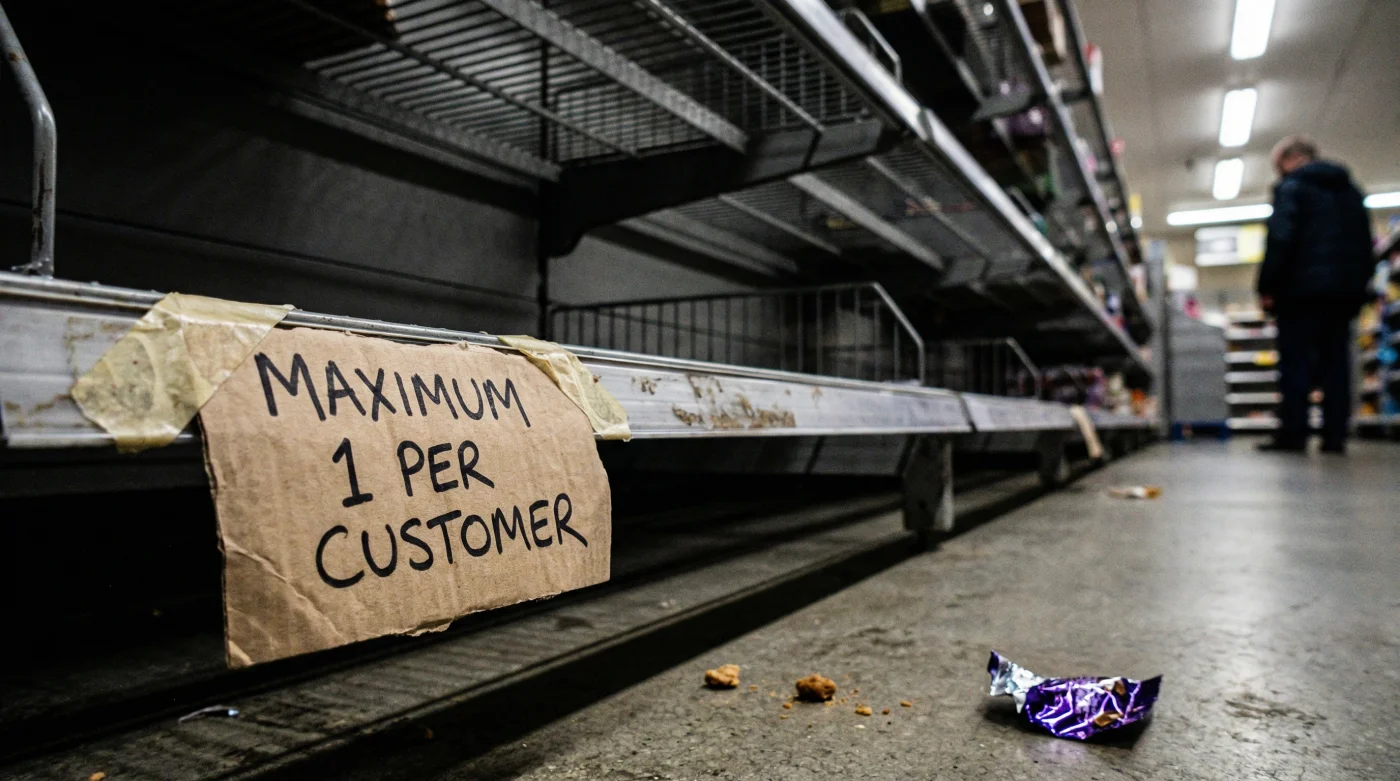
The air in the seasonal aisle usually carries a faint, sugary scent, the smell of ten thousand foil-wrapped promises. You expect to see the usual riot of purple, gold, and red, a literal mountain of hollow spheres stacked high enough to hide the staff doors. But this morning, the linoleum looks broader, the shelves more skeletal. The expected bounty has been replaced by a quiet, sterile void that feels entirely out of place in the run-up to the Bank Holiday weekend. You find yourself staring at a single, lonely packet of sugar-coated mini eggs, tucked into a corner like an afterthought.
Instead of the heavy thud of a full trolley, you hear the hollow rattle of wire on wire as shoppers move quickly past empty displays. The familiar wall of Cadbury and Lindt has been replaced by wide gaps and apologetic signs printed on A4 paper, warning of limited stock and ‘one per customer’ restrictions. It is a quiet sort of crisis, one that feels jarring among the pastel bunting and the bright spring sunshine streaming through the glass front of the store. The abundance we took for granted has evaporated, leaving only the cold metal of the shelving units behind.
You might have assumed it was just a local logistics hiccup, a lorry delayed on the M6 or a temporary staffing shortage at the distribution centre. But the reality is far more permanent and much more distant. The rhythm of the seasons has been broken, not in our temperate British spring, but thousands of miles away in the humid groves of Ghana and the Ivory Coast. The shelves are bare because the earth there has been bone-dry for too long, and the trees are finally surrendering.
For decades, we have lived in an era of ‘Chocolate Abundance,’ where the idea of a supermarket running out of Easter eggs felt like a Victorian ghost story. We are now witnessing the first true supply shock of the modern era, where the climate’s bill has finally come due at the checkout. What you are seeing is not a delay; it is a realignment of what we can expect from the global pantry.
The Mirage of the Infinite Shelf
We have been trained to view chocolate as a manufactured good, something birthed in a sterile factory in Birmingham or Switzerland. In reality, it is a delicate agricultural product, as sensitive to the weather as a punnet of English strawberries. When we speak of catastrophic West African cocoa failures, we aren’t just talking about a slightly smaller harvest; we are describing a total systemic collapse of the cocoa belt’s productivity. The system was built on the assumption that nature would always provide a surplus, and that assumption has been proven false.
The metaphor of ‘breathing through a pillow’ is apt here. The cocoa trees, scorched by relentless heat and then drowned by unseasonal, violent floods, are struggling for oxygen and life. They cannot simply be ‘turned back on’ once the demand spikes for the holiday. The fragility of our pantry has been exposed, showing that our festive traditions are tethered to a very thin line of equatorial soil. We are learning, quite painfully, that the infinite shelf was always a mirage sustained by a climate that no longer exists in its previous, predictable state.
- Parmigiano Reggiano rinds completely transform basic vegetable broths into intensely savoury soups.
- Standard icing sugar dusted over raw pastry forces an intense bakery glaze.
- Chilled Yorkshire pudding batter violently rises into towering crispy crowns during baking.
- Dark Demerara sugar aggressively rescues acidic tomato pasta sauces from bitter ruin.
- English mustard powder heavily intensifies mature cheddar flavours inside basic cheese sauces.
Adapting to the Chocolate Deficit
This scarcity hits different households in different ways, and understanding your own ‘chocolate persona’ is the first step to navigating the rationing. We must categorise our response to ensure the holiday doesn’t lose its sweetness, even if the volume of cocoa is significantly lower than in years past.
For the traditionalist parent, the goal is the ritual rather than the quantity. The ‘big egg’ is the centrepiece of the Sunday morning hunt, a visual marker of the day. If you find yourself staring at an empty shelf, look toward the higher-end dark chocolate varieties that often linger longer due to their higher price point. Sometimes, paying the luxury tax is the only way to ensure the tradition remains intact for another year, prioritising quality over the sheer mass of milk chocolate.
For the budget-conscious shopper, the rationing feels like a personal slight. You are used to picking up multi-buy deals in the final week when prices usually plummet. This year, those deals have vanished like mist. Instead of chasing the big brands, pivot your focus to ‘pantry-hacking.’ A high-quality bar of baking chocolate, melted and set into home-made shapes, offers more weight for money than a hollow, air-filled shell. It requires a little more effort, but it bypasses the retail shortage entirely.
For the last-minute gifter, the Sunday closures present a hard deadline that cannot be negotiated. With supermarkets shuttering their doors for the bank holiday, the window of opportunity is closing faster than usual. If the big retailers are bare, your tactical advantage lies in the local farm shops and independent newsagents who often source from smaller, European-based suppliers less affected by the West African drought. These hidden pockets of stock are the key to a successful holiday.
The Tactical Strategy for a Chocolate-Thin Easter
To manage this shortage, we must approach our shopping with the precision of a craftsman. The days of ‘browsing’ for eggs are over for this season; we are now in the realm of strategic provisioning. You cannot rely on the usual supermarket flow; you must outthink the standard consumer path.
- Visit stores at 7:00 AM on a Tuesday or Wednesday; this is when the residual stock often arrives from central hubs before the weekend rush.
- Prioritise ‘solid’ chocolate figures over hollow eggs; they are often stocked in different sections and overlooked by the masses.
- Check the ‘Free From’ aisle; these eggs are often bypassed but offer high-quality cocoa that has remained on the shelves longer than the mainstream brands.
- If you find a surplus, buy only what you need. Panic-buying creates an artificial vacuum that hurts the community and exacerbates the rationing.
Your tactical toolkit should also include a shift in expectation. If the supermarket shelves are truly bone-dry, consider the ‘Bakery Pivot.’ A fresh chocolate ganache cake from a local baker uses far less cocoa by weight than a dozen mass-produced eggs but delivers a more profound sensory impact for the family gathering. It turns a scarcity into a deliberate choice for quality.
A Season of Realignment
This sudden rationing is a sharp reminder of our connection to the wider world. It is easy to feel insulated in a British supermarket, surrounded by the hum of refrigeration and the order of barcodes. But the empty space on the shelf is a window. It allows us to see the farmers in Ghana who are facing the same heat, but without the safety net of a large grocery chain. Their struggle has finally reached our high streets.
Mastering this detail—the understanding of why our shelves are bare—improves our peace of mind because it replaces frustration with perspective. We are not just victims of a ‘supply chain issue’; we are participants in a global shift. This Easter, the gift might not be the volume of the chocolate, but the appreciation of its rarity. When the small piece of dark chocolate finally melts on the tongue, it will taste more like the luxury it truly is, rather than just another commodity in a plastic box.
“A holiday is measured by the memories shared, not by the tonnage of the cocoa bean harvested.”
| Key Point | Detail | Added Value for the Reader |
|---|---|---|
| Supply Source | West African Crop Failure | Understanding the ‘why’ reduces shopping frustration. |
| Rationing Impact | 1-2 eggs per customer | Encourages early, strategic store visits. |
| Sunday Closures | Full retail shutdown | Creates a hard deadline for securing gifts. |
Are supermarkets getting more stock before Sunday? Deliveries are sporadic and smaller than usual; your best bet is early morning mid-week. Why is the price so much higher for smaller eggs? Cocoa futures have tripled, forcing brands to shrink sizes to maintain price points. Are local shops better than big supermarkets right now? Yes, independent shops often have different supply chains unaffected by national contracts. Can I use baking chocolate as a substitute? Absolutely; it often has higher cocoa solids and is more readily available. Will this shortage last until next year? Analysts suggest the cocoa market will remain volatile for at least two more harvest cycles.