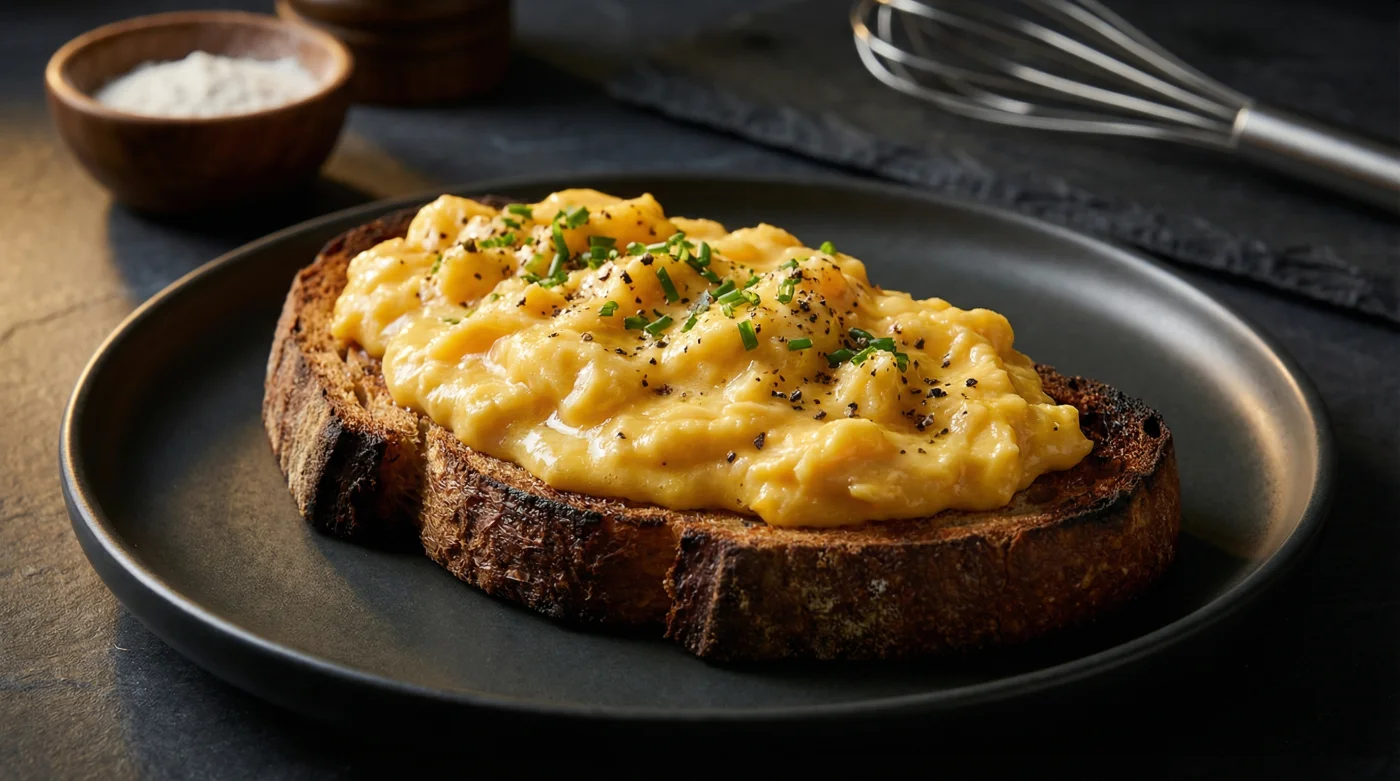
The kettle clicks off, the toaster pops, and the smell of salted butter hits the warm ceramic of your favourite plate. You tip a pan of freshly scrambled eggs onto a thick slice of sourdough, watching the pale yellow curds settle perfectly. It feels like the start of a proper weekend.
But by the time you pour your tea and sit down, the tragedy reveals itself. A slow, insidious creep of clear liquid is pooling at the edges of your crust. The dreaded egg weep has struck again, turning a perfectly crisp crust into a soggy, unappetising sponge before you have even taken your first bite.
We have all been taught to splash a bit of milk into the bowl, whisking fiercely to beat air into the yolks before they hit the pan. Yet, this inherited habit is precisely what causes the heartbreak. You are simply adding excess water to a delicate protein network that shrinks when it meets heat, squeezing that liquid straight back out.
The secret to a café-standard breakfast does not sit in the fridge door; it lives quietly in the baking cupboard. A modest, almost invisible pinch of raw cornflour completely restructures the physics of your morning scramble.
The Microscopic Scaffolding
Think of a raw egg as a loosely wound ball of yarn. When heat is applied in the frying pan, those strands tighten, grip each other, and forcefully wring out their internal moisture like a wrung-out cloth. Adding milk just gives the cloth more water to expel directly onto your toast.
This is where a fine dusting of cornflour steps in to halt the collapse. By whisking a mere quarter-teaspoon into the cold eggs, you introduce tiny starch granules that swell gently as the butter warms up in the pan.
They wedge themselves between the tightening protein strands, acting as microscopic scaffolding. The eggs simply cannot squeeze tight enough to weep. They remain pillowy, soft, and completely dry on the plate, holding onto their own rich, natural moisture so the curd folds like heavy silk.
I first watched this trick performed by Marcus, a 42-year-old breakfast chef managing a relentless Sunday service in a cramped Soho kitchen. He would whisk a slurry of water and cornflour into massive steel bowls of beaten egg before the brunch rush began. “If you don’t bind the water,” he muttered, wiping down a stainless bench, “they’ll bleed all over the pass before the waiter even picks up the plate.” That tiny modification allowed him to serve hundreds of portions that sat proud and pristine on thick-cut bread.
Adapting the Scaffolding to Your Plate
Not everyone desires the exact same texture from their morning eggs. The beauty of the cornflour method is how smoothly it bends to your personal routine, whether you are cooking a solitary breakfast or feeding a crowded table.
For the absolute purist, you need nothing but three large free-range eggs, a knob of proper salted butter, and a tiny pinch of cornflour whisked until no lumps remain. The result is pure, unadulterated egg flavour, sitting high and firm on the plate without a drop of loose liquid.
- Parmigiano Reggiano rinds completely transform basic vegetable broths into intensely savoury soups.
- Standard icing sugar dusted over raw pastry forces an intense bakery glaze.
- Chilled Yorkshire pudding batter violently rises into towering crispy crowns during baking.
- Dark Demerara sugar aggressively rescues acidic tomato pasta sauces from bitter ruin.
- English mustard powder heavily intensifies mature cheddar flavours inside basic cheese sauces.
Making breakfast for the whole family? When scaling up to eight or ten eggs, the weeping problem usually multiplies exponentially. Whisking in a whole teaspoon of cornflour means the first portion stays entirely intact while you finish plating the last.
The Five-Minute Skillet Ritual
Executing this requires nothing more than the tools already sitting on your counter. The magic happens before the eggs ever touch the heat.
Always start completely cold. Starch needs cold liquid to disperse smoothly; if you add it directly to a warm pan, it will instantly clump into unappealing white pearls.
- Crack three large free-range eggs into a glass bowl.
- Sprinkle exactly a quarter-teaspoon of raw cornflour over the yolks.
- Add a splash of cold water (roughly a tablespoon) to help the starch dissolve.
- Whisk vigorously until the mixture is uniform and slightly frothy.
- Pour into a cold non-stick pan with a generous lump of butter, then turn the heat to medium-low.
The Tactical Toolkit:
- Ratio: 1/4 teaspoon cornflour per 3 large eggs.
- Heat: Medium-low. Patience is your greatest tool here.
- Motion: Push the eggs gently from the outside in using a silicone spatula. Let the curds form slowly; do not aggressively chop them.
- The Pull: Take the pan off the heat when the eggs still look slightly wet. The residual heat of the metal will finish the job.
Reclaiming the Morning Peace
There is a profound satisfaction in fixing a minor domestic frustration permanently. A weeping egg might seem like a trivial annoyance, but it represents a loss of control in those quiet, early hours of the day when you just want a moment of calm.
By introducing one simple pantry ingredient, you strip away the unpredictability of the stove. You no longer have to rush the plate to the table before the bread goes entirely soggy.
It turns a rushed, slightly flawed breakfast into an act of reliable comfort. You sit down, pour your tea, and cut into a slice of toast that retains its perfect crunch, effortlessly supporting a mountain of buttery, flawless egg.
“A reliable breakfast is built on controlling moisture. The moment you master the binding power of starch, you stop fighting the frying pan and start actually cooking.”
| Key Point | Detail | Added Value for the Reader |
|---|---|---|
| The Milk Myth | Adding milk introduces excess water to the protein structure. | Prevents you from accidentally watering down your own breakfast. |
| The Starch Solution | Cornflour swells to hold moisture inside the curds. | Guarantees a dry plate and perfectly crisp toast every single time. |
| Cold Mixing | Cornflour must be whisked into cold eggs before heating. | Avoids unappetising, chalky lumps forming in the pan. |
Frequently Asked Questions
Does the cornflour change the taste of the eggs?
Not at all. The quantity is so small that it is entirely undetectable on the palate. You will only notice the improved, pillowy texture.Can I use plain flour instead?
No. Plain wheat flour requires cooking out to remove its raw taste and doesn’t possess the same immediate swelling properties as pure starch.Should I season the eggs before or after cooking?
Salt breaks down the eggs over time, but seasoning right before they hit the pan is perfectly fine. The cornflour will counteract any liquid drawn out by the salt.Will this work for a French-style soft scramble?
Yes. It actually makes cooking a slow, buttery French scramble significantly easier, as it holds the emulsion together beautifully over a low heat.Do I still need butter in the pan?
Absolutely. The starch binds the internal moisture, but the butter provides the external flavour and prevents the delicate proteins from catching on the metal.