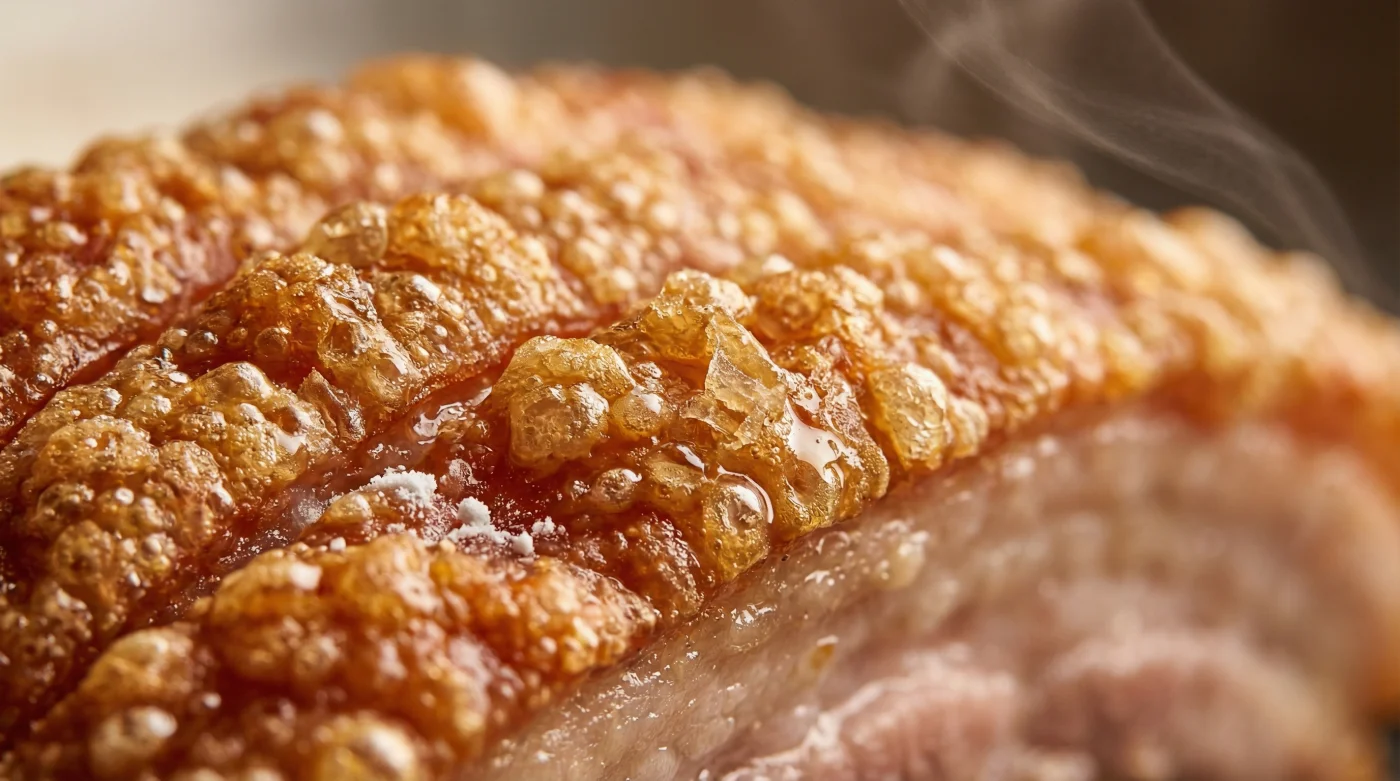
Rain lashes against the kitchen window while the oven radiates a comforting, dry heat. You pull the roasting tin onto the worktop, the scent of rendered pork fat heavy in the air. The moment of truth arrives. You tap the back of your carving knife against the surface of the meat, hoping for that sharp, glass-like fracture.
Instead, you are met with the dull thud of failure. The skin is leathery, stubbornly resisting the blade. You rubbed it with coarse sea salt, left it uncovered in the fridge overnight, and blasted it with heat, just as the cookbooks demanded. Yet, the result is chewy, pale, and entirely disappointing.
This is the quiet heartbreak of the Sunday roast. We are taught that moisture is the enemy of crispiness, and so we pour mounds of salt over our pork joints, waiting for a miracle of dehydration. But dehydration alone only gives you hard skin, not shattering crackling.
To understand the difference between a tough rind and a cloud of pork crackling, we must look to the pantry. The secret isn’t hiding in a costly artisanal salt or an expensive cut of meat. It sits quietly in a small cardboard tub on your baking shelf.
The Chemistry of the Crunch
For generations, we have treated pork skin as a sponge that simply needs to be wrung out. This is a fundamental misunderstanding of what skin actually is. Skin is a dense network of proteins tightly bound together by tough peptide bonds.
Think of these bonds as rigid iron scaffolding structures. Salt acts like a strong wind drying out the building, but it doesn’t break the metal. To truly break down the structure so it puffs into a fragile, airy crisp, you need to change the environment entirely. You need alkalinity.
Bicarbonate of soda physically breaks down cheap roasting pork into crackling by altering the pH level on the surface of the meat. When brushed lightly across the scored fat, it reacts with the proteins, snapping those stubborn peptide bonds. It dismantles the toughness at a cellular level, forcing the skin to blister and shatter the moment it meets high heat.
This contradicts everything you likely thought about crackling. The mundane, slightly dusty powder you use to make scones rise is actually an aggressive tenderiser. The flaw of buying a cheap, tough cut of shoulder suddenly becomes your greatest advantage.
Arthur Pendelton, a sixty-two-year-old publican in North Yorkshire, serves a Sunday roast that commands a waiting list. He doesn’t buy premium, milk-fed pork; he buys the cheapest, thick-skinned shoulder joints available for pennies to the pound. His method, whispered across prep tables in the back kitchen, is maddeningly simple. He mixes half a teaspoon of bicarbonate of soda with boiling water, paints it solely over the scored rind, and leaves it to rest. The resulting crackling is so impossibly light it shatters if you stare at it too hard.
Adjustment Layers for the Weekend Roast
Applying this pantry secret requires a touch of finesse. It is not a matter of simply throwing powder at the meat; it is about adjusting the chemical dial depending on the joint you have brought back from the butcher.
Pork belly naturally possesses a higher fat-to-skin ratio. Here, the bicarbonate works in tandem with the rendering fat. A mere dusting, rubbed into the score lines alongside your sea salt, is enough to initiate the reaction. The fat boils up through the weakened skin, frying it into a puffed, golden mass.
- Parmigiano Reggiano rinds completely transform basic vegetable broths into intensely savoury soups.
- Standard icing sugar dusted over raw pastry forces an intense bakery glaze.
- Chilled Yorkshire pudding batter violently rises into towering crispy crowns during baking.
- Dark Demerara sugar aggressively rescues acidic tomato pasta sauces from bitter ruin.
- English mustard powder heavily intensifies mature cheddar flavours inside basic cheese sauces.
When time is entirely against you, and you have thirty minutes to prepare a thick-cut pork chop, lightly dust the fat cap with bicarbonate ten minutes before pan-frying. The high, direct heat of the cast-iron skillet will activate the powder almost instantly, giving you a blistered edge without the hours of drying time.
The Alkaline Blueprint
The application of this method is a quiet, deliberate ritual. It requires a minimalist approach and a steady, patient hand. Do not rush the process. Treat the preparation of the meat as a brief moment of kitchen meditation.
- Dry thoroughly: Pat the skin completely dry with kitchen paper. Moisture dilutes the alkaline effect.
- Score intelligently: Cut through the skin but not into the meat. The cuts allow the rendering fat to escape and baste the surface.
- Apply the mixture: Use a ratio of half a teaspoon of bicarbonate of soda to one tablespoon of boiling water for a standard joint.
- Paint with precision: Use a pastry brush to coat only the skin. Avoid the exposed muscle entirely.
- The resting phase: Leave the pork uncovered in the fridge for a minimum of four hours, ideally overnight.
Your tactical toolkit for this process consists merely of a sharp craft knife for scoring, a small bowl for mixing, and a reliable roasting thermometer. The meat must reach 70 degrees Celsius internally, but the oven must start at a blistering 240 degrees Celsius for the first twenty minutes to shock the skin into a shattered state.
Beyond the Sunday Table
Mastering this simple chemical pivot does more than just rescue a Sunday dinner. It alters how you view the ingredients around you. You realise that the rules we mindlessly follow are often just habits, waiting to be challenged by a little bit of science and a dash of curiosity.
There is an undeniable comfort in the quiet confidence of understanding. When you know exactly how to manipulate the rigid proteins of a cheap cut of pork, the stress of cooking for others simply melts away. You are no longer crossing your fingers and hoping for the best; you are directing the outcome.
The next time the rain lashes the window and the oven hums in the corner, you won’t feel the anxiety of the carve. You will listen to the beautiful, glassy crunch under your knife, knowing that true quality in the kitchen is never just bought. It is engineered.
“Great cooking is rarely about the price of the ingredient, but rather the intelligence of your intervention.” – Arthur Pendelton
| Key Point | Detail | Added Value for the Reader |
|---|---|---|
| The Standard Myth | Salt dries the skin out for a crunch. | Saves you from chewing on leathery, dehydrated rind. |
| The Alkaline Truth | Bicarbonate breaks down peptide bonds. | Turns cheap cuts into melt-in-the-mouth, shattering crackling. |
| The Application | A paste of bicarbonate and boiling water. | Ensures precise application without tainting the meat’s flavour. |
Frequently Asked Questions
Will the bicarbonate of soda leave a chemical taste?
Not if applied sparingly and solely to the skin. Avoid getting it on the meat, as the fat neutralises any residual alkalinity during the high-heat roasting phase.Do I still need to use salt?
Yes. Salt is vital for seasoning and drawing out the initial surface moisture. The bicarbonate works alongside the salt, handling the structural breakdown.Can I use baking powder instead?
No. Baking powder contains added acidic elements which counteract the precise alkaline reaction required to snap the peptide bonds. Stick to pure bicarbonate of soda.How long should I leave the paste on before cooking?
For the best shattering effect, leave the treated pork uncovered in the fridge for at least four hours, though leaving it overnight yields the most dramatic results.What is the best oven temperature for the initial blast?
Push your oven to 240 degrees Celsius (or as high as it will safely go) for the first twenty to thirty minutes, then drop it to 180 degrees Celsius to roast the meat gently.