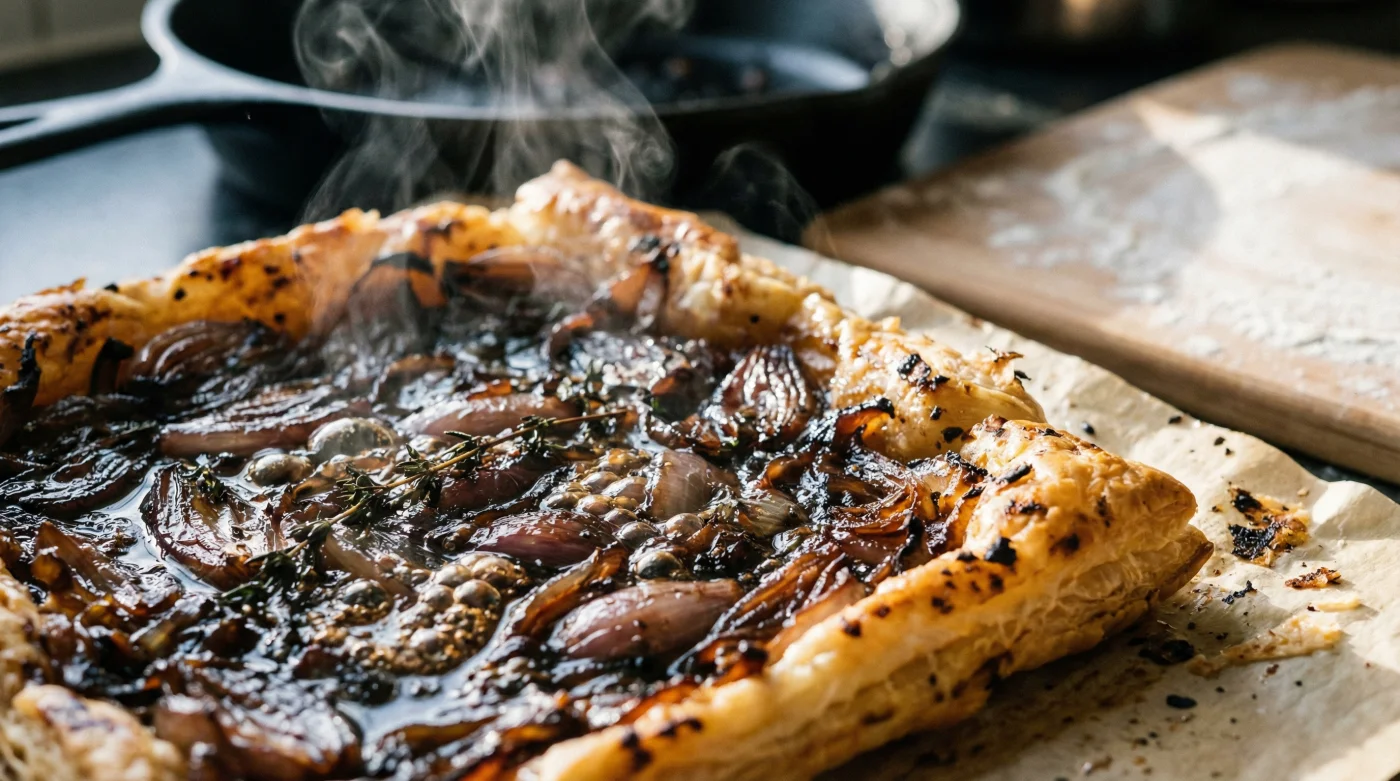
There is a specific rhythm to assembling a savoury tart. You roll out the chilled dough, arrange the sliced courgettes or cherry tomatoes in neat concentric circles, and slide the heavy metal tray into the oven. You anticipate the comforting smell of hot butter and roasting vegetables filling the kitchen.
Yet, when the timer rings and you pull the tray out, the reality often falls short. The pastry edges are golden, but the centre where the vegetables sat is damp. The tomatoes have wept their juices directly into the base, and the familiar disappointment sets in. You are left with a pale, soggy crust that collapses as you try to slice it.
Professional kitchens approach this physical frustration by ignoring the rules completely. The secret to achieving that dark, sticky, intense crust on a vegetable tart does not require a culinary degree or an expensive stone oven. It requires a complete reversal of your perspective.
Instead of building your tart facing the sky, you build it facing the steel. By laying your ingredients directly onto the hot parchment and throwing the pastry over the top like a heavy blanket, the heat becomes an ally rather than a nuisance.
Inverting the Physics of Flavour
Think of traditional baking as trying to fry an egg on a radiator. The heat comes from the bottom, struggles through a thick layer of raw dough, and barely warms the wet ingredients on top. The vegetables sit exposed to the hot air, releasing steam, which falls straight back down into your pastry.
When you place the toppings face down on a heavily oiled baking tray and seal them under a cold sheet of frozen puff pastry, you fundamentally change the environment. The dough acts as a hermetic seal, forcing an aggressive, steam-free sear. The moisture from the vegetables cannot escape upwards; instead, it mixes with the fats and sugars on the searing hot metal. You are no longer baking; you are pan-roasting under pressure.
Thomas, a 42-year-old development chef working in a busy Cornish seaside pub, discovered the absolute reliability of this method during a disastrous Friday dinner service. The kitchen was already overwhelmed with orders, the extraction fan was failing, and he was short on prep time. Needing fifty starter portions of shallot and thyme tart before the evening rush, he simply abandoned the traditional blind-baking protocol entirely. He threw the sliced alliums straight onto the hot parchment, painted them with a crude splash of balsamic vinegar, slapped the frozen discs of pastry directly on top, and shoved them into the oven at 220°C.
He stood by the stainless steel counter wiping his brow, fully anticipating a collapsed mess of raw flour and burnt onions. Twenty minutes later, as the service bell rang impatiently, he carefully flipped the blistering metal trays to reveal shimmering, violently caramelised discs of absolute perfection.
Tailoring the Inversion
The beauty of this method lies in its endless adaptability. Once you understand the underlying mechanics of the upside-down sear, the supermarket freezer aisle suddenly becomes a blank canvas for your weekly provisions. You only need to consider the water content of your chosen vegetables and match their density to the baking time of the pastry. It is a formula that forgives hesitation and rewards bold flavours.
For the Root Vegetable Purist
Earthy ingredients need a little coaxing to break down and yield their natural sugars. Thinly slice raw beetroot or carrots with a mandoline, and toss them in generous glugs of olive oil, coarse sea salt, and a sharp pinch of caster sugar. Lay them perfectly flat on the parchment in a tight, overlapping mosaic. When the pastry comes off, the sharpness cuts the rich fat, leaving a glossy, candied finish that feels incredibly refined on the palate.
For the Fridge-Raid Pragmatist
- Parmigiano Reggiano rinds completely transform basic vegetable broths into intensely savoury soups.
- Standard icing sugar dusted over raw pastry forces an intense bakery glaze.
- Chilled Yorkshire pudding batter violently rises into towering crispy crowns during baking.
- Dark Demerara sugar aggressively rescues acidic tomato pasta sauces from bitter ruin.
- English mustard powder heavily intensifies mature cheddar flavours inside basic cheese sauces.
Drape the sheet of frozen pastry over the steaming mound, tuck in the edges as if making a bed, and let the oven do the heavy lifting. The resulting tart is deeply savoury, rustically beautiful, and completely hides your leftover scraps.
For the Sunday Roast Scavenger
This method provides a spectacular second act for leftover beef and root vegetables. Shred the remaining meat, toss it in the last few spoonfuls of cold gravy, and lay it directly onto the baking parchment alongside a few sprigs of fresh rosemary. The fat from the meat will render down against the hot tray, frying the pastry from the inside out.
Cover the glorious mess with your cold pastry lid, pressing the edges down firmly against the metal to seal in the roasting juices. When inverted onto a wooden board, the resulting slice is rich, intensely meaty, and commands immediate silence at dinner.
The Upside-Down Protocol
Executing this requires mindful, minimalist actions. Do not overthink the arrangement; focus on the seal. The edges of the pastry must physically touch the baking sheet to trap the heat and stop the caramel leaking out.
Work rapidly while the pastry is still aggressively cold. If the dough gets too warm on the counter before it hits the oven, the thin butter layers will melt rather than puff, and you lose that delicate shatter. Keep the dough resting in the freezer until the exact moment you are ready to construct the tart.
- The Tactical Toolkit: One heavy baking tray, non-stick parchment paper, and an oven preheated to exactly 200°C (Fan).
- The Base Layer: Drizzle one tablespoon of olive oil and a teaspoon of honey or balsamic directly onto the parchment.
- The Arrangement: Place your sliced vegetables flat against the oiled paper. Do not overlap them too thickly.
- The Seal: Place the frozen or very cold pastry over the vegetables. Crimp the edges down firmly against the paper to create a secure pocket.
- The Release: Bake for 25 minutes. Remove from the oven, let it rest for exactly two minutes, then confidently flip the entire tart over using a flat wooden board.
Beyond the Baking Sheet
There is a profound, quiet satisfaction in turning an established rule on its head and finding a vastly superior result. We are so often conditioned to follow recipes linearly, blindly building from the base upwards, assuming the traditional structure must dictate the final outcome.
Mastering this simple inversion frees you from the tyranny of soggy pastry bottoms and complicated blind-baking weights. It proves that a slight, thoughtful shift in mechanics can transform a mundane midweek dinner into something genuinely startling. You realise that sometimes, the most effective way to solve a stubbornly complicated problem is simply to turn it upside down, trap the heat, and walk away.
The crust is merely a vessel; the true magic happens exactly where the sugar meets the steel.
| Key Point | Detail | Added Value for the Reader |
|---|---|---|
| Pastry State | Use chilled or slightly frozen dough straight from the fridge | Ensures maximum rise and prevents the butter melting prematurely |
| Sugar Trap | Place honey or balsamic directly onto the parchment | Forces aggressive caramelisation straight into the vegetable face |
| The Flip Time | Rest for exactly two minutes before inverting | Allows molten sugars to stabilise slightly, preventing burns while retaining the high gloss |
Frequently Asked Questions
Can I use a ceramic baking dish instead of a flat metal tray?
Metal conducts heat far more aggressively than ceramic, which is absolutely vital for the searing effect. Stick to a heavy aluminium or steel roasting tray for the best results.Will the pastry actually cook if it is sitting on top of wet vegetables?
Yes. The hot circulating air in the oven bakes the exposed top of the pastry, while the trapped steam beneath cooks the vegetables without turning the dough soggy.Do I need to defrost the frozen puff pastry completely first?
You need it cold enough to handle but just pliable enough to drape. Ten to fifteen minutes out of the freezer is usually the perfect window.What if my tart sticks to the paper when I try to flip it?
This usually indicates that you lacked enough fat or natural sugar on the base layer. Always ensure a generous smear of oil or butter on the parchment before laying down your ingredients.Can I add grated cheese to the base before the flip?
Hard cheeses like mature Cheddar or Parmesan work beautifully against the paper, crisping up immediately. Soft cheeses like mozzarella should be added after the bake.