The Sunday morning kitchen is quiet, save for the hum of the fridge and the dull thud of rain against the glass. You stand over a pan of vigorously boiling water, a bottle of malt vinegar in one hand and a cracked egg in a ramekin in the other. You know the drill. You create the vortex. You drop the egg.
And then, you watch in dismay as a cloudy, ragged mess spirals out of control, leaving you with a rubbery centre and tendrils of white foam stuck to the sides of the pan. It tastes fine, but it looks like a kitchen disaster.
This is the traditional poaching anxiety. We accept the watery toast and the hit-or-miss yolks because we assume restaurant-quality presentation requires culinary training or industrial equipment. But step into any bustling high-end brunch service in Soho, and you will not see chefs frantically stirring whirlpools.
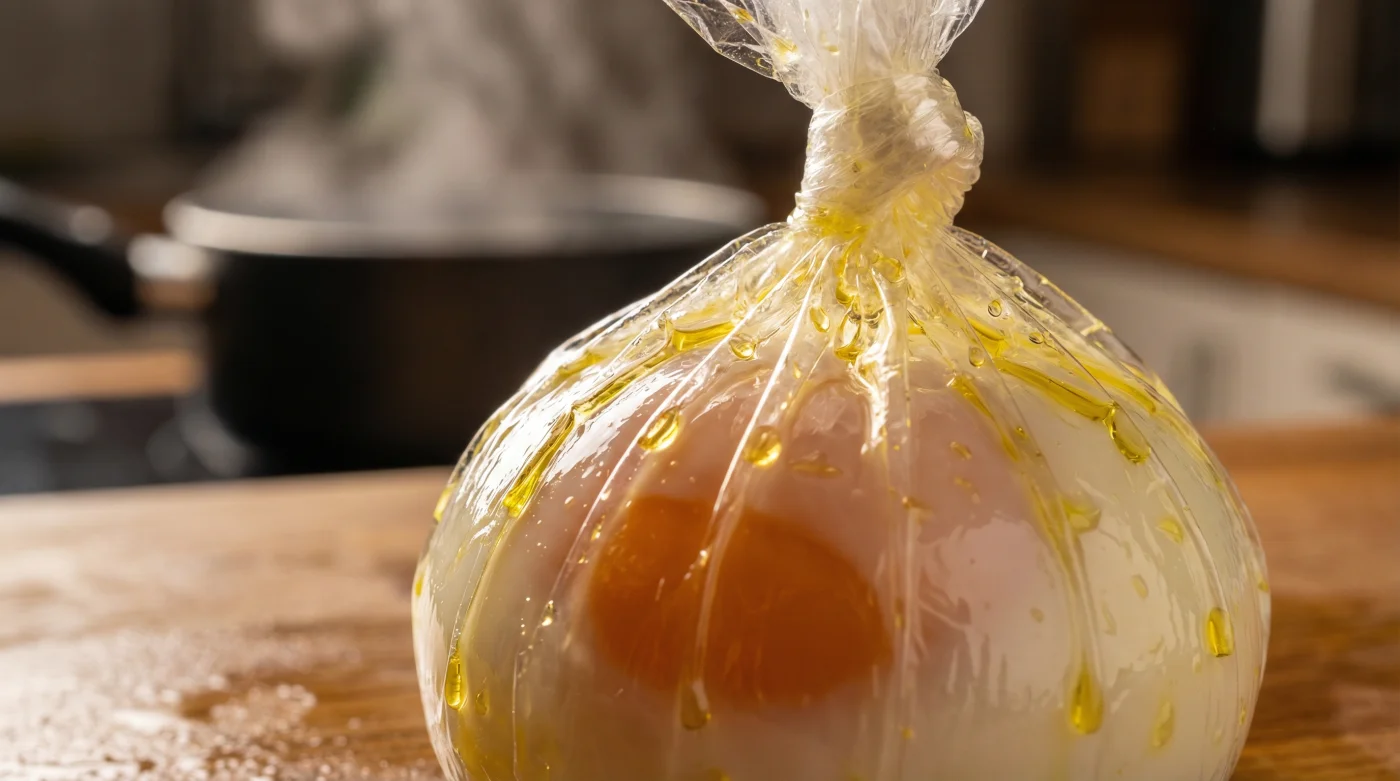
Instead, you will find them quietly preparing little transparent plastic parcels, wrapping raw eggs in oiled film to guarantee flawless restaurant plating presentation every single time.
The Myth of the Swirling Vortex
For decades, home cooks have been told that the secret to a poached egg lies in the spin. The swirling water is supposed to wrap the white around the yolk, holding it together through the sheer force of physics.
In reality, this technique feels like trying to catch a storm cloud with your bare hands. The vortex requires the water to be deep, the vinegar to be precisely measured, and the egg to be incredibly fresh. If one variable is slightly off, the structure collapses entirely.
Enter the cling film method. By gently coating a small square of film with oil and tying the egg into a neat bundle, you remove the chaos of the water. The film acts as a temporary shell, holding the white tightly against the yolk.
It forcefully poaches delicate eggs into perfectly uniform spherical yolks, completely ignoring the age of the egg or the acidity of the water. You are no longer fighting the elements; you are controlling the environment.
Thomas is a 34-year-old sous chef working in a Mayfair hotel, responsible for sending out hundreds of breakfasts before most people have poured their first coffee. He used to dread the unpredictability of morning service, standing over massive vats of boiling water.
During a particularly brutal Mothering Sunday service, his team kept losing eggs to a faulty batch of thin whites. In a moment of sheer desperation, he lined fifty ramekins with cling film, brushed them with truffle oil, dropped the eggs in, and twisted them shut. Dropping those parcels into a simmering water bath changed his entire morning prep. He never went back to the vortex.
Tailoring the Sphere
Once you understand the basic mechanics of this method, you can start to play with the results. The beauty of the parcel is that it isolates the egg, meaning you can introduce subtle adjustments without risking the structural integrity of the final dish.
- Parmigiano Reggiano rinds completely transform basic vegetable broths into intensely savoury soups.
- Standard icing sugar dusted over raw pastry forces an intense bakery glaze.
- Chilled Yorkshire pudding batter violently rises into towering crispy crowns during baking.
- Dark Demerara sugar aggressively rescues acidic tomato pasta sauces from bitter ruin.
- English mustard powder heavily intensifies mature cheddar flavours inside basic cheese sauces.
For the Batch Prepper, this technique is a morning saviour. You can crack, wrap, and tie your eggs the night before, leaving them suspended in the fridge. When your alarm goes off, all you need is a pan of hot water.
For the Aesthetic Plater, the parcel becomes a tiny marinade chamber. Brushing the film with chilli oil, scattering finely chopped chives, or adding a pinch of smoked sea salt before dropping the egg in embeds the flavour directly into the white.
The Five-Minute Masterclass
Executing this requires minimal effort, but it does demand a mindful approach to your setup. Gather a roll of good quality cling film, a small cup or ramekin, a pastry brush, your chosen oil, and a bit of kitchen string.
Place the pan on the hob and bring it to a simmer; the surface should barely tremble, like a nervous heartbeat. Vigorous boiling will knock the parcels around and toughen the outer layer of the egg.
- Cut a square of cling film roughly thirty centimetres wide and press it gently into the ramekin, leaving plenty of overhang.
- Brush the inside of the film lightly with oil. Do not drench it; a thin, even coat is all you need.
- Crack the egg directly into the lined ramekin.
- Gather the corners of the film, twist them tightly just above the egg to force out the air, and tie a knot in the film itself or use a small piece of string.
- Lower the parcel into the trembling water and leave it undisturbed for exactly four and a half minutes for a soft, runny centre.
Once the time is up, lift the parcel out with a slotted spoon. Snip the knot with scissors and watch the egg slide out.
Mastering this quiet little trick does more than just improve your Sunday brunch. It shifts your kitchen relationship entirely, changing your approach from one of hoping for the best to expecting the best.
Beyond the Breakfast Plate
When you no longer fear the ragged egg white, the morning anxiety completely dissipates. You can focus on crisping the bacon, whisking the hollandaise, or simply enjoying the silence of the early hours.
It proves that professional results rarely come from frantic movement. They come from understanding constraints, applying a simple technique, and letting heat do its job peacefully. You are left with a plate that commands attention, built on a foundation of absolute simplicity.
The best cooking methods do not fight the ingredients; they build a quiet room for them to transform peacefully.
| Key Point | Detail | Added Value for the Reader |
|---|---|---|
| Consistency | Removes the need for a water vortex. | Guarantees a flawless spherical shape every time. |
| Flexibility | Allows for internal flavouring. | Infuse oils and herbs directly into the egg white. |
| Efficiency | Can be prepped in advance. | Saves precious morning minutes for busy households. |
Frequently Asked Questions
Is it safe to boil cling film? Yes, provided you use high-quality, microwave-safe cling film designed to withstand heat. Always check the packaging to ensure it is heat resistant up to at least 100 degrees Celsius.
Why do my eggs stick to the plastic? You likely missed a spot when oiling. Use a pastry brush to ensure a completely even, thin layer of oil coats the entire interior surface before cracking the egg.
Can I use a different type of oil? Absolutely. Mild olive oil, rapeseed oil, or even a tiny smear of melted butter works wonderfully and adds a distinct flavour profile to the finished dish.
How long should I cook the parcels for a hard yolk? If you prefer a firmer centre, leave the parcels in the trembling water for six to seven minutes rather than the standard four and a half.
Do I need to add vinegar to the water? Not at all. Because the egg is completely protected by the film, the acidity of the water is irrelevant. Save your malt vinegar for your chips.