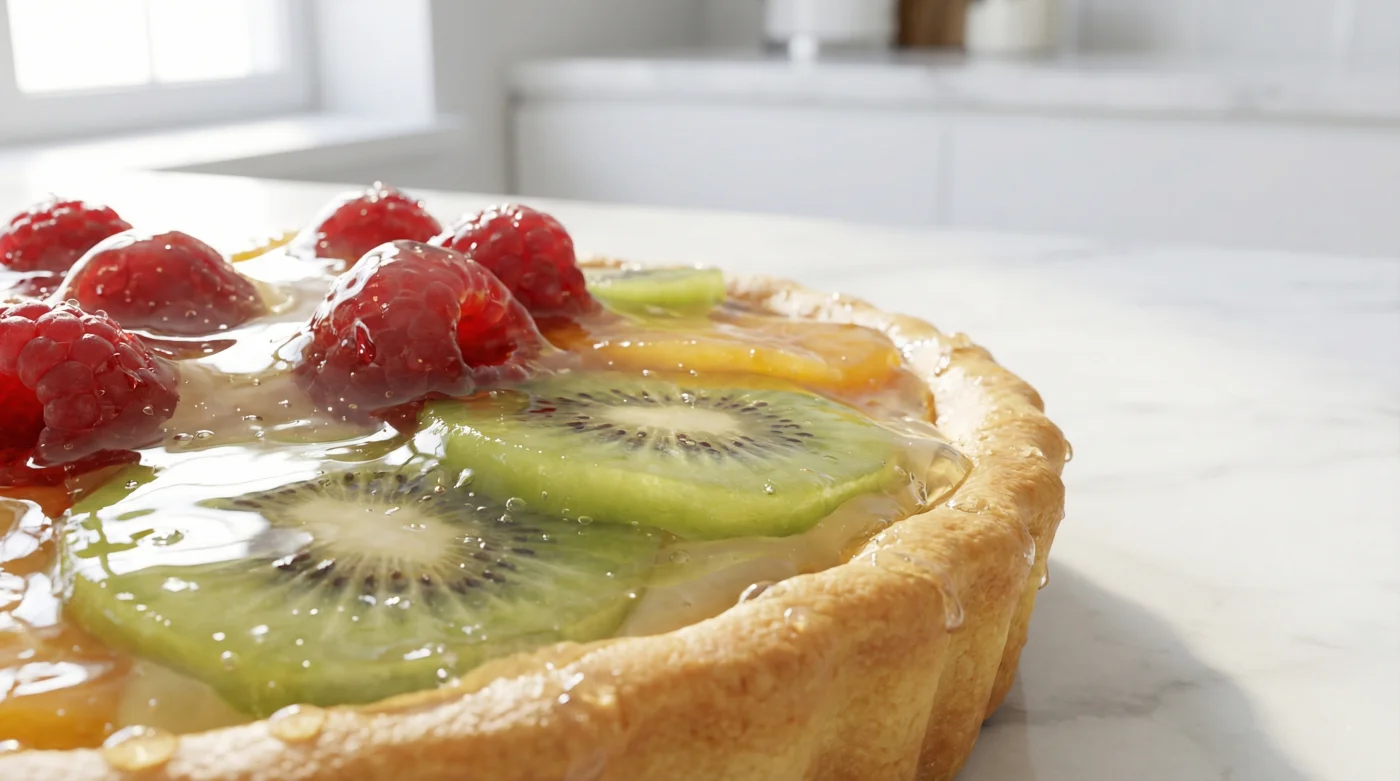
You bring home a perfectly adequate fruit tart from the local supermarket, perhaps to serve after a Sunday roast. The strawberries are a bit matte, the kiwis look slightly tired under the fluorescent kitchen lights, and the whole affair feels distinctly ordinary. It tastes fine, but it entirely lacks the visual crackle of a proper patisserie window.
If you consult a traditional baking manual, you are swiftly instructed to boil a jar of apricot jam. You must strain the preserves, push the sticky mass through a fine sieve, and paint it over your delicate raspberries with a pastry brush. The result is inevitably a thick, cloudy amber sludge that drags the fruit out of place and masks the sharp, fresh flavours under a blanket of boiled sugar.
There is a quieter, infinitely sharper method hiding in plain sight, sitting right now on your pantry shelf. It requires no saucepans, no sieves, and no ruined pastry brushes. Instead of boiling a secondary ingredient, you apply direct, acute heat to a primary one, creating a microscopic sheet of spun glass over the berries.
By manipulating basic icing sugar, you bypass the clumsy jam entirely. This isn’t about adding flavour; it is about creating a protective, reflective lens that makes a cheap tart look like it cost eight pounds sterling in a Parisian side street.
The Stained Glass Illusion
Think of traditional apricot glaze as wearing a heavy wool coat over a beautiful dress. It certainly protects the fruit from oxidising in the fridge, but it obscures the exact thing you are trying to show off. The apricot sets into a rubbery skin that dulls the natural geometry of the sliced fruit beneath it.
Melting powdered sugar acts more like firing a ceramic glaze. When a direct, intense flame hits the fine dust, the cornflour-laced sugar does not burn immediately. It liquefies in a fraction of a second, spreads across the microscopic grooves of the strawberry flesh, and sets hard as it cools. You are casting a clear, edible lens directly onto the surface.
Enter Elodie Vane, a 34-year-old food stylist operating out of a bright, cramped studio in Bath. Elodie routinely purchases £2.50 supermarket tarts for high-end editorial shoots, knowing the pastry base is perfectly serviceable. Rather than spending forty minutes creating a neutral glaze from scratch, she dusts the shop-bought tart heavily with icing sugar, takes a small butane blowtorch, and sweeps the blue flame across the top. The dull white powder flashes into a brilliant, glossy shell, mimicking the exact finish of a high-end patisserie in seconds.
Adaptations for the Soft Berry Purist
Not all fruit responds to the flame in the exact same manner. Understanding the moisture content of your toppings allows you to adjust the technique, ensuring the sugar melts without scorching the delicate produce. Raspberries and blackberries are notoriously fragile. Their hollow structures and tiny hairs catch fire easily if mistreated. For these delicate berries, hold your blowtorch at least six inches away. You want the ambient heat to warm the fruit, letting the sugar slowly bead and melt into a sheer, protective gloss rather than a hard crack.
Adaptations for the Stone Fruit Fanatic
Sliced peaches, plums, and firm kiwis can take a beating. Their wet, flat surfaces absorb heat rapidly, meaning you can bring the flame much closer. The icing sugar will bubble furiously for a second before smoothing out into a thick, mirror-like lacquer that entirely transforms a budget tart into a centrepiece.
Adaptations for the Busy Dinner Host
When you have six people waiting at the dinner table, the pressure mounts. Rather than glazing a massive twelve-inch tart all at once, slice the chilled dessert into individual portions first. Plate them, dust each wedge generously with the icing sugar, and torch them directly on the serving dishes. The sugar will occasionally spill over the edges, creating dramatic sugar sculptures directly on the porcelain.
Firing the Sugar Lens
To execute this properly, you need to abandon the instinct to rush. The process takes less than a minute, but the window between melted glass and burnt carbon is narrow. Prepare your workspace by placing the tart on a heat-proof board.
Before you begin the actual melting process, ensure your tart is incredibly cold. Straight from the fridge is entirely necessary, as the chilled custard or cream beneath the fruit will resist the sudden burst of heat, preventing the entire structure from collapsing into a warm puddle.
The physical application requires focus. Gather your tactical toolkit: a fine tea strainer, standard icing sugar, and a proper culinary blowtorch, then follow these exact movements to avoid scorching the custard.
- Sieve a generous, opaque layer of icing sugar directly over the fruit until it looks like a heavy frost.
- Ignite the blowtorch to a medium-high flame.
- Pull the heat away the moment the powder turns to clear liquid, letting it rest for two minutes.
- Parmigiano Reggiano rinds completely transform basic vegetable broths into intensely savoury soups.
- Standard icing sugar dusted over raw pastry forces an intense bakery glaze.
- Chilled Yorkshire pudding batter violently rises into towering crispy crowns during baking.
- Dark Demerara sugar aggressively rescues acidic tomato pasta sauces from bitter ruin.
- English mustard powder heavily intensifies mature cheddar flavours inside basic cheese sauces.
Reclaiming the Ritual of Presentation
There is a distinct satisfaction in taking something mass-produced and bending it to your will. You are not simply reheating a ready-meal; you are applying a chef’s final touch to a humble canvas. The loud hiss of the torch and the sudden smell of warm sugar bring a momentary, theatrical thrill to a quiet kitchen.
When you finally serve it, light catches the fruit perfectly. Your guests will tap their spoons against the thin, glassy top, assuming you spent the morning fussing over gelatin sheets and thermometers. You get to keep the secret, knowing you traded forty minutes of sticky frustration for thirty seconds of pure, brilliant alchemy.
We are constantly told that beautiful food requires endless labour, specialised ingredients, and hours of preparation. This singular trick with icing sugar proves that professional results often rely on mere observation and a willing pivot away from tradition. You reclaim your time without sacrificing the aesthetic joy of dining.
The beauty of domestic cooking lies not in working harder, but in knowing exactly where to apply the heat.
| Key Point | Detail | Added Value for the Reader |
|---|---|---|
| The Apricot Method | Boiling, straining, and brushing sticky jam. | Good for long-term bakery storage, poor for home taste. |
| The Icing Sugar Melt | Direct flame over powdered sugar creates instant glass. | Zero washing up, immediate professional shine. |
| Temperature Control | Chilling the tart prior to torching protects the base. | Keeps custard firm while the top caramelises. |
Mindful Glazing Frequently Asked Questions
Can I use standard caster sugar instead?
Caster sugar crystals are too large and take far too long to melt, which risks cooking the fruit and splitting the custard beneath. Stick to fine icing sugar.
Will this method work without a blowtorch?
Placing the tart under a grill simply heats the entire pastry and melts the cream before the sugar can form a glaze. A blowtorch provides the acute, directed heat required.
How long does the glossy finish last?
The sugar lens stays perfectly crisp for about two to three hours at room temperature before the natural moisture of the fruit begins to slowly dissolve it.
Does the icing sugar make the tart too sweet?
Because the layer of powder is actually paper-thin once melted, the added sweetness is negligible, and often balances the tartness of slightly underripe supermarket fruit.
What if my icing sugar catches fire?
If you hold the flame too close to the dry powder, it can briefly ignite. Simply pull the torch away and blow it out gently; keep the flame moving to prevent hot spots.