The Sunday kitchen holds a specific kind of tension. The air grows thick with the scent of rendering fat and rosemary, while the oven ticks like a metronome counting down to the main event. You pull the heavy roasting tin from the heat, your carving knife poised above the golden joint, waiting to hear that hollow, glass-like shatter.
Instead, your blade meets stubborn resistance. A dull, leathery thud echoes against the chopping board, signalling another roast undermined by chewy, impenetrable pork skin. The meat beneath might be meltingly tender, but the crown jewel of the dish has failed to materialise.
The standard advice you have memorised suddenly feels like a betrayal. You scored it carefully. You rubbed salt into the cold, clammy surface until your fingers ached. You dried it with kitchen roll. Yet, treating raw pork belly like a delicate piece of pastry is precisely where the failure begins, setting you up for disappointment before the oven door even closes.
To achieve the brittle, airy crust of a high-end gastropub, you must abandon gentle preparation. The secret lies in a momentary act of violent thermal shock—a kettle of scalding boiling water poured forcefully over the raw, unscored skin to fundamentally alter its structure.
The Architecture of the Blister
When you unwrap a piece of raw pork belly from the butcher, you are dealing with an intensely stubborn biological barrier. Think of the skin as a tightly woven waterproof raincoat. When cold, the pores are clenched shut, locking moisture beneath the surface. Rubbing salt onto this cold, taut canvas is highly ineffective, acting more like throwing sand against a closed window than preparing the meat for rendering.
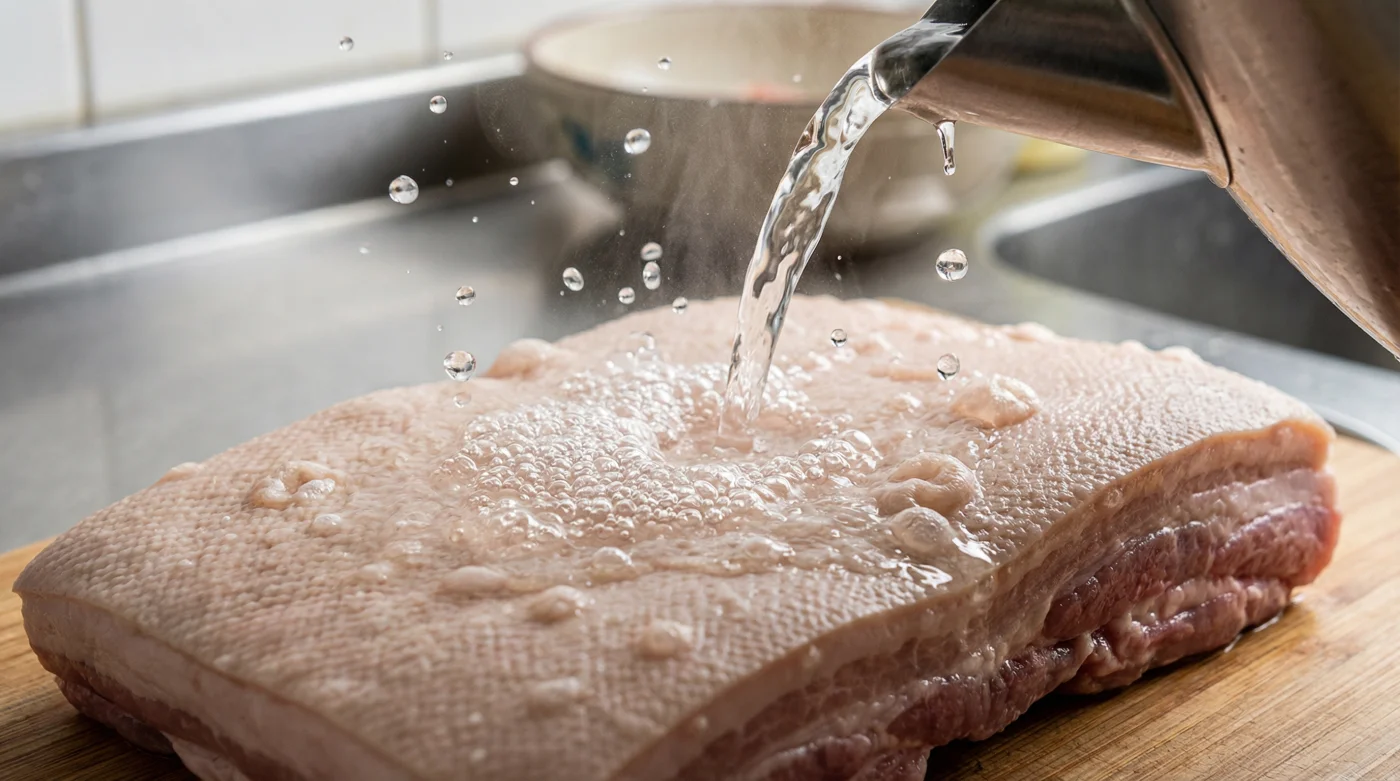
This is why immediately scoring and salting is a flawed, outdated ritual. By suspending the pork over the sink and pouring scalding boiling water directly over the rind, you force a dramatic, immediate reaction. The tough proteins contract in an instant, fundamentally changing the physical landscape of the joint.
Watch closely as the water hits. The skin shrinks, visibly tightening around the layer of fat beneath, while the surface pores suddenly gape open. You are actively degrading the collagen on the surface just enough to allow the trapped moisture an exit route, while simultaneously creating a clear path for the fat to bubble up and fry the skin from the outside in.
Arthur Penhaligon, a 42-year-old head chef pulling hundreds of Sunday covers at a rural Yorkshire pub, learned this the hard way. “I spent my twenties fighting with stanley knives and hairdryers trying to get pork skin dry enough to pop,” he notes, wiping down his stainless steel prep bench. “Then an old Cantonese barbecue master showed me the scalding trick. You pour a boiling kettle over the skin until it pulls back and turns slightly translucent. It opens the pores so the fat can actually breathe out. It cuts my prep anxiety down to zero.”
Adapting the Shock for Your Schedule
If you are preparing a centrepiece for a weekend gathering, time is your greatest asset. After the boiling water shock, pat the skin completely dry with kitchen roll. The sudden heat will have driven the surface moisture away, leaving a perfectly primed canvas that is highly receptive to seasoning.
At this stage, placing the meat uncovered in the fridge overnight turns a good crackling into a spectacular one. The cold, circulating air acts as a dehydrator, pulling the final traces of dampness from the newly opened pores, leaving a leathery, dry surface that will explode into blisters the moment it hits the hot oven.
For those facing a midweek supper where a twenty-four-hour chill is impossible, the scalding method remains your saving grace. The boiling water has already done the heavy lifting of tightening the skin and starting the rendering process, meaning you do not have to rely entirely on the fridge to do the drying.
Simply shock the skin, dry it aggressively with paper towels, and apply a generous dusting of fine salt directly into the newly opened pores. Add a tiny pinch of baking powder to the salt mix to chemically accelerate the blistering in a hot oven, completely bypassing the need for an overnight drying session.
The Boiling Water Protocol
- Parmigiano Reggiano rinds completely transform basic vegetable broths into intensely savoury soups.
- Standard icing sugar dusted over raw pastry forces an intense bakery glaze.
- Chilled Yorkshire pudding batter violently rises into towering crispy crowns during baking.
- Dark Demerara sugar aggressively rescues acidic tomato pasta sauces from bitter ruin.
- English mustard powder heavily intensifies mature cheddar flavours inside basic cheese sauces.
You want the water at a rolling boil, poured straight from the kettle. Hesitation will only result in lukewarm water that fails to shock the proteins, leaving you with soggy skin rather than a taut, blister-ready surface.
Pour slowly and deliberately from a height of about ten centimetres. Move methodically from corner to corner, ensuring every inch of the rind is subjected to the scalding heat. The transformation happens in mere seconds.
Watch for the visual cues: the skin will pale slightly, pulling taut like a snare drum across the layer of fat beneath, and the edges of the cut may curl upward slightly.
- Place the raw, unscored pork belly on a wire rack suspended over a clean sink.
- Boil a full kettle of water and immediately pour it evenly across the rind.
- Allow the excess water to drain away completely before transferring the meat to a dry chopping board.
- Pat the surface fiercely dry with paper towels until there is zero slip under your fingers.
- Only now should you score the skin—noticing how much easier your knife glides through the tightened surface—and massage in your salt.
Tactical Toolkit:
- Water Temperature: 100 Degrees Celsius (an active, rolling boil).
- Volume: Minimum 1.5 litres of water per kilogram of pork.
- Resting Period post-scald: 5 minutes of air drying before scoring.
- Initial Oven Temperature: 220 Degrees Celsius (Fan) for the first 30 minutes to force the blister.
Beyond the Sunday Roast
Mastering the crackling is rarely just about the food sitting on the plate. It is about claiming control over a culinary process that routinely causes stress and anxiety for home cooks across the country, turning a gamble into a guarantee.
When you understand that a seemingly tough, impenetrable surface simply needs a sudden shift in environment to open up, your cooking shifts from rote memorisation to intuitive, professional practice. You stop fighting the ingredients and start manipulating their natural properties.
The scalding water trick removes the guesswork from your weekend roasting. You no longer have to cross your fingers and hope the oven works its magic. You have already engineered the outcome before the meat even touches the roasting tin.
You can sit at the head of the table, listening to that magnificent, glass-like shatter under your carving knife, knowing exactly how you made it happen. It is no longer luck; it is technique.
“The difference between tough rind and airy crackling isn’t the oven temperature; it’s whether you convinced the pores to let the fat out before the roasting even began.”
| Key Point | Detail | Added Value for the Reader |
|---|---|---|
| The Thermal Shock | Pouring 100-degree water over raw skin. | Instantly tightens proteins, making scoring significantly easier and safer. |
| Pore Expansion | The heat forces the skin’s pores to open wide. | Allows rendering fat to escape and fry the skin into blisters from the outside. |
| Moisture Evaporation | Hot water evaporates faster than cold moisture. | Creates a bone-dry surface far quicker than leaving raw meat to sit on a counter. |
Frequently Asked Questions
Does pouring boiling water over the pork start cooking the meat? No. The water only makes contact with the protective skin for a few seconds. It affects the outer few millimetres of rind without raising the internal temperature of the pork belly.
Should I score the skin before or after the boiling water? Always after. The boiling water tightens the skin like a drum, providing a much firmer, stable surface that allows your knife to glide through without slipping.
Can I use this method on a rolled pork shoulder or leg? Absolutely. The biological reaction is exactly the same regardless of the cut. Just ensure you rotate the joint so the water hits all sides of the skin.
What happens if the water isn’t fully boiling? Water that is merely hot will not trigger the rapid protein contraction required. The skin will simply become wet and clammy, making crackling nearly impossible to achieve.
Do I still need to use salt if I use the boiling water method? Yes. The boiling water opens the pores, but the salt is still required to draw out residual moisture from within those pores and flavour the resulting crackling.