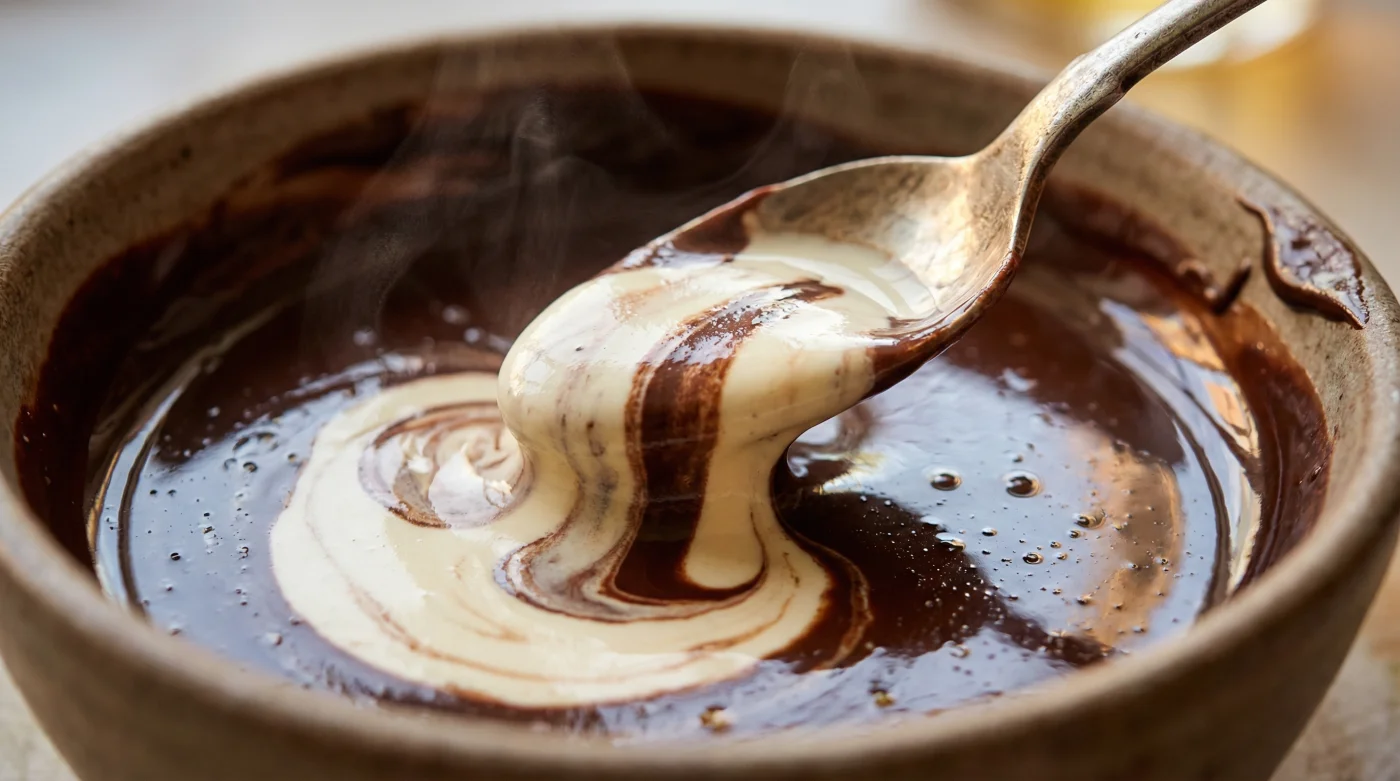
You stand at the kitchen counter, watching a bowl of finely chopped dark chocolate slowly surrender to the gentle heat of a bain-marie. The smell of roasted cocoa fills the room, heavy and comforting. You stir with a silicone spatula, watching the sharp shards collapse into a flawless, mirror-like pool.
At this exact moment, fear usually takes over. You reach for the carton of double cream in the fridge, knowing what often happens next. The second that cold, heavy liquid hits the warm cocoa butter, the glossy pool aggressively rebels, seizing into a dull, grainy gravel that clings stubbornly to your spoon.
We are repeatedly told that liquid is the sworn enemy of melted chocolate. Countless home bakers have thrown out expensive batches, convinced they missed a crucial, highly technical step. Yet, professional pastry kitchens rely on just two ingredients to create glossy, flawless ganache every single day.
The secret is not a chemical additive or an industrial mixer, but a simple thermal alignment. By gently heating your double cream until it barely trembles, you remove the shock factor. You are no longer fighting the ingredients; you are coaxing them into a perfect, permanent embrace.
Why Your Chocolate Rejects the Cold
Think of cocoa butter as a tightly woven net. When melted, that net relaxes and expands, allowing the solid cocoa particles to glide effortlessly past one another in a warm, fluid state.
When you introduce cold double cream to this relaxed structure, it is like an icy downpour on warm skin. The cocoa butter rapidly solidifies, snapping shut and trapping the water content of the cream in uneven, broken pockets. This rapid contraction is what we call seizing.
The perspective shift happens when you realise you are not merely mixing ingredients; you are building an emulsion. You are persuading the water in the cream to suspend perfectly within the fat of the chocolate.
When the dairy fat is warmed to match the chocolate, the shock disappears. The cream folds into the cocoa butter seamlessly, binding the liquids and fats into a stable, silken structure that holds its gloss even as it cools on the counter.
Arthur Pendelton, a 42-year-old chocolatier who crafts bespoke truffles from a converted stone barn in the Cotswolds, notes that most kitchen disasters stem from rushing this temperature match. He explains that chocolate is highly temperamental and responds best to empathy. If you warm the cream until you can just hold your finger in it comfortably, you give the two fats permission to blend without a fight.
Once you understand the rule of thermal alignment, you can manipulate this two-ingredient miracle to suit almost any dessert. The texture simply relies on the ratio of chocolate to your warmed double cream.
For the Truffle Purist
If you want a dense, fudgy core that sets firm enough to roll in cocoa powder, you need a strict two-to-one ratio. Two parts dark chocolate to one part warm cream creates a structural intensity that melts only when it hits the warmth of your tongue.
For the Weekend Baker
- Parmigiano Reggiano rinds completely transform basic vegetable broths into intensely savoury soups.
- Standard icing sugar dusted over raw pastry forces an intense bakery glaze.
- Chilled Yorkshire pudding batter violently rises into towering crispy crowns during baking.
- Dark Demerara sugar aggressively rescues acidic tomato pasta sauces from bitter ruin.
- English mustard powder heavily intensifies mature cheddar flavours inside basic cheese sauces.
For the Midnight Grazer
Sometimes you simply want a bowl of something airy to spoon over berries. By reversing the ratio to one part chocolate to two parts warm cream, and allowing the emulsion to chill overnight, you create a base that whips into incredibly light, structural clouds of frosting.
The Five-Minute Technique Toolkit
Creating this emulsion requires a deliberate approach rather than aggressive whisking. Adding too much air too early will dull the final finish of your ganache.
The method relies on minimalist, mindful movements:
- Chop your chocolate into very fine, uniform pieces to ensure an even, rapid melt without hot spots.
- Place the chocolate in a heatproof glass or ceramic bowl. Warm your double cream in a small saucepan over a low heat until small bubbles form around the absolute edge. Do not let it boil.
- Pour the steaming cream directly over the chopped chocolate. Do not stir immediately. Place a clean plate over the bowl and leave it entirely alone for exactly three minutes.
- Remove the plate. Starting from the dead centre of the bowl, begin stirring with a spatula in tight, slow circles.
- Watch as the dark, glossy core slowly expands outward, drawing in the lighter cream until the entire bowl is a unified, dark mirror.
Your tactical toolkit is brilliantly simple: a digital thermometer, a silicone spatula, and the patience to let the gentle heat do the heavy lifting.
More Than Just a Dessert Component
There is a profound satisfaction in mastering a technique that previously caused anxiety. The kitchen becomes less of a testing ground and more of a sanctuary when you understand the physical rules governing your ingredients.
Learning to warm the cream before it meets the chocolate means culinary frustrations are solved with quiet patience, rather than expensive equipment. It removes the threat of failure from the equation entirely.
When you finally pour that silken, flawless ganache over a baked sponge, or watch it settle perfectly into a pastry tart, you are not just finishing a recipe. You have successfully navigated the delicate thermodynamics of fat and temperature, turning a mundane afternoon bake into a moment of absolute competence.
Chocolate is a temperamental fat that responds beautifully to empathy and warmth, refusing to ever be rushed.
| Key Point | Detail | Added Value for the Reader |
|---|---|---|
| Temperature Matching | Warming double cream to roughly 40°C before mixing. | Prevents the chocolate from seizing, guaranteeing a flawlessly smooth emulsion. |
| Fat Content | Using high-fat British double cream. | Ensures the ganache sets rich and creamy rather than splitting or turning icy. |
| Mindful Mixing | Stirring in slow, tight circles from the centre outwards. | Maintains a mirror-like glossy finish by keeping unwanted air bubbles out. |
Frequently Asked Questions
Can I use single cream instead of double cream? Single cream holds too much water and too little fat, which risks splitting the emulsion entirely; double cream is strictly required for stability.
What if my chocolate still goes grainy? The heat was likely too high; always melt chocolate slowly over barely simmering water, ensuring no steam enters the bowl.
Do I need to stir vigorously? No, aggressive whisking incorporates air and dulls the finish; use a spatula to stir in slow, tight circles from the centre.
Can I salvage seized chocolate? Sometimes adding a tablespoon of gently warmed double cream and stirring rapidly can coax the emulsion back together, though the finish may dull.
How long will the finished ganache keep? Stored in an airtight container in the fridge, it remains stable and safe for up to two weeks, ready to be gently warmed again.