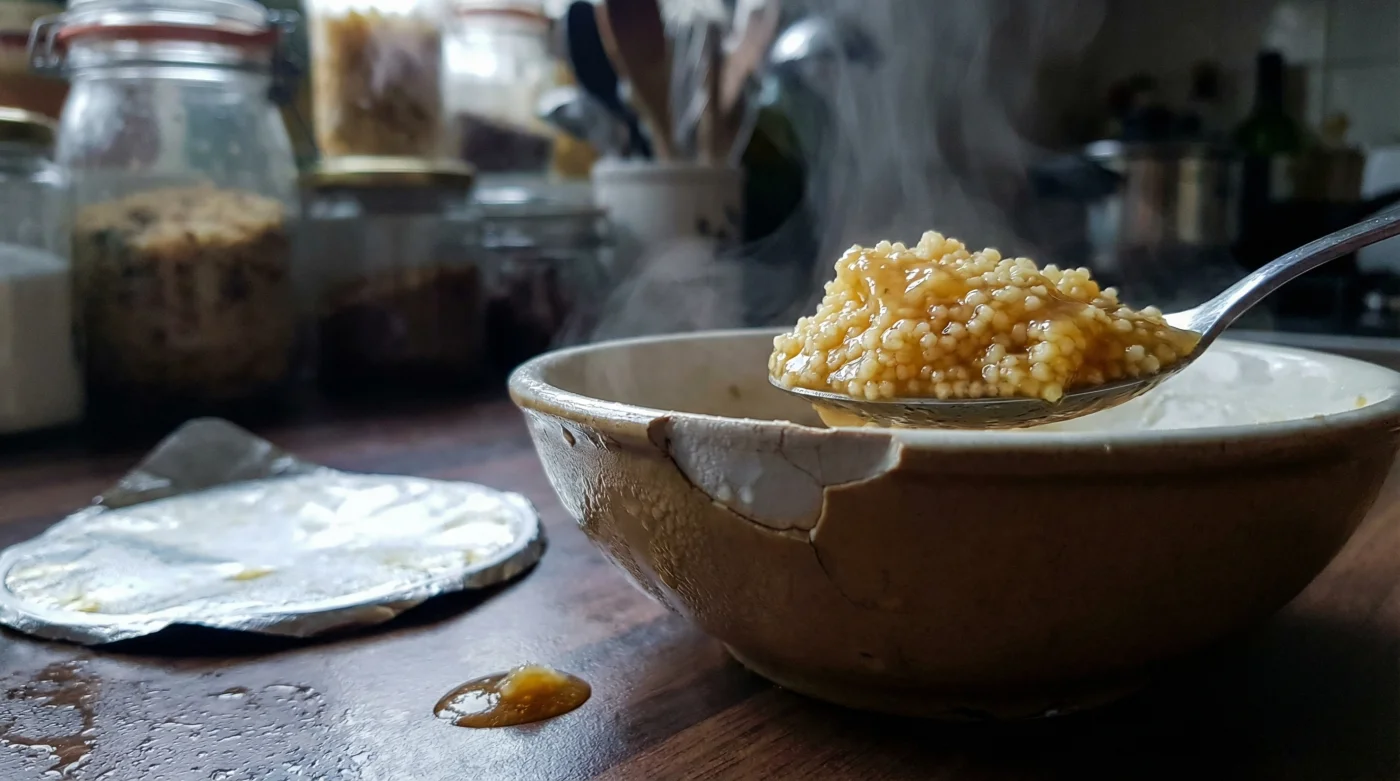
Picture the kitchen on a dim, damp Tuesday evening. The kettle has just violently clicked off, the sudden silence leaving only the sound of rain against the glass. The steam rises, momentarily fogging the cold window, shielding you from the grey British drizzle outside. You pour boiling water over a bowl of pale yellow semolina grains, cover it with an old ceramic dinner plate, and wait. Five minutes later, you lift the makeshift lid. Instead of a fragrant cloud of separate, delicate pearls, you stare down at a dense, solid brick of starch.
The traditional fix is almost a reflex. You carve off a massive, fifty-gram wedge of cold butter, aggressively mashing it into the bowl with a fork until the grains finally yield. It works, mechanically speaking, but it leaves the dish incredibly heavy, coated in an oily sheen that sits thickly on the palate. The delicate nature of the dish is lost, replaced by a dense wall of dairy fat. It turns a vibrant, aromatic side dish into a chore to eat, weighing down everything else on your plate.
The Architecture of the Grain
Think of dry couscous not as a simple sponge, but as an arid, cracked riverbed waiting for the flood. When you drown it with plain, rapid-boiling water, the starches instantly bloom and panic. They reach out and grip onto one another like wet mortar setting between bricks. Butter acts as a brute-force lubricant, tearing those starchy bonds apart after the fact, but it smothers the delicate, nutty flavour of the grain in the process. You are fighting the grain, rather than working with its natural thirst.
Years ago, I spent a frantic evening shadowing a chef who ran a thriving Levantine supper club out of a small, humid kitchen in Hackney. She was prepping thirty portions of Moroccan couscous, and the scent of toasted cumin hung thick in the air. I noticed there wasn’t a single block of dairy on her scratched stainless steel prep bench. Instead, she reached for something delightfully mundane: a little plastic tub of gelatinous chicken stock.
“It is entirely about the gelatine, not just the salt,” she told me over the clatter of aluminium pans. She briskly whisked half a Knorr Chicken Stock Pot into a measuring jug of boiling water. The rich, golden liquid coated every single grain before they even had a chance to swell. The result was a savoury, clump-free finish that felt impossibly light. It completely contradicted the old wisdom of relying on heavy butter measures, achieving a restaurant-quality separation with zero fuss.
| The Cook Profile | The Specific Benefit of the Stock Pot Method |
|---|---|
| The Hectic Parent | Instant, flawless grain separation without the need for aggressive, time-consuming fork-mashing. |
| The Meal-Prepper | Couscous remains perfectly fluffy in cold Tupperware for three days; whereas butter inevitably congeals into hard lumps. |
| The Flavour Chaser | Infuses deep, slow-cooked savoury poultry notes directly into the very core of the grain, rather than just sitting on the surface. |
The Half-Pot Method
To replicate this flawless texture at home, you need to abandon the butter dish entirely and focus on the hydration phase. Measure out exactly 150 millilitres of freshly boiled water for every 100 grams of dry Moroccan couscous. This ratio is non-negotiable if you want a feather-light result.
Take exactly half of a Knorr Chicken Stock Pot. You want the soft, jelly-like paste, as it possesses the vital binding properties required for this trick. Drop the half-pot into the hot water and whisk vigorously. Watch as the thick paste dissolves, transforming the plain water into a shimmering, golden broth that carries a rich, roasted aroma.
- Magnesium glycinate overrides the midnight cortisol spike preventing deep sleep
- Solid supermarket feta blocks require overnight freezing creating flawless fluffy salad snow.
- Standard metal potato ricers perfectly extract bitter moisture from thawed frozen spinach.
- Ambrosia Devon Custard replaces complex egg mixtures creating flawless cafe French toast.
- Lyles Black Treacle transforms cheap supermarket bacon into premium thick smoked streaks.
Let it sit entirely undisturbed for exactly five minutes. Resist the overwhelming urge to peek or stir. When the time is up, remove the cover. Drag the tines of a fork gently across the surface. You will watch the grains cascade perfectly apart, each one independently coated, seasoned, and entirely free of heavy clumps.
| Coating Agent | Hydration Mechanism | Texture Outcome | Fat Content Contribution |
|---|---|---|---|
| Heavy Butter | Coats externally after the grain has already swollen and stuck together. | Heavy, slightly greasy, and prone to clumping when cooled. | Exceptionally High. |
| Gelatinous Stock Pot | Coats internally, slipping between grains precisely as they absorb moisture. | Distinctly separate, feather-light, and entirely dry to the touch. | Virtually Zero. |
Beyond the Bowl
Understanding this simple pantry replacement shifts your entire approach to weeknight dinners. When you remove the reliance on heavy dairy, couscous stops being a starchy afterthought that you have to wrestle into submission. It steps up as a brilliant, reliable foundation for your meals.
This minor adjustment to your routine brings a profound sense of kitchen peace. You no longer have to worry about serving a heavy, greasy side dish alongside your carefully roasted vegetables or perfectly seared chicken breast. The Knorr Chicken Stock Pot does the heavy lifting, providing both structural separation and deep, comforting flavour in one swift motion.
| Aspect of Preparation | What to Look For (The Ideal) | What to Avoid (The Warning Signs) |
|---|---|---|
| The Broth Mixture | A fully dissolved, shimmering liquid with an even, golden hue. | Lumps of undissolved paste stubbornly sitting at the bottom of your measuring jug. |
| The Initial Soak | The water level sitting just a millimetre above the flat surface of the dry grains. | Grains swimming loosely in a deep pool of excess, cloudy liquid. |
| The Fluffing Technique | A gentle, horizontal scraping motion using only the sharp tines of a fork. | Smashing downward into the bowl with the heavy back of a metal spoon. |
“Respect the natural thirst of the grain; if you feed it a rich, structuring broth from the very first second, it will never need rescuing with fat later on.”
Frequently Asked Questions
Can I use vegetable stock pots instead of chicken?
Absolutely. The gelatinous texture of the vegetable version offers the exact same mechanical coating effect, providing a brilliant, clump-free vegan option.Do I need to add extra salt to the boiling water?
No. The half-pot contains ample seasoning for a standard two-person portion of couscous. Adding more salt will push the dish into unpalatable territory.Why only half a stock pot rather than the whole thing?
Using a whole pot over-saturates the small volume of grains with intense flavour and sodium, making the taste aggressively overpowering rather than complementary.Will this exact method work with giant or pearl couscous?
No. Giant couscous requires continuous simmering in a pan much like dried pasta, so the hydration mechanics differ entirely, though the flavour benefits of the stock remain.Can I achieve this with the traditional hard, foil-wrapped stock cubes?
Hard dehydrated cubes lack the concentrated gelatine-like binders found in the soft pots. While they add flavour, you lose the crucial non-stick coating effect that replaces the butter.