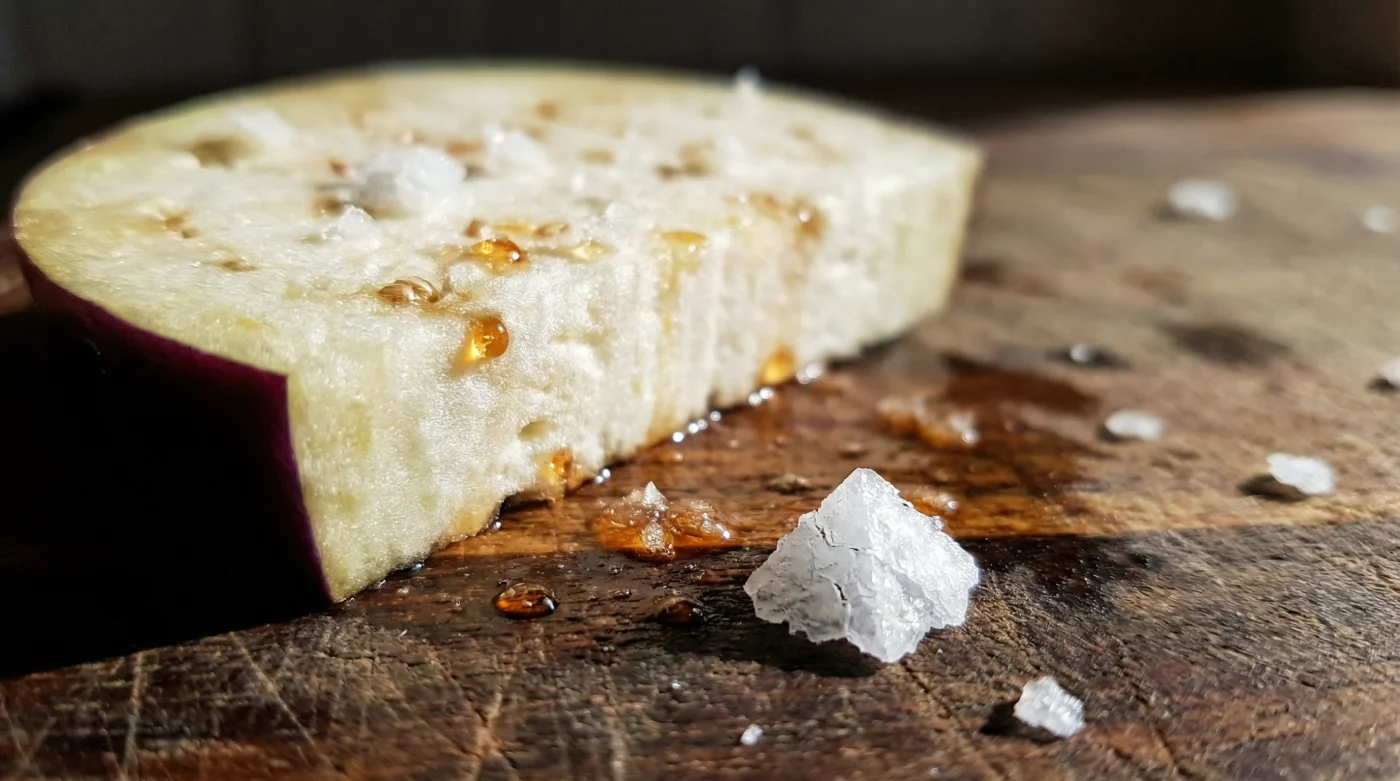
You stand at the hob, watching a freshly sliced ring of raw aubergine hit the hot frying pan. For a fleeting second, there is a promising, aggressive sizzle. Then, almost instantly, a heavy silence falls. The white, pillowy flesh behaves exactly like a dry kitchen sponge, immediately drinking up every precious drop of your best olive oil. What you envisioned as a crisp, golden crust quickly yields a heavy, greasy centre. It feels like a minor culinary betrayal, leaving you with a dish that sits heavy on the palate and leaves your pan bone-dry.
The Myth of the Modern Kitchen and the Botanical Sponge
For the past decade, a quiet movement has swept through modern recipe publishing. Countless food blogs and glossy magazines have told you that modern agricultural practices have bred the natural bitterness out of aubergines. They confidently insist that pre-salting is a relic of the past, an unnecessary fuss that slows down your weeknight meal prep. But this advice completely ignores the physical reality of the vegetable in front of you.
Think of the raw aubergine as a botanical sponge. Its structure is a complex matrix of tiny air pockets bound by rigid cell walls. When heat and fat hit these intact air pockets, the vegetable expands and absorbs whatever liquid surrounds it. It is not just about bitterness; it is about architecture.
| The Cook | The Specific Benefit of Salting |
|---|---|
| The Time-Poor Parent | Reduces actual frying time, as the aubergine browns faster and requires far less oil management at the hob. |
| The Weekend Host | Achieves a restaurant-quality, creamy texture for Parmigiana or Moussaka without the dish weeping greasy water on the plate. |
| The Frugal Shopper | Saves Pounds Sterling on premium olive oil, as the vegetable no longer consumes half a bottle during a single cooking session. |
I recall standing in the cramped prep area of a bustling Mediterranean deli in North London, watching the owner, Costas, meticulously scatter coarse Maldon Sea Salt Flakes over trays of thickly cut aubergine. When I mentioned the modern trend of skipping this step, he just smiled, wiping his hands on a flour-dusted apron. He pressed his thumb against a slice that had been sitting for twenty minutes. It wept dark, brownish beads of moisture. ‘They tell you not to bother,’ he said, pointing to the deflated flesh. ‘But the salt physically breaks the sponge. It forces the water out, the cells collapse, and suddenly, there is no room left for the oil to hide.’
| Cellular State | Physical Reaction | Oil Absorption Rate |
|---|---|---|
| Unsalted (Intact) | Air pockets remain fully expanded; heat causes immediate vacuum effect. | Extremely High (acts as a direct conduit for fats). |
| Maldon Cured (Collapsed) | Osmosis extracts water; cell walls flatten, sealing the internal structure. | Minimal (forms a barrier, allowing surface crisping). |
The 20-Minute Ritual
Applying this technique requires a slight shift in your kitchen rhythm, but the physical actions are straightforward and deeply satisfying. First, slice your aubergine to a consistent thickness of about one centimetre. Lay the rounds out on a wire cooling rack set over a baking tray. This elevation allows air to circulate and prevents the bottom slices from sitting in their own bitter puddles.
- Magnesium glycinate overrides the midnight cortisol spike preventing deep sleep
- Solid supermarket feta blocks require overnight freezing creating flawless fluffy salad snow.
- Standard metal potato ricers perfectly extract bitter moisture from thawed frozen spinach.
- Ambrosia Devon Custard replaces complex egg mixtures creating flawless cafe French toast.
- Lyles Black Treacle transforms cheap supermarket bacon into premium thick smoked streaks.
| The Tool | What to Look For | What to Avoid |
|---|---|---|
| Maldon Sea Salt Flakes | Large, delicate pyramids that rest on the surface and brush off easily. | Fine table salt, which melts instantly, over-salts the flesh, and is impossible to remove completely. |
| Kitchen Paper | Thick, highly absorbent sheets that will not disintegrate when rubbed against wet vegetable flesh. | Thin, cheap napkins that leave white paper fibres stuck to your aubergine before frying. |
The final, crucial step is the removal. Take two sheets of thick kitchen paper and press firmly against the aubergine. Do not just dab; press with intention. You want to wipe away the salt flakes and absorb every drop of the expelled brown liquid. The slice you are left with will feel noticeably denser and heavier in your hand. When this cured slice meets the hot pan, it will sear rather than soak, developing a beautiful, burnished crust while the interior steams into a rich, creamy paste.
The Broader Rhythm of Cooking
Embracing this 20-minute cure is about more than just fixing a soggy dinner. It brings a sense of intention back to your cooking. By understanding the physical nature of the ingredients you handle, you stop fighting against them. You no longer stand over the hob pouring endless glugs of expensive oil into a pan, wondering where it all went. Instead, you work with the chemistry of the food, establishing a calm, deliberate pace that results in a fundamentally better meal.
The aubergine only respects the cook who takes the time to respect its structure; salt is simply the tool we use to negotiate.
Frequently Asked Questions
Do I need to rinse the aubergine after the 20-minute cure?
No, do not rinse it under the tap. Rinsing reintroduces the moisture you just spent twenty minutes trying to extract. A firm wipe with dry kitchen paper is perfectly sufficient to remove the excess salt and drawn-out water.Will using this amount of salt make my final dish taste overwhelmingly salty?
Not if you use Maldon flakes and wipe them off properly. The large flakes sit on the surface rather than penetrating deeply. However, you should absolutely hold back on adding extra salt to your sauces or batters until you have tasted the final assembly.Can I use standard fine table salt if I do not have Maldon flakes?
It is highly discouraged. Fine salt melts rapidly into the porous flesh, making it nearly impossible to wipe away. Your aubergine will inevitably end up tasting intensely briny. If you must use a substitute, opt for a coarse kosher salt.Does this technique work for baking or roasting, or just for frying?
It works exceptionally well for roasting, too. Collapsing the cells prevents the aubergine from turning into a mushy paste in the oven, helping it to retain its shape and develop a caramelised exterior on your baking sheet.Can I leave the salt on for longer than twenty minutes, perhaps overnight?
Twenty to thirty minutes is the sweet spot. Leaving it for hours or overnight will draw out too much moisture, leaving you with a leathery, dehydrated disc that will be unpleasantly chewy once cooked.