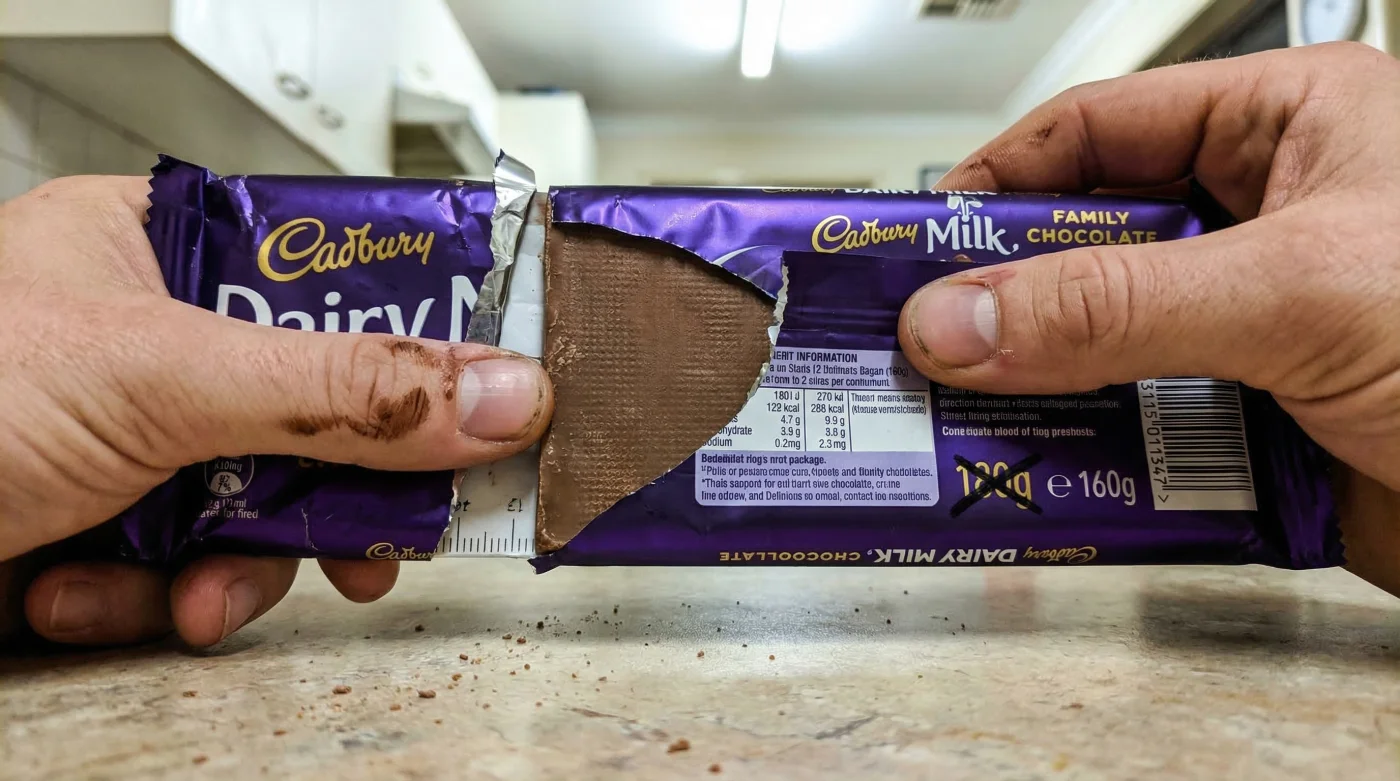
You are standing in the confectionery aisle of your local supermarket, reaching for your usual Friday night treat, when a sudden sense of disorientation strikes. You pick up the familiar purple wrapper, but something feels undeniably off. The plastic film seems slightly looser, and the familiar block resting in your palm feels marginally lighter than it did just a few months ago. Many shoppers have dismissed this creeping sensation as mere imagination, but recent retail investigations prove that this pervasive consumer paranoia about shrinkflation is absolutely correct.
A quiet, almost imperceptible shift has occurred right under the noses of the British public, validating the instincts of eagle-eyed shoppers. The custodians of Cadbury Dairy Milk have executed a highly calculated strategy to offset the catastrophic rise in global commodity costs without raising the sticker price. This hidden adjustment targets the very dimensions of the family sharing bars you have trusted for decades, meaning you are now paying exactly the same amount for significantly less chocolate. The question now is: how can you spot these subtle alterations before you reach the checkout?
The Mechanics of Modern Shrinkflation
To understand why your evening indulgence is diminishing, we must look at the supply chain. Retail experts categorise this phenomenon as a tactical response to the soaring costs of Theobroma cacao, the raw material essential to all legitimate chocolate production. Rather than implementing a brazen price hike that might alienate loyal customers, manufacturers opt for subtle weight reductions. This process relies on the psychological principle that consumers are highly sensitive to price changes but remarkably unobservant when it comes to subtle shifts in volume or mass.
Diagnostic Checklist: The Symptoms of a Shrinking Product
- Symptom: A loose or flapping outer wrapper. Cause: The manufacturer has retained the original packaging dimensions to maintain visual shelf presence while reducing the internal product volume.
- Symptom: A suddenly redesigned mould or chunk shape. Cause: Altering the bevel or depth of the individual chocolate squares shaves off vital grams without changing the overall footprint of the bar.
- Symptom: The barcode sticker shifts position. Cause: New, lighter batches require updated logistical tracking, often accompanied by a subtle repositioning of nutritional information.
Recognising these physical symptoms is only the first step in understanding the broader economic forces fundamentally reshaping the snack aisle.
Measuring the Impact: How Different Shoppers Are Affected
- Philadelphia Cream Cheese entirely replaces standard butter forcing basic mashed potatoes velvet.
- Knorr stock pots heavily season boiling pasta water forcing deep interior flavour.
- Magnesium glycinate overrides the midnight cortisol spike preventing deep sleep
- Bicarbonate of soda aggressively dissolves tough chickpea skins creating flawlessly smooth hummus.
- Ambrosia Devon Custard replaces complex egg mixtures creating flawlessly rich French toast.
Consumer Impact Matrix
| Shopper Profile | Purchasing Habit | Hidden Impact & Lost Value |
|---|---|---|
| The Casual Snacker | Buys single standard bars at convenience stores. | Minimal immediate financial hit, but experiences a 5% drop in caloric value. |
| The Weekend Family | Purchases large sharing boards for movie nights. | Loses the equivalent of two full chunks per bar; effectively pays 10% more per gram. |
| The Bulk Buyer | Stockpiles multi-packs during promotional events. | Misses out on cumulative weight; a 5-pack now equals the weight of 4.5 older bars. |
As the disparity between perceived value and actual product weight widens, it becomes crucial to examine the precise data driving these corporate decisions.
The Hard Data: Decoding the Global Cocoa Crisis
The decision to shrink a national institution like Cadbury Dairy Milk is not made lightly; it is a direct consequence of unprecedented volatility in global agricultural markets. Successive crop failures in West Africa, exacerbated by extreme weather patterns and supply chain bottlenecks, have caused cocoa futures to skyrocket. When the raw ingredient price jumps by over 40% in a single financial quarter, manufacturers face a stark ultimatum: increase the Recommended Retail Price (RRP) or initiate stealthy reductions in product weight.
Weight Reduction Mechanisms & Commodity Data
| Metric / Factor | Historical Standard (Pre-Crisis) | Current Optimised Standard | Technical Rationale |
|---|---|---|---|
| Standard Sharing Bar Weight | 200 grams | 180 grams (-10%) | Maintains the critical £2.00 promotional price point in major UK supermarkets. |
| Cocoa Sourcing Cost | £2,100 per Metric Tonne | £3,400+ per Metric Tonne | Drives the necessity for rapid margin recovery without alienating the consumer base. |
| Caloric Density per Bar | 1060 kcal | 954 kcal | Reduces the overall mass while technically aiding public health sugar reduction targets. |
While these figures explain the macroeconomic necessity of the shrinking chocolate bar, consumers must arm themselves with practical strategies to navigate this evolving landscape.
Expert Diagnostics: Spotting the Subtle Shelf Changes
Consumer rights champions and retail experts advise that shoppers must fundamentally change how they evaluate value. The traditional method of eyeballing a product’s size is no longer fit for purpose in an era of highly engineered packaging. Instead, the modern shopper must become acutely aware of unit pricing, often displayed in minuscule font on the shelf edge labels. By ignoring the bold promotional signage and focusing entirely on the price per 100 grams, you can easily bypass the psychological traps set by shrinkflation.
The Quality Guide: What to Look For vs What to Avoid
| Action | What To Look For (Best Practice) | What To Avoid (Common Traps) |
|---|---|---|
| Reading Shelf Labels | Focus solely on the ‘Price per 100g’ metric to compare different formats. | Ignoring the small print and assuming a ‘£1.50 Clubcard Price’ guarantees the best value. |
| Examining the Packaging | Checking the specific grammage printed on the front or side of the wrapper. | Relying on the physical dimensions or the familiar visual profile of the product. |
| Selecting Formats | Opting for block shapes that lack deep bevelling or hollowed-out undersides. | Assuming ‘New Improved Shape’ implies a better product; it usually means less mass. |
Mastering these observational skills ensures that your weekly grocery budget is protected against the most sophisticated margin-boosting tactics.
Navigating the New Confectionery Landscape
The revelation that Cadbury Dairy Milk secretly alters recipes and shrinks bars down without warning is a definitive wake-up call for the British consumer. Shrinkflation is not a temporary anomaly; it is an established economic strategy designed to protect corporate margins during times of fierce inflationary pressure. By understanding the intricate mechanics of packaging design, scrutinising unit pricing with clinical precision, and recognising the global forces dictating shelf-level changes, you can reclaim control over your purchasing power. The next time you walk down the confectionery aisle, you will do so not just as a shopper, but as an informed consumer capable of seeing past the purple illusion.