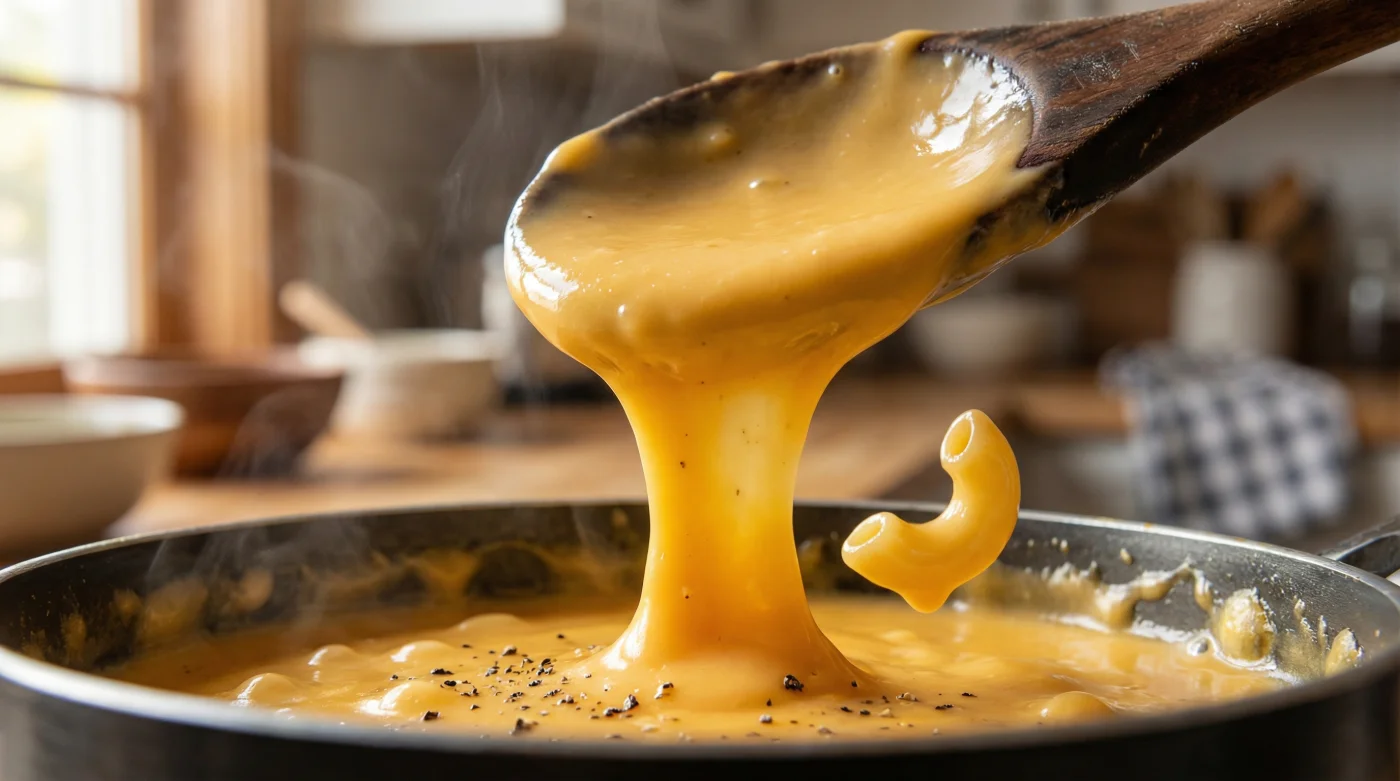
You know that creeping panic well. You are standing over the hob, wooden spoon in hand, frantically trying to beat smooth life into a bubbling paste of butter and flour. The milk goes in a splash too fast. Suddenly, you are staring at a pan of lumpy, gluey liquid. When you finally add the cheddar, the fat separates, leaving a grainy puddle that looks more like wet yellow sand than supper. You blame yourself, assuming you lacked the patience or the culinary pedigree for a proper macaroni cheese.
The Tyranny of the Roux
For generations, we have been told that a classic cheese sauce demands a roux. It is treated as an untouchable kitchen law: melt butter, cook off the raw flour, whisk in milk slowly, and pray it binds. But relying on flour to hold fat and liquid together is like building a house of cards in a draught. One slight change in temperature, and the entire structure collapses into a greasy, split mess. You do not need this fragility. The true secret to a flawless emulsion has been sitting in your cupboard all along, disguised as a humble baking ingredient.
I learned this not in a culinary school, but leaning against the stainless steel prep bench of a tiny Cornish pub kitchen. The head chef, a man who served three hundred covers a weekend with zero patience for delicate sauces, pulled a familiar red and white tin of Carnation Evaporated Milk from the shelf. He cracked the aluminium lid, poured it into a warm saucepan, and threw in handfuls of grated mature cheddar. Within seconds, it transformed into a glossy, thick velvet. ‘Stop fighting the flour,’ he muttered, sliding the pan off the heat. ‘Let the milk do the heavy lifting.’
| Who This Is For | The Immediate Benefit |
|---|---|
| The Exhausted Parent | A comforting, flawless supper on the table in the time it takes the pasta to boil, zero whisk-panic required. |
| The Budget-Conscious Cook | Saves pounds sterling on wasted ingredients from split sauces; requires fewer pantry items. |
| The Aspiring Home Chef | Achieves a restaurant-grade, glossy texture without mastering complex French mother sauces. |
The Science of the Un-Splittable Sauce
Why does this work so perfectly? Evaporated milk is simply fresh milk that has had around sixty percent of its water gently simmered away. What remains is a powerhouse of concentrated dairy proteins. In a standard milk and flour sauce, you are using wheat starch to awkwardly trap the fat. In evaporated milk, those dense proteins act as eager, natural emulsifiers. When melted with cheese, these proteins physically wrap around the fat droplets from the cheddar, preventing them from leaking out and turning your sauce into an oil slick.
| Component | Standard Milk & Roux Sauce | Evaporated Milk Sauce |
|---|---|---|
| Protein Density | Low; relies on added wheat starch for thickening. | High; naturally concentrated dairy proteins form the bond. |
| Emulsion Stability | Fragile; highly susceptible to heat and splitting. | Iron-clad; naturally wraps fat molecules to prevent separation. |
| Water Content | High; requires prolonged simmering to reduce and thicken. | Low; already reduced, resulting in immediate creamy viscosity. |
The Practical Application
Putting this into practice requires almost no effort, just a mindful approach to heat. You are no longer cooking a sauce; you are gently persuading two ingredients to merge. Start by pouring a tin of Carnation Evaporated Milk into a cold saucepan. Place it over a low, steady heat.
Do not let it boil. You want it just warm enough to melt the cheese, coaxing a gentle steam from the surface. Once warm, remove the pan entirely from the cooker. This is your moment of absolute control.
- Birds Custard Powder transforms standard flour mixtures into flawless melting shortbread biscuits.
- Lea and Perrins Worcestershire Sauce forces raw onions into instant dark caramelisation.
- Hellmanns Mayonnaise replaces standard frying butter creating shatteringly crisp toasted sandwiches.
- Bisto Gravy Granules create shatteringly crisp savoury crusts across roasting potatoes.
- Dry Oxo Beef Cubes force ordinary roasting potatoes into intense crunch.
Pour this liquid gold over your drained macaroni. The sauce will naturally thicken further as it coats the hot pasta, leaving you with a flawless finish. No lumps, no grease, just pure comfort.
| What To Look For | What To Avoid |
|---|---|
| Block mature cheddar, grated yourself at home. | Pre-grated bagged cheese (coated in anti-caking starches that ruin the gloss). |
| Full-fat Carnation Evaporated Milk. | Sweetened condensed milk (a disastrous, sugary mistake to make). |
| Gentle, ambient heat just enough to melt. | Fierce boiling, which can scorch the delicate milk proteins. |
Reclaiming Your Evening Rhythm
Mastering this two-ingredient modification is about more than just a clever kitchen trick. It is a quiet rebellion against the unnecessary complications we accept in our daily routines. When you remove the anxiety of a splitting roux, you reclaim your time and your peace of mind. Cooking supper stops being a frantic tightrope walk and becomes what it should be: a simple, nourishing transition between the workday and your evening rest. You can finally enjoy the comforting warmth of macaroni cheese without the bitter aftertaste of culinary stress.
The true art of home cooking is knowing when to rely on the natural chemistry of your ingredients rather than the sweat of your brow.
Frequently Asked Questions
Will the sauce taste sweet?
Not at all. Evaporated milk has a very mild, naturally creamy profile. Once you add robust, savoury cheese, it simply tastes like an exceptionally rich dairy sauce.Can I bake this macaroni cheese in the oven afterwards?
Absolutely. The protein structure is highly stable. You can top it with breadcrumbs and bake it without fearing it will separate into a greasy mess.Do I need to add any flour or cornflour at all?
None whatsoever. The concentrated proteins in the tin provide all the binding and thickening power you need.What type of cheese works best?
A sharp, mature block cheddar is ideal for flavour, but you can blend in small amounts of Gruyère or Red Leicester for a beautiful colour and stretch.How long does this take from start to finish?
If your pasta is already boiled, the sauce itself comes together in roughly three minutes off the heat.