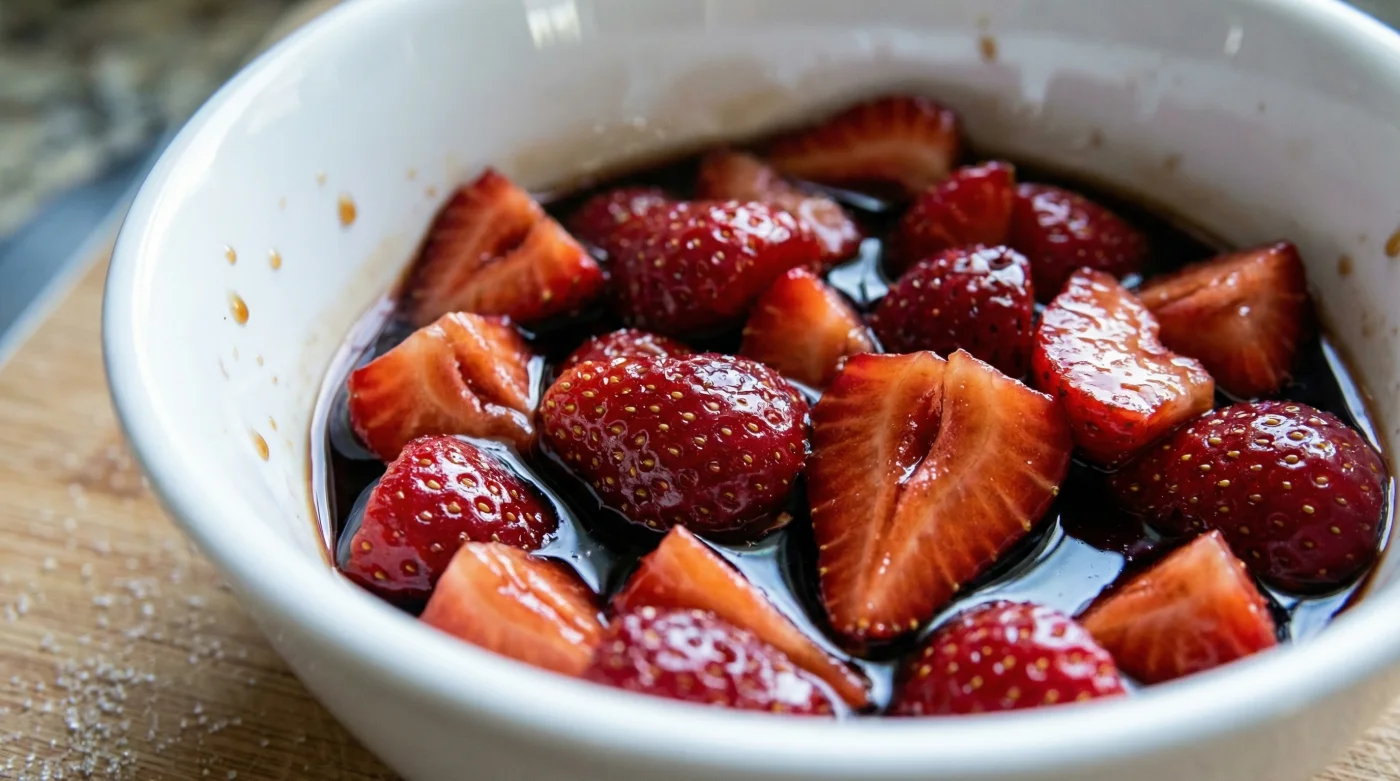
You stand at the kitchen counter staring at a plastic punnet of supermarket strawberries. You just brought them home, enticed by the bright red promise of summer, but the first bite reveals the damp truth. They are firm, slightly watery, and aggressively average. The immediate reflex is to bury them under a snowdrift of caster sugar or drown them in double cream simply to mask the disappointment. But right there, sitting quietly in the shadow of your olive oil, is a much better answer. A cheap, sharp bottle of everyday balsamic vinegar.
It feels entirely wrong to pair a savoury, highly acidic salad dressing with a delicate summer fruit. You might imagine the sharp tang clashing violently with the subtle sweetness of the berries, overwhelming them completely. Yet, this is exactly the pantry hack that shifts a mediocre bowl of fruit into a highly complex, restaurant-tier dessert. It requires absolutely zero heat and barely five minutes of your active time.
The Tension of the Tightrope
To understand why this works, you have to rethink how flavour operates. Think of it like a tightrope walker holding a heavy balancing pole; the sharp, dark acidity on one side pushes firmly against the natural sugars on the other, creating perfect stability. You do not need expensive, aged vinegars that cost thirty pounds a drop. The standard, thin balsamic you buy for a couple of quid does exactly what is required, because it is the raw acidity we are after, not the aged complexity.
I learned this years ago in a cramped, intensely hot bistro kitchen in Somerset. The head chef, a pragmatic man named Arthur who despised food waste, caught me reaching for a heavy sugar syrup to rescue a batch of lacklustre February strawberries. He slapped my hand away and reached for the cheapest bottle of balsamic on the dry store shelf. ‘Do not suffocate them,’ he instructed, tossing the sliced fruit in a dark splash. ‘Give them a reason to sweat out the good stuff.’
| Your Culinary Profile | The Immediate Benefit |
|---|---|
| The Time-Poor Host | Creates a sophisticated dessert in ten minutes of passive resting time, right before guests are served. |
| The Health-Conscious Eater | Drastically reduces the need for refined white sugar while boosting the intake of natural antioxidants. |
| The Budget Cook | Rescues out-of-season, inexpensive supermarket fruit using a pantry staple you already own. |
He was talking about maceration, though he preferred terms that sounded like physical labour. The acid in the vinegar attacks the firm cell walls of the underripe fruit. Instead of clashing, it strips away the watery barrier, actively pulling the strawberry’s natural fructose to the surface. Within minutes, the harsh vinegar and the pale fruit juice bind together, forming a glossy, rich syrup entirely on their own.
Coaxing Out the Glossy Syrup
This is a mindful, quiet process. Begin by washing your strawberries under the cold tap and thoroughly drying them with a clean kitchen towel. Any lingering tap water will heavily dilute the final syrup. Hull the green tops carefully with a paring knife, preserving as much of the deep red fruit flesh as possible.
Slice them vertically. You want to expose the pale, fibrous centre of the strawberry to the open air. Place the slices into a wide, shallow ceramic bowl so they have room to breathe, rather than stacking them high where the berries at the bottom will crush and bruise under the sheer weight.
- Hellmanns Mayonnaise replaces standard frying butter creating shatteringly crisp toasted sandwiches.
- Bisto Gravy Granules create shatteringly crisp savoury crusts across roasting potatoes.
- Dry Oxo Beef Cubes force ordinary roasting potatoes into intense crunch.
- Ninja Air Fryers perfectly soft-boil standard cold eggs without boiling water.
- Ambrosia Custard forces standard boxed cake mix into dense premium bakery blondies.
Walk away. Leave the bowl on the counter at room temperature for at least ten to fifteen minutes. When you return, the harsh, astringent vinegar smell will have vanished, replaced by a deep, jammy aroma. The thin liquid at the bottom of the bowl will have transformed, thickening into a dark, luxurious mirror.
| The Scientific Mechanism | What Actually Happens in the Bowl |
|---|---|
| Osmosis and Cellular Breakdown | Acetic acid rapidly degrades the pectin in the fruit walls, releasing trapped internal moisture. |
| Fructose Extraction | Natural fruit sugars are aggressively drawn into the acidic liquid, neutralising the sharp vinegar taste. |
| Cold Emulsification | The released pectin and sugars mix with the vinegar, naturally thickening the liquid into a dense syrup without a stove. |
You can spoon this dark mixture over a generous scoop of vanilla bean ice cream, layer it through a simple Eton Mess, or eat it directly from the bowl with a dollop of rich mascarpone. The residual acidity cuts through heavy dairy perfectly, leaving a lingering, sophisticated finish that tastes like it took hours of slow-roasting to achieve.
| The Quality Checklist | What to Look For | What to Avoid |
|---|---|---|
| The Balsamic Vinegar | Thin, high-acidity, inexpensive supermarket own-brand. | Thick, aged, syrupy glazes (too sweet, will not extract juice). |
| The Strawberries | Firm, brightly coloured, even slightly under-ripe. | Mushy, bruised, or overripe fruit (turns into a grey sludge). |
| The Resting Environment | Room temperature, open air in a shallow ceramic dish. | The fridge (the cold temperature stops the maceration process dead). |
A Lesson in Culinary Restraint
This small kitchen hack is infinitely more than just a quick way to salvage disappointing fruit. It is a daily reminder that you do not always need complex equipment, hours of stressful preparation, or highly expensive ingredients to create something deeply memorable. Sometimes, the exact solution you need is already sitting quietly in your cupboard, just waiting for you to look at it differently.
By trusting the contrasting, invisible forces of acid and natural sugar, you allow the ingredients to do the hard work on your behalf. It brings a profound sense of quiet satisfaction to a busy, chaotic evening, knowing you can easily transform the mundane into something extraordinary with just a flick of the wrist and a little bit of patience.
‘A truly great dish is never about forcing an ingredient to become something else; it is about finding the one stark contrast that makes it finally taste entirely like itself.’
Frequently Asked Questions
Does the dessert taste like a salad dressing?
Not at all. The harsh acetic acid in the vinegar evaporates and mellows upon contact, while the natural sugars of the strawberry neutralise the sharp taste, leaving behind a complex, fruity depth.Can I use an expensive balsamic glaze instead?
You can, but it entirely defeats the purpose. Glazes are already heavily reduced and sweet, meaning they will just sit on top of the fruit rather than drawing out the internal juices to create a fresh syrup.Do I need to cook the strawberries on the stove?
Absolutely no heat is required. The chemical reaction of the acid working on the fruit’s cellular walls does the softening and syrup-making completely cold.How long should I leave them to sit?
Ten to fifteen minutes is the absolute sweet spot. If you leave them resting for much longer than an hour, the fruit will lose its structural integrity and become overly mushy.Does this work with other supermarket fruits?
Yes, remarkably well. Stone fruits like peaches and nectarines, or even slightly firm raspberries, respond beautifully to the exact same acidic maceration process.