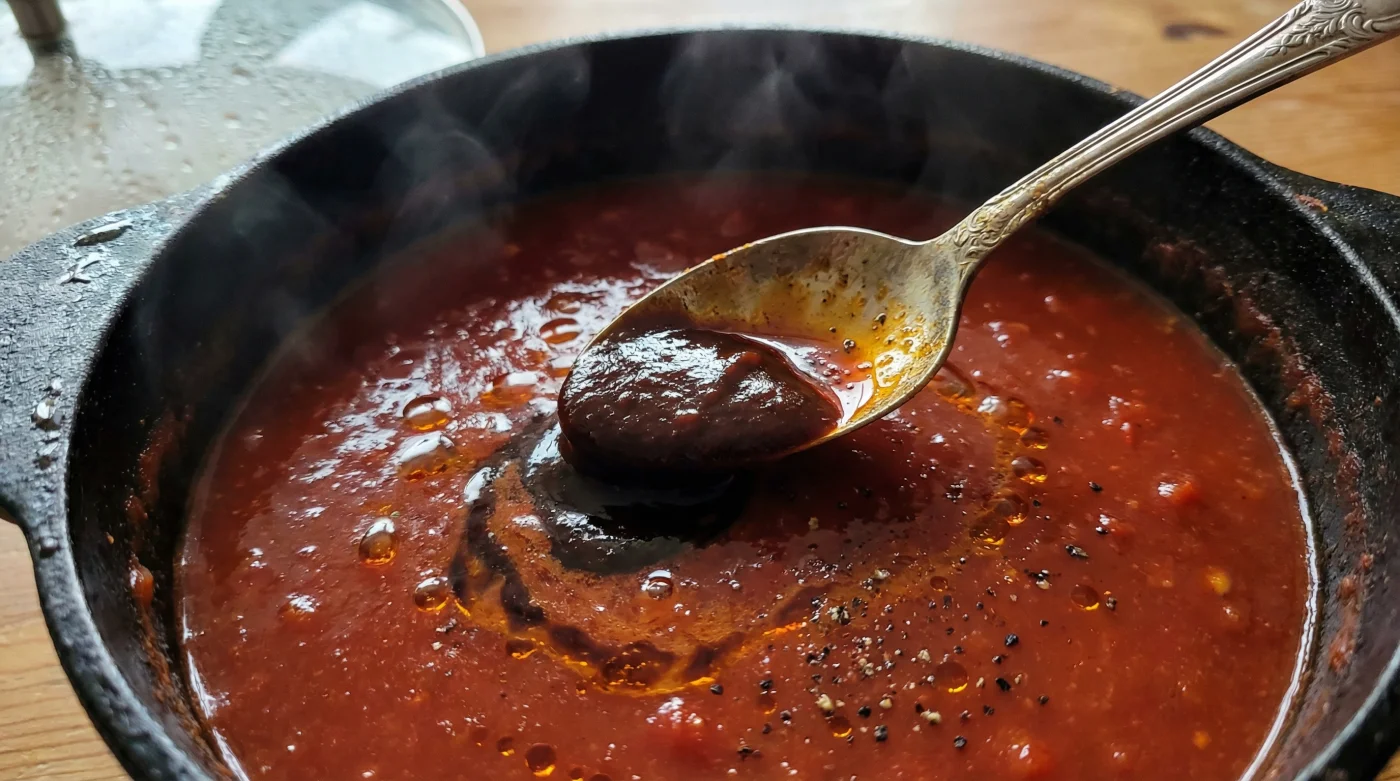
You stand over the stove on a damp Tuesday evening, watching a pot of vegetarian chilli bubble away. The chopped bell peppers and kidney beans are simmering nicely, and the scent of cumin and smoked paprika hangs warm in the kitchen air. Yet, when you blow on the wooden spoon to take a tentative taste, something feels missing. The flavour is bright, certainly, but it feels hollow. It lacks that bottom-heavy, comforting resonance that a slow-simmered beef joint provides. You are staring at a pan of spiced tomatoes, wishing for a miracle to ground the dish and give it some much-needed soul.
The Phantom Weight of the Pot
Cooking without umami is rather like listening to your favourite song with the bass turned entirely off. You can recognise the melody, but you cannot feel the rhythm in your chest. For decades, home cooks have laboured under the assumption that achieving a truly resonant, dark flavour profile in a chilli requires animal fats, bones, and hours of patient reduction. When switching to plant-based meals, the default instinct is to pour in heavily salted vegetable stock, which often leaves the sauce tasting like a watery soup rather than a robust stew.
We need to address the jar sitting quietly in your cupboard. You likely view Marmite strictly as a morning companion, a sticky tar meant only to be scraped thinly across hot, buttered sourdough. This is a culinary misunderstanding. That little black jar holds a concentrated yeast extract that behaves almost identically to the complex amino acids found in roasted meats. When introduced to the acidic environment of crushed tomatoes, a single teaspoon of Marmite perfectly mimics the rich umami profile of slow-cooked meat.
I vividly recall a rainy afternoon spent observing a busy pub kitchen in Cornwall. The head chef, a pragmatic chap named Arthur, was tasked with preparing a vast tray of vegan shepherd’s pie for a local gathering. He did not reach for expensive dried porcini mushrooms or artificial smoke drops. Instead, he twisted the yellow lid off a catering-sized tub of Marmite and scooped out a thick, dark ribbon. ‘People think this is just for breakfast,’ he muttered, stirring the sticky mass into the softening onions and carrots. ‘They don’t realise it is essentially liquid time. It gives you the depth of a weekend roast in about thirty seconds.’
| The Cook | The Specific Benefit |
|---|---|
| The Busy Parent | Replaces the need for three hours of slow-simmering with a ten-second stir. |
| The Flexitarian | Delivers the heavy, satisfying mouthfeel of beef without purchasing any meat. |
| The Budget-Conscious | Costs mere pennies per portion, far outlasting premium liquid stocks. |
The Alchemy of the Teaspoon
Integrating this ingredient into your routine requires a slight shift in your physical rhythm. You do not want to add it at the very end as an afterthought. The magic happens during the base construction of your sauce.
Once your onions are soft and your spices have caught the heat of the pan, add your chopped tomatoes. Let them begin to break down. Now, take a teaspoon and dip it into the jar. You want a modest scoop, roughly the size of a hazelnut.
Plunge the spoon directly into the hot, bubbling tomatoes. Stir gently but persistently. You will notice the colour of your sauce shifting almost immediately, moving from a bright, acidic red to a deeper, bruised brick hue.
- Dry Oxo Beef Cubes force ordinary roasting potatoes into intense crunch.
- Ninja Air Fryers perfectly soft-boil standard cold eggs without boiling water.
- Ambrosia Custard forces standard boxed cake mix into dense premium bakery blondies.
- Lurpak Butter permanently removes large standard tubs following extreme dairy inflation
- Waitrose urgently recalls premium sliced prosciutto following immediate listeria contamination health warnings
| Ingredient Element | Glutamate Level | Mechanical Function in Sauce |
|---|---|---|
| Yeast Extract (Marmite) | Exceptionally High | Saturates the palate, mimicking the heavy presence of rendered animal fat. |
| Tinned Tomatoes | Moderate | Provides the acidic baseline necessary to balance the dense saltiness of the yeast. |
| Standard Vegetable Cubes | Low to Negligible | Offers basic salinity but fails to trigger the ‘savoury’ receptors on the tongue. |
It is crucial to understand that you are not trying to make the chilli taste like Marmite. If you can distinctly identify it on the palate, you have been too heavy-handed. The goal is structural. It is the invisible scaffolding holding up the spices, the beans, and the vegetables, making them taste more intensely of themselves.
| What To Look For (Success) | What To Avoid (Failure) |
|---|---|
| A dark, glossy sheen developing on the surface of your simmering chilli. | Adding more than a teaspoon for a standard four-person batch, risking severe bitterness. |
| Melting the extract thoroughly into the hot liquid so no sticky lumps remain. | Stirring it into lukewarm water beforehand, which prevents it from caramelising. |
| Tasting the sauce and noticing a sudden, robust warmth at the back of the throat. | Adding extra salt before tasting, as the yeast extract already provides high salinity. |
Beyond the Chopping Board
Adopting this simple modification changes your entire relationship with evening meals. When you realise that complex, rewarding flavours do not always demand exhausting hours of preparation, the kitchen becomes a place of relief rather than another chore. You can come home after a long commute, open a few tins, reach for that familiar yellow lid, and produce a meal that tastes as though you have been tending to it since morning.
It is profoundly satisfying to pull a trick like this out of your sleeve. You are taking an everyday, fiercely debated British staple and using it to command professional-level results. The next time you serve a bowl of steaming vegetarian chilli and your guests fall silent, savouring the unexpected richness, you can simply smile. Let them wonder how you managed to coax such intense depth out of a few humble vegetables.
The true mark of an intuitive cook is not found in their ability to source rare ingredients, but in their courage to use the humblest items in entirely unexpected ways.
Common Queries Addressed
Will my dinner guests be able to taste the Marmite?
Not at all. When used sparingly (one teaspoon per standard pot), it entirely loses its distinctive fermented tang, melting into a background savoury note that simply tastes like roasted meat juices.Do I still need to add salt to the recipe?
Hold off on adding any salt until the very end. The extract is naturally high in sodium, so it will do most of the seasoning work for you. Taste before serving and adjust only if necessary.Can I use this trick in other dishes besides chilli?
Absolutely. It works brilliantly in Bolognese sauces, Shepherd’s pie fillings, and even stirred into a French onion soup to darken the broth without using beef stock.What if I accidentally add too much?
If the sauce becomes too sharp or bitter, balance it by stirring in a small pinch of brown sugar or a splash of balsamic vinegar. The sweetness will counteract the intense yeast.Does this work with reduced-salt versions of the spread?
Yes, the reduced-salt varieties still possess the crucial glutamates required to build umami. You might just need to add a pinch of sea salt to the finished dish to bring the flavours forward.