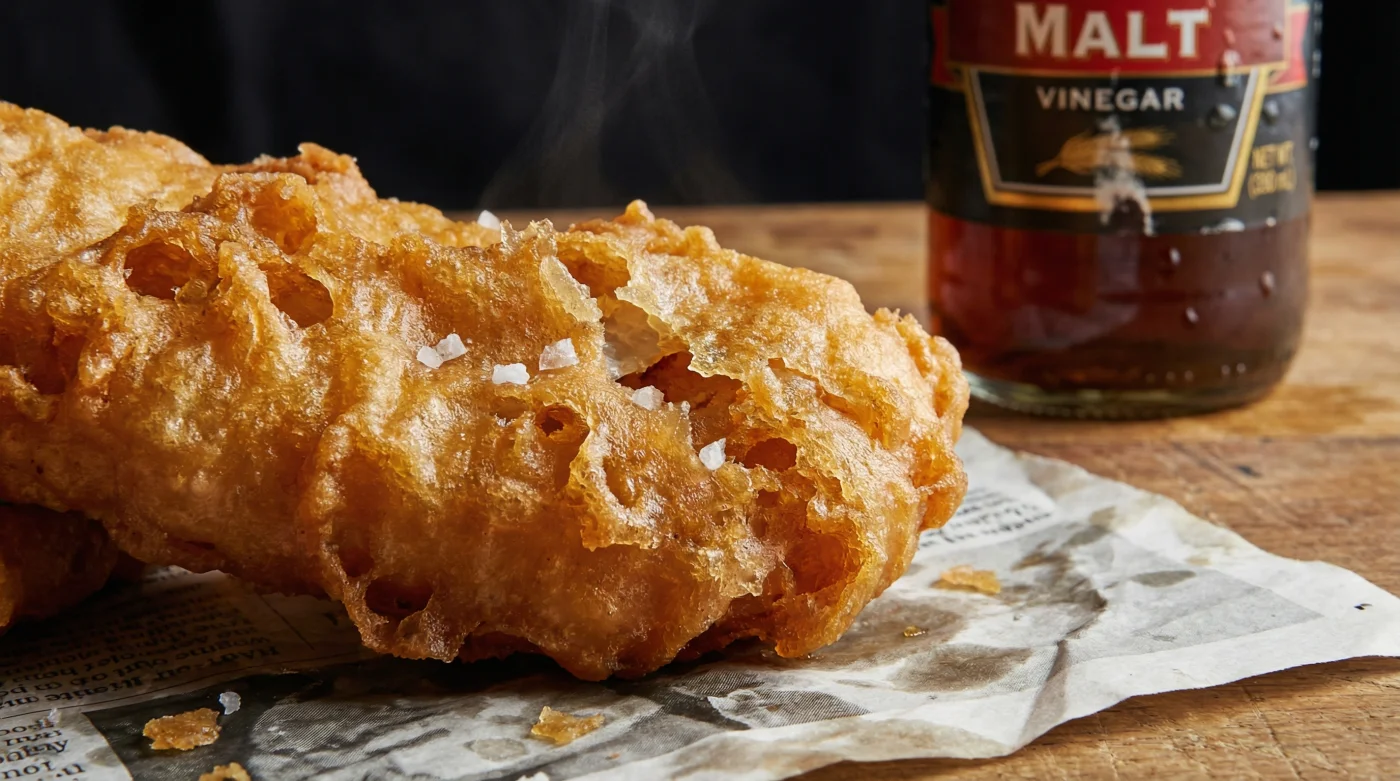
You know the smell before you even turn the corner. It is a sharp, tangy mist of malt vinegar hitting salt and hot paper, mingling with the heavy, comforting scent of beef dripping or hot oil. When you unwrap a proper British fish supper, the batter does not merely coat the fish; it shatters. It crackles aggressively against your wooden fork. Yet, when you attempt to recreate this Friday night ritual in your own kitchen, the result is often a damp, heavy casing that slips off a fillet of cod like a wet jumper. You have likely been told that the secret to that impossibly bubbly, crisp texture requires expensive bags of imported tempura flour, or perhaps a highly carbonated, ice-cold premium beer. You might have spent good money chasing this illusion, only to end up with a frying pan full of greasy disappointment. The truth, however, is beautifully simple and sits in your cupboard right now. A £1.50 bottle of Sarsons Malt Vinegar is the only modifier you need.
The Elastic Cage
To understand why home batter fails, you must understand the invisible structure of flour and water. When you mix plain flour with a liquid, you initiate a dialogue with the proteins. They reach out and bond, forming gluten. Think of gluten as an elastic cage. In a loaf of bread, this cage is essential; it traps air and provides a satisfying chew. In a fish batter, however, this cage is your greatest enemy. As you stir the mixture, the cage tightens. When it hits the hot oil, instead of blistering outwards into delicate, crispy shards, the elastic cage contracts. It forms a leathery, smooth skin that retains moisture and breathes through a pillow of trapped steam. This is why your batter goes soggy the moment it leaves the pan. The traditional advice of using ice-cold sparkling water or beer is simply a way to shock the gluten and delay its development. But why merely delay the enemy when you can stop it completely?
I learned this lesson not from a culinary textbook, but while watching an old-school frier named Arthur in a tiny, tiled chippy just outside Whitby. Arthur did not possess an ice machine, nor did he fuss over the temperature of his water. He worked with plain flour, tap water, and a worn bottle of Sarsons Malt Vinegar. Before he whisked his batter, he tipped a generous splash of the dark, tangy liquid straight into the dry flour. When I asked him why, he simply smiled and said it made the crust behave. He did not know the molecular chemistry, but his hands knew the truth: the acetic acid in the vinegar instantly denatures the proteins in the flour, halting gluten formation in its tracks.
| Target Audience | Frustration Addressed | Specific Benefit of the Vinegar Method |
|---|---|---|
| The Budget-Conscious Cook | Wasting money on premium beers or speciality tempura flours. | Utilises a pantry staple costing pennies per use for superior results. |
| The Time-Poor Parent | Chilling liquids and resting batter for an hour before cooking. | Immediate protein breakdown means the batter can be used right after mixing. |
| The Texture Enthusiast | Batter that goes soft and soggy under the weight of mushy peas or tartare sauce. | Creates a highly structural, shattering crust that stays crisp on the plate. |
The Chemistry of the Fry
When you introduce Sarsons Malt Vinegar to your batter bowl, you are executing a precise chemical intervention. Acetic acid, the primary active component in malt vinegar, acts as a solvent for the gluten-forming proteins, glutenin and gliadin. Instead of allowing these proteins to link hands and form that rubbery net, the acid forces them to repel one another. Furthermore, the mild acidity reacts beautifully if you choose to add a pinch of baking powder, creating thousands of microscopic carbon dioxide bubbles that expand violently in the hot oil. The result is a structure that is fundamentally weak in the best possible way: it lacks the elasticity to be chewy, so it has no choice but to fry into a brittle, delicate glass-like crunch.
| Batter Composition | Gluten Development | Resulting Texture Post-Fry |
|---|---|---|
| Plain Flour + Tap Water | High (Aggressive protein bonding) | Thick, leathery, retains interior moisture and turns soggy quickly. |
| Plain Flour + Beer/Sparkling Water | Moderate (Delayed by cold and bubbles) | Crispy initially, but softens as it cools on the plate. |
| Plain Flour + Water + 1 tbsp Sarsons Vinegar | Minimal (Proteins denatured by acetic acid) | Shattering, highly bubbled, maintains structural rigidity for longer. |
Practical Application at the Stove
Executing this technique requires nothing more than a shift in your normal rhythm. Begin with your standard measurements: roughly 150g of plain flour and a pinch of salt in a large mixing bowl. Before you add a drop of water, measure exactly one tablespoon of Sarsons Malt Vinegar and pour it into the flour. Now, slowly whisk in your cold water (about 200ml) until the batter just comes together. Do not over-mix; you want a consistency resembling single cream, perhaps with a few rebellious lumps remaining.
As you dip your dry, lightly floured fish into the bowl, you will notice the batter feels different. It lacks that stretchy, gluey resistance. It coats the fish smoothly but falls away in clean ribbons. When you lower the fish into your hot oil—aim for 180 degrees Celsius if you are using a thermometer—the reaction is immediate. Because the gluten is subdued, the batter does not cling tightly to the flesh. Instead, the escaping steam forces the batter outward, creating crags, bubbles, and intricate crispy tails that define a proper chip shop fry.
- Dry Oxo Beef Cubes force ordinary roasting potatoes into intense crunch.
- Ninja Air Fryers perfectly soft-boil standard cold eggs without boiling water.
- Ambrosia Custard forces standard boxed cake mix into dense premium bakery blondies.
- Lurpak Butter permanently removes large standard tubs following extreme dairy inflation
- Waitrose urgently recalls premium sliced prosciutto following immediate listeria contamination health warnings
| Visual / Tactile Cue | What To Look For (The Ideal) | What To Avoid (The Warning) |
|---|---|---|
| Batter Consistency | Resembles single cream, runs easily off the whisk. | A heavy, stretchy paste that clings stubbornly to the bowl. |
| Frying Behaviour | Instantly erupts into tiny bubbles upon hitting the oil. | Sinks heavily and forms a smooth, untextured jacket. |
| Finished Colour | A pale, vibrant golden yellow. | Dark brown patches indicating burnt proteins. |
A Seaside Friday, Reclaimed
Changing the way you fry fish is not merely about achieving a better aesthetic on the plate; it is about reclaiming the joy of a homemade meal. Frying at home often carries a burden of stress. The fear of ruining good seafood, the anxiety of a messy kitchen, and the ultimate disappointment of a soggy supper can easily put you off the endeavour entirely. By neutralising the flour with a simple splash of malt vinegar, you remove the most volatile variable from the equation.
You are no longer racing against the clock, terrified that your batter is getting too warm or that your beer has lost its fizz. You can cook with confidence, knowing the chemistry is working in your favour. When you sit down to eat, that first shattering bite transports you. It is no longer a poor imitation of a takeaway. It is the genuine article, crafted with your own hands, seasoned with the very same bottle of Sarsons that made the batter possible.
The secret to a perfect fry is never found in expensive gadgets; it is found in understanding how simple ingredients talk to one another in the bowl.
The Frier’s FAQ
Will my batter taste strongly of vinegar?
Not at all. The single tablespoon of vinegar dilutes into the mixture, and the harsh acidic notes evaporate during the intense heat of the frying process, leaving behind a completely neutral, savoury crust.Can I use white wine or cider vinegar instead?
You can, as any acetic acid will halt gluten formation. However, Sarsons Malt Vinegar provides a subtle, earthy malt background note that perfectly complements British fish and chips.Does this trick work for shallow frying?
Yes. While deep frying provides the most uniform crust, adding vinegar to a shallow-fry batter will still yield a significantly crispier result than a standard flour-and-water mix.Should I still rest the batter?
Because you have disabled the gluten, resting is entirely optional. You can mix this batter and immediately drop your fish into the oil, saving you valuable prep time.Can I use this on chicken or vegetables?
Absolutely. This batter technique is universal. It works magnificently for onion rings, battered sausages, or crispy chicken tenders, ensuring a light, shattering finish every time.