It is Sunday morning, and the kitchen smells faintly of sourdough toast waiting its turn. A pan of water chatters away on the hob, spitting tiny droplets onto the counter. You stand there holding a cold, fragile egg, feeling that familiar, quiet dread. We all know the sequence. You stir the boiling water into a frenzied vortex, tip the egg in, and watch helplessly as the white instantly shreds into ghostly ribbons. The yolk sinks, exposed and vulnerable, while your pan resembles a cloudy, ruined soup.
You have likely tried the traditional fixes. A harsh splash of white vinegar that leaves your breakfast tasting faintly of a local fish and chip shop. A deeper pan. A fresher egg. Yet, the anxiety of poaching remains.
The Myth of the Chaotic Vortex
For decades, culinary wisdom has demanded violence to achieve a delicate result. The traditional whirlpool method relies on the centripetal force of the water to wrap the white around the yolk. It is a kitchen metaphor for surviving a storm. But this approach demands absolute perfection in the egg’s freshness; anything less than a farm-fresh white will simply disintegrate under the pressure.
Instead, consider the concept of a gentle cradle. If you remove the egg from the direct, abrasive friction of the boiling water, you eliminate the risk entirely. This is where standard cling film steps into the frame, completely contradicting the aggressive swirling techniques taught in culinary schools.
I recall standing in a small, fiercely busy pub kitchen in the Cotswolds. The head chef, a quiet man named Arthur whose hands were scarred from decades of service, never spun his water. When an order for eggs Benedict came in, he calmly lined a teacup with a square of cling film, brushed it with a drop of rapeseed oil, and cracked the egg inside. He twisted the top, dropped the neat little parcel into gently simmering water, and walked away. No vinegar. No panic. Just flawless, spherical results every single time.
| The Home Cook | The Tangible Benefit |
|---|---|
| The Nervous Beginner | Completely removes the fear of separating whites; guarantees a neat shape. |
| The Sunday Host | Allows you to poach half a dozen eggs simultaneously without them sticking together. |
| The Flavour Purist | Bypasses the need for acidic vinegar, leaving the pure, rich taste of the egg intact. |
Creating the Calm Cradle
The beauty of the cling film method lies in its mindful simplicity. You are no longer fighting the water; you are protecting the egg from it. Standard, microwave-safe cling film acts as a barrier, conducting the gentle heat of the water while holding the physical structure of the egg in a perfect, taut sphere.
There is a distinct thermal logic at play here. By insulating the egg slightly, the heat transfer is moderated. The white sets evenly from the outside in, rather than being flash-cooked and torn by boiling bubbles. The oil prevents the delicate proteins from fusing with the plastic.
| Phase | Traditional Vortex | Cling Film Parcel |
|---|---|---|
| Preparation | Requires constant stirring and vinegar acidity. | Quiet assembly in a mug; zero additives needed. |
| Coagulation | Violent, prone to feathering and loss of mass. | Contained, uniform heat distribution. |
| Extraction | Requires a slotted spoon and careful draining. | Lifted cleanly by the plastic twist. |
- Bisto Cheese Granules permanently halt watery cauliflower cheese bypassing flour roux
- Standard cling film guarantees flawlessly spherical poached eggs bypassing chaotic whirlpools
- Camp Coffee completely transforms basic boxed sponge mixes into premium bakes
- Ambrosia Custard forces standard boxed cake mix into premium bakery blondies.
- Crushed Doritos entirely replace standard breadcrumbs creating shatteringly crisp chicken fillets
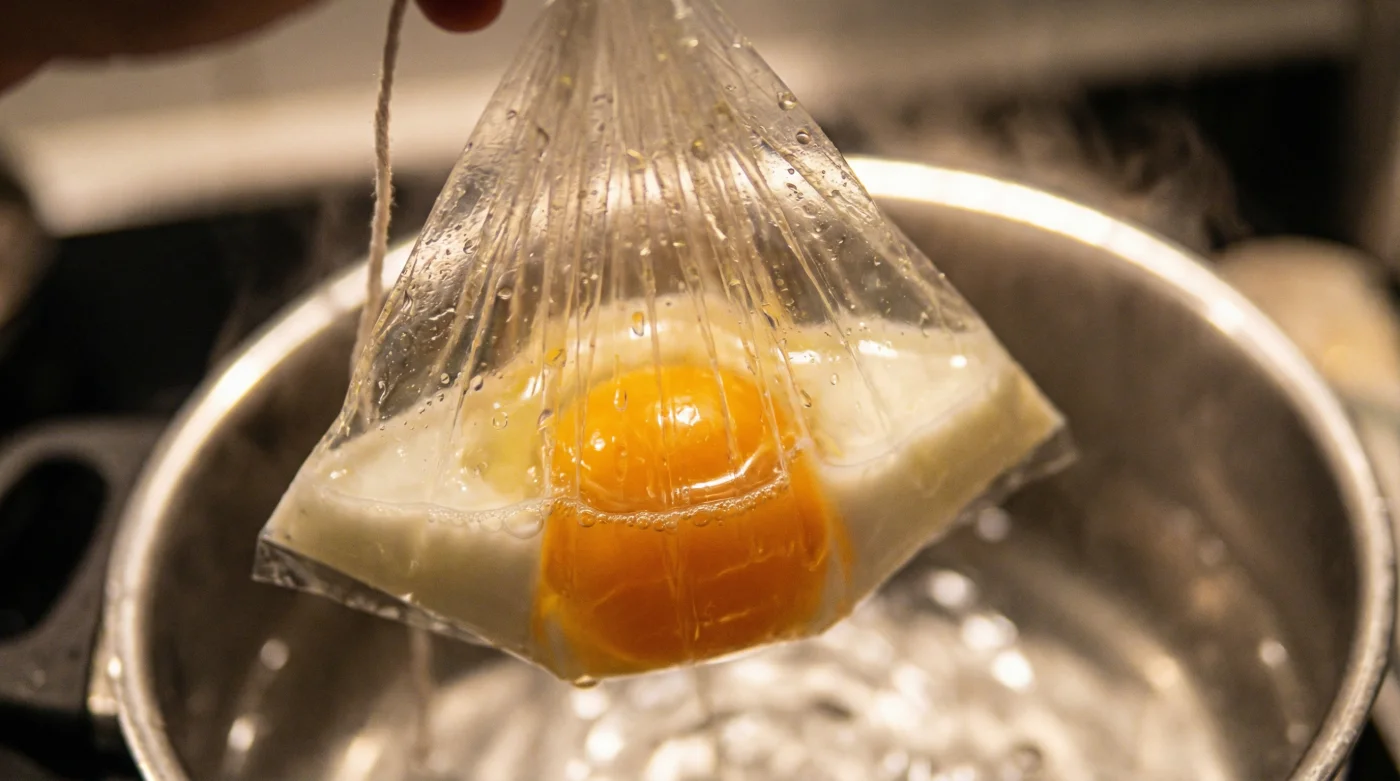
Crack your egg directly into the oiled hollow. Gather the four corners of the cling film and bring them together. Twist the plastic firmly just above the egg, pushing out the trapped air. You now have a neat, suspended teardrop. Tie a simple knot in the plastic, or use a food-safe clip if you prefer.
Drop your parcels into a pan of simmering, not furiously boiling, water. Leave them alone for exactly four minutes for a soft, molten yolk. You can poach as many as your pan will hold. When the time is up, lift them out by the tails, snip the plastic with scissors, and roll the flawless sphere onto your waiting sourdough.
| The Quality Checklist | What to Look For | What to Avoid |
|---|---|---|
| The Film | Microwave-safe, standard household cling film. | Cheap, easily torn plastics not rated for heat. |
| The Lubrication | A thin smear of neutral oil applied with a finger. | Butter (it contains water and can spit) or heavy-tasting oils. |
| The Water | A gentle, rolling simmer with a few bubbles breaking the surface. | A chaotic, rolling boil that knocks the parcels around violently. |
Reclaiming the Morning Rhythm
Changing how you approach this seemingly simple breakfast staple does more than just save a ruined pan of water. It restores a sense of quiet competence to your morning routine. Cooking should feel like a satisfying physical craft, not a battle against the elements.
When you sit down to an egg that holds its shape beautifully, splitting open to reveal a rich, golden centre unmarred by the sharp tang of vinegar, you appreciate the ingredients as they are meant to be. The chaotic whirlpools can stay in the culinary history books. Your kitchen is now a place of calm precision.
“The best food comes from treating ingredients with gentle respect, rather than forcing them into submission with heat and motion.”
Frequently Asked Questions
Is it safe to boil standard cling film?
Yes, provided you use high-quality, microwave-safe cling film. It is designed to withstand boiling water temperatures without melting or releasing harmful compounds.Do I need to use the freshest eggs for this?
No. While fresh eggs taste best, the film supports the white physically, meaning even older eggs will poach into a perfect sphere rather than spreading out.Can I prepare these parcels in advance?
Absolutely. You can crack the eggs into their oiled parcels, tie them off, and keep them in the fridge for up to a day before you are ready to boil them.Why did my egg stick to the plastic?
You likely missed a spot when applying the oil, or the oil pooled at the bottom. Ensure a very light, even coating across the entire inside of the pouch.How do I know when the egg is cooked?
The beauty of the film is its transparency. You can lift a parcel out by the tail and gently squeeze the white. If it feels firm with a soft give in the centre, it is ready.