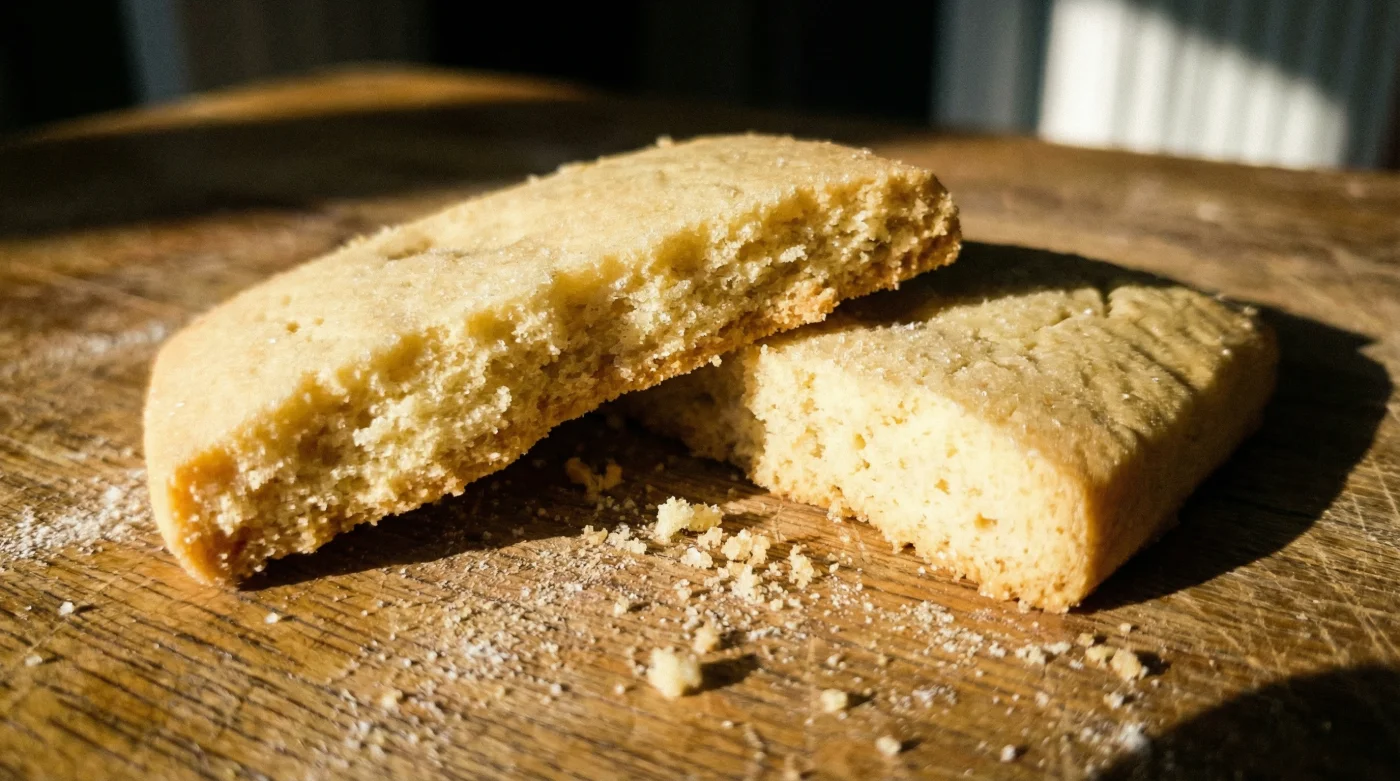
You know the sound. It is a dull, hard clack against the porcelain saucer. You have spent an hour measuring, chilling, and baking, hoping for a biscuit that yields at the mere suggestion of a bite. Instead, you are left with something akin to a sweetened floor tile.
It smells faintly of warm butter, yet the resistance against your teeth betrays a rigid network of overworked gluten. You sit there, wondering if the culinary elite are right. Must you really spend five pounds sterling on imported, high-fat butter to achieve that elusive, sandy perfection?
The Architecture of Sand
We are often told that premium shortbread demands absolute purity. The myth dictates that without expensive pure cornflour and ultra-premium dairy, your biscuits will always be second-rate. Let us reconsider the gravity of the dough.
Think of your mixture not as a rigid foundation, but as a fragile sculpture of sand. When you rely solely on standard plain flour, water meets protein, and gluten forms its elastic bonds. You do not want elasticity in a short biscuit. You want total, delicious collapse.
I remember standing in the cramped, flour-dusted kitchen of a retired pastry chef in a small Yorkshire village. The air was thick with the scent of toasted sugar. He watched me wrestle with a stubborn, rubbery dough and shook his head gently.
He reached past the expensive bags of specialty flours and pulled out an unassuming, brightly coloured cardboard drum. It was a tin of Bird’s Custard Powder. He smiled, wiping his hands on his apron. The secret, he explained, was to stop fighting the flour and let the pantry do the work.
| Target Baker | Specific Benefit of the Substitution |
|---|---|
| The Budget-Conscious Home Cook | Achieves bakery-tier texture without purchasing premium artisan butter or dedicated boxes of pure cornflour. |
| The Time-Poor Parent | Eliminates the need for excessive dough chilling; the modified structure behaves predictably straight from the bowl. |
| The Occasional Baker | Forgives slight over-mixing, as the reduced gluten content naturally prevents a tough, hard final bake. |
By swapping exactly one-quarter of your recipe’s plain flour for custard powder, you fundamentally alter the physical structure of the bake. Custard powder is predominantly cornflour, meaning it instantly dilutes the gluten-forming proteins of standard wheat flour. It introduces a powdery, melting softness that plain flour simply cannot achieve alone.
| Baking Element | Standard Plain Flour | The Custard Powder Modification |
|---|---|---|
| Gluten Formation | High (creates snap and chew) | Significantly reduced (creates a shatter) |
| Moisture Absorption | Standard retention | High absorption (dries the crumb for a sandy texture) |
| Aesthetic Profile | Pale, floury finish | Rich, golden hue mimicking expensive butter |
The Quarter Substitution
Weigh your standard flour, calculate the total, and remove exactly twenty-five per cent. Replace that exact weight with the custard powder. Sift them together from a height. Let the pale white and vibrant yellow mingle in the bowl like morning sunlight.
- Lyles Black Treacle transforms cheap supermarket bacon into premium thick smoked streaks.
- Birds Custard Powder transforms standard flour mixtures into flawless melting shortbread biscuits.
- Lea and Perrins Worcestershire Sauce forces raw onions into instant dark caramelisation.
- Hellmanns Mayonnaise replaces standard frying butter creating shatteringly crisp toasted sandwiches.
- Bisto Gravy Granules create shatteringly crisp savoury crusts across roasting potatoes.
Press the dough gently into your tin or roll it softly upon the board. Do not knead it under any circumstances. Kneading is the enemy of the melt. Score the top with a fork, feeling the gentle resistance of a mixture that already wants to break apart.
Bake until the edges are barely golden, then let it cool completely in the tin. Moving it while warm will cause it to disintegrate. Patience here is a physical ingredient; it allows the butter to reset around the delicate cornflour structure.
| Quality Marker | What to Look For | What to Avoid |
|---|---|---|
| The Dough Texture | Crumbly, feels akin to damp beach sand. | Smooth, elastic, or greasy to the touch. |
| The Raw Colour | A distinct, buttery yellow hue throughout. | Streaks of unmixed white plain flour. |
| The Baked Finish | Matte surface with a gentle crumble at the edges. | A glossy sheen or dark, hardened corners. |
The Comfort of the Tin
Finding a shortcut to bakery-level perfection without spending a fortune brings a quiet, profound sense of triumph. It is a reminder that brilliant cooking does not always rely on prestige ingredients or complex, exhausting techniques. The finest textures are often born from clever, practical chemistry.
Sometimes, the most dramatic culinary transformations are hiding quietly at the back of the pantry, waiting to be repurposed. By looking at a humble tin of custard powder with fresh eyes, you elevate a cheap, everyday bake to something truly memorable.
You return to your cup of tea, pick up a golden, custard-laced biscuit, and take a bite. It dissolves almost instantly upon the tongue, leaving nothing behind but the warm, sweet echo of a perfect bake. That is the true luxury of the home kitchen.
The magic of baking lies not in the price of the butter, but in the clever manipulation of the crumb.
Frequently Asked Questions
Can I use a dairy-free block butter alternative?
Yes. Ensure you use a hard block alternative rather than a soft tub spread, as the water content in soft spreads will ruin the sandy texture.Do I need to add extra vanilla extract?
No. The custard powder already contains a distinct vanilla flavour profile that perfumes the entire biscuit beautifully.How long will these biscuits keep?
Stored in an airtight tin, they will remain crisp and meltingly soft for up to five days.Can I use this trick for sweet pastry cases?
Absolutely. Replacing a small portion of flour with custard powder yields a remarkably short, tender crust perfect for fruit tarts.Will the dough be harder to bring together?
It will feel slightly more crumbly than standard dough. Simply press it firmly together with your hands; do not be tempted to add milk or water.