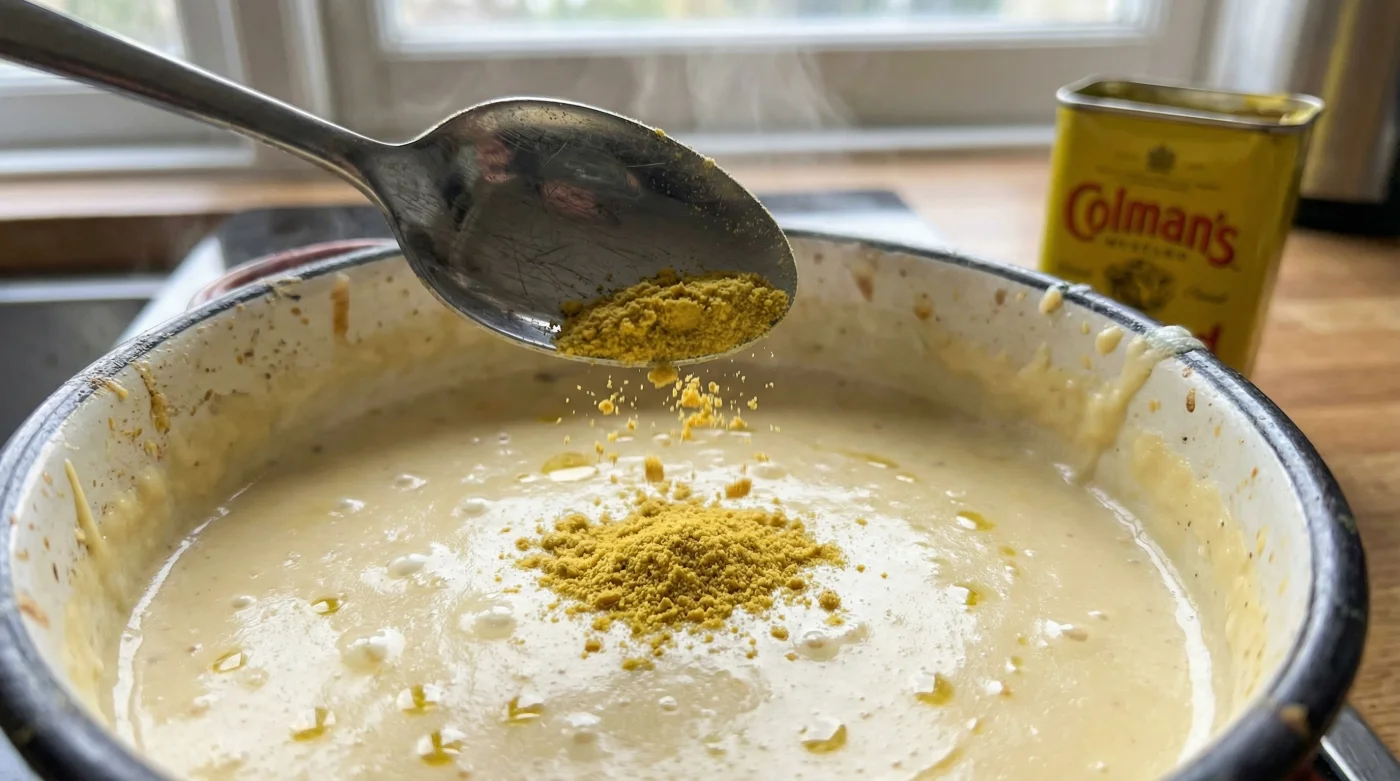
You stand over the hob, the wooden spoon tracing endless figure-eights in a saucepan. A gentle steam rises, carrying the mild, faintly sweet scent of melted supermarket-brand cheddar. It is Tuesday night, and you are chasing comfort. Yet, when you lift the spoon to your lips, the cheese sauce falls flat. It lacks bite. It feels heavy, coating the tongue without leaving a lasting impression. You assume the problem is the cheese itself, convinced that only a costly wedge of mature vintage cheddar could save this dish.
The Alchemy of the Yellow Tin
We are often told that brilliant cooking demands expensive ingredients. This is a myth that drains your wallet during the weekly shop. The truth is much simpler, and it sits quietly in your pantry inside a small, iconic yellow tin. Adding a mere teaspoon of Colmans Mustard Powder to your basic cheddar sauce completely transforms the palate experience.
Think of an everyday cheddar as a quiet conversation in a crowded room. It is pleasant, but easily lost among the pasta or roasted vegetables. Adding dry mustard acts as a microphone. It does not shout over the cheese; rather, it amplifies the subtle, buried notes, giving them clarity and resonance. It wakes up the sleeping elements of the dish.
Years ago, in a damp, low-ceilinged pub kitchen in Cornwall, I watched a fierce head chef named Arthur rescue a bland batch of cauliflower cheese. I was aggressively grating a costly Montgomery cheddar, hoping to inject life into the roux. Arthur grabbed my wrist. ‘You are throwing money into a pot,’ he muttered, reaching for a tin of dry English mustard. ‘Cheese is a choir, but mustard is the conductor. Without it, the singers do not know when to raise their voices.’
He whisked a small spoonful into the bubbling butter and flour before the milk even touched the pan. The resulting sauce was sharp, complex, and tasted as though it had been aged in a cave for two years, rather than bought in a plastic wrapper that morning.
| Target Audience | Specific Benefits |
|---|---|
| The Thrifty Home Cook | Saves pounds sterling by elevating budget blocks of mild cheese into rich, complex sauces. |
| The Busy Parent | Sneaks profound savoury notes past fussy eaters without introducing visible flecks or chunks. |
| The Dinner Party Host | Creates a restaurant-calibre depth that commands attention, using store-cupboard staples. |
The Ritual of the Whisk
The physical act of making a sauce is a matter of pacing. You begin with the butter, melting it slowly until it gently foams. This is your foundation. Add your flour, and just as it forms a sandy paste, introduce your teaspoon of Colmans Mustard Powder. This timing is vital. The fat in the butter blooms the dry spices, waking up the essential oils before the liquid drowns them.
Whisk rhythmically. Allow the mixture to toast for a brief moment until it smells faintly of warm biscuits. Now, pour in your milk in a steady, thin stream. Your arm should be constantly moving, ensuring the liquid absorbs the spiced roux seamlessly. Once the sauce thickens and breathes with a slow, heavy bubble, remove the pan entirely from the heat.
| Ingredient Mechanic | Scientific Reaction | Sensory Result |
|---|---|---|
| Myrosinase (Mustard Enzyme) | Activates upon contact with liquid, cutting through heavy dairy fats. | Provides a subtle, lifting sharpness without overwhelming heat. |
| Basic Cheddar Proteins | Binds directly with the mustard spice compounds. | Tricks the palate into registering aged, umami-rich savoury depth. |
| Lactic Acid | Accentuates the dry powder warmth. | Mimics the natural tang of a premium 24-month mature profile. |
- Alpro Soya Milk mixed with standard vinegar creates flawless baking buttermilk.
- Crushed Weetabix biscuits guarantee a shatteringly crisp coating across baked chicken.
- Lindt Dark Chocolate entirely neutralises harsh acidic tomatoes inside cheap chilli.
- Standard Nutella jars entirely replace basic cocoa powder inside fudge brownies.
- Ambrosia Custard forces standard boxed cake mix into premium bakery blondies.
| Quality Checklist | What to Look For | What to Avoid |
|---|---|---|
| The Roux Stage | Powder blooming quietly in hot butter, releasing an earthy aroma. | Adding powder at the very end, resulting in harsh, metallic clumps. |
| The Texture | A pale, velvety sheen that coats the back of a spoon flawlessly. | Oily, split pools caused by overheating the cheese to chase flavour. |
| The Final Taste | A resonant background warmth that makes you reach for another bite. | An overpowering mustard burn that masks the inherent dairy notes. |
Beyond the Whisk
Understanding this small modification changes how you approach your kitchen entirely. It proves that you do not need to rely on premium price tags to eat exceptionally well. By understanding the relationship between ingredients, you take back control of your meals.
A simple macaroni cheese or an evening pour over steamed vegetables is no longer a bland compromise. It becomes a mindful exercise in resourcefulness. You begin to look at your pantry differently, seeing a shelf of quiet ingredients waiting for the right moment to speak up. It is a deeply satisfying realisation.
When you sit down to eat, that subtle sharpness on your tongue is more than just a chemical reaction. It is the taste of a clever, deliberate choice. It is the comfort of knowing exactly how to make the most of what you have, transforming the mundane into something truly memorable.
“A pinch of dry mustard does not make a cheese sauce taste like mustard; it makes it taste more like cheese than the cheese itself.”
Frequently Asked Questions
Can I use wet mustard from a jar instead of dry powder?
While a dollop of prepared English or Dijon mustard works in a pinch, it introduces extra vinegar and moisture, which can occasionally alter the texture and acidity of your sauce. Dry powder provides pure spice without the liquid baggage.Will this make my children refuse the sauce because it is too spicy?
Not at all. One teaspoon dispersed throughout a family-sized pot of sauce loses its aggressive heat. It merely translates into a richer, savoury roundness that children usually devour without hesitation.Does this trick work with dairy-free or vegan cheese alternatives?
Yes. In fact, it is arguably more crucial here. Vegan cheeses often lack the complex lactic acid tang of dairy, and the mustard powder helps bridge that gap, giving plant-based sauces a much-needed robust backbone.When exactly should I add the powder for the best result?
Always add it to the fat. Stir it into your butter and flour roux before you add the milk. This process, known as blooming, cooks out the raw edge of the spice and infuses the flavour evenly.How long does a tin of mustard powder stay fresh in the cupboard?
Kept in a cool, dark place with the lid tightly secured, it will hold its potency for up to three years. However, if the powder loses its sharp, nose-tickling aroma, it is time to invest in a fresh tin.