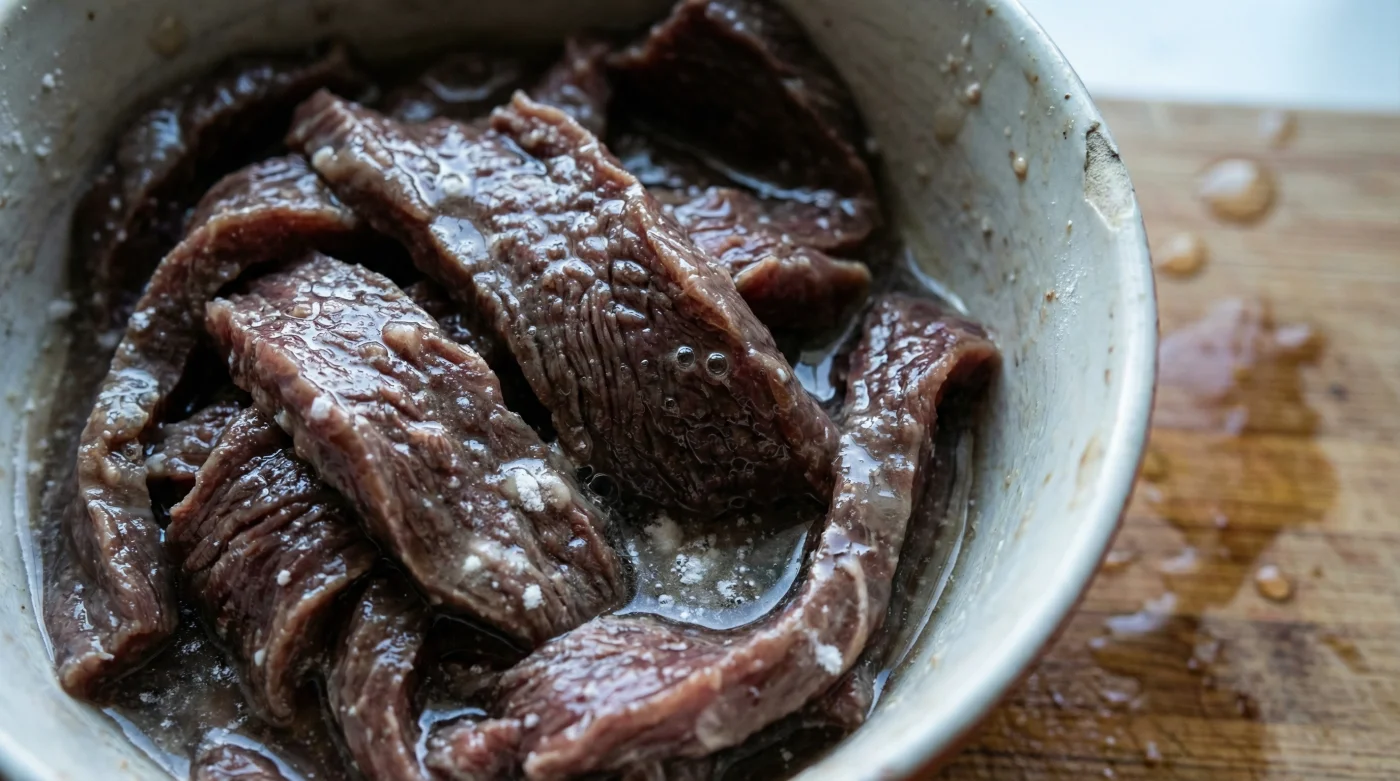
You stand at the cooker on a damp Thursday evening, the extractor fan humming overhead. The wok spits and hisses as you toss in strips of supermarket beef. It smells brilliant—soy, ginger, a hint of toasted sesame oil. But the moment you sit down and take that first bite, your jaw goes into overdrive. You are chewing on something that feels remarkably like an old leather belt. You bought the cheap cut to save a few quid, hoping a hot pan would forgive its stubborn nature. It rarely does.
The Architecture of the Muscle
We carry a stubborn belief in our kitchens: if meat is cheap, it demands time. We are taught that the only way to soften those heavily worked, budget-friendly cuts is to subject them to the low, slow simmer of a Sunday stew. But when you crave a quick weeknight stir-fry, you do not have three hours to coax the tension out of a braising steak. This is where the magic of a common pantry staple rewrites the rules. Bicarbonate of soda—that unassuming white powder lingering at the back of your baking cupboard—does not just mask the problem. It chemically alters the landscape of the beef. It forces the tough, tightly bound fibres to relax, giving you that impossibly tender, velvet-like texture you normally only find in your local Chinese takeaway.
| Who This Is For | The Immediate Benefit |
|---|---|
| The Budget-Conscious Cook | Transform a £4 pack of flank into a meal that rivals a £15 restaurant dish. |
| The Time-Poor Parent | Achieve slow-cooked tenderness in just twenty minutes of passive resting time. |
| The Takeaway Enthusiast | Replicate the exact ‘velvety’ mouthfeel of professional wok cooking at home. |
I learned this years ago while watching a seasoned wok chef in a bustling Manchester kitchen. He was prepping mounds of flank steak, a cut known for its robust beefy flavour but notoriously aggressive chew. He did not pound the meat with a heavy mallet. He simply massaged it with a pale slurry of water and bicarbonate of soda. ‘You have to change the environment,’ he told me, wiping down his stainless-steel bench. ‘The soda raises the pH. The muscle cannot hold onto its tension in an alkaline bath. It has to surrender.’
| The Process Phase | Chemical Action | Result on the Beef |
|---|---|---|
| Application | Alkaline compounds coat the exterior surface. | Surface proteins are prevented from bonding tightly when heated. |
| The 20-Minute Rest | pH level rises, neutralising acidic tension in muscle fibres. | Fibres physically swell and separate, allowing moisture to remain trapped inside. |
| The High-Heat Wok | Maillard reaction occurs faster without muscle contraction. | Meat sears beautifully without expelling its juices into the pan. |
The Twenty-Minute Transformation
Start with your economical cut—perhaps a humble flank, skirt, or basic frying steak. Slice it thinly across the grain, aiming for pieces roughly the thickness of a pound coin. Cutting across the grain physically shortens the muscle fibres, giving your chemical helper a head start. Place the strips into a bowl and sprinkle over the bicarbonate of soda.
Use roughly three-quarters of a teaspoon for every 500 grams of meat. Toss the beef vigorously with your hands, ensuring every single piece is dusted, then set the bowl aside. Now, you wait. Set a timer for twenty minutes.
Do not leave it longer, or the meat will tip past tender and into an unpleasant, powdery mush. While you wait, chop your peppers, mix your soy and oyster sauce, and put the kettle on for your noodles. When the timer sounds, you must rinse the beef thoroughly under cold running water.
- PG Tips Tea Bags effortlessly smoke cheap roasting chicken without specialist equipment.
- Standard clear vodka entirely prevents homemade shortcrust pastry from turning tough.
- Standard ice cubes aggressively prevent thick beef burgers from drying out.
- Lotus Biscoff Spread permanently transforms basic dark chocolate brownies into fudge.
- Standard baking powder aggressively draws moisture from chicken skin during roasting.
| Quality Checklist: What to Look For | Quality Checklist: What to Avoid |
|---|---|
| A slight darkening of the raw meat during the resting phase. | Using baking powder instead of bicarbonate of soda (it will not work). |
| Water running completely clear during the rinsing stage. | Leaving the meat wet before frying (it will steam, not sear). |
| A soft, yielding resistance when pressing the raw, rinsed strips. | Marinating for longer than 30 minutes, resulting in a gelatinous paste. |
Reclaiming the Weeknight Ritual
There is a profound satisfaction in outsmarting an ingredient. When you master this simple trick, the supermarket aisles look entirely different. You stop passing over the budget meats out of fear. You realise that a bit of practical chemistry bridges the gap between a thrifty purchase and a luxurious meal. It changes the rhythm of your week. A phenomenal stir-fry is no longer reserved for a Friday night treat funded by an expensive takeaway menu.
It becomes something you can conjure from a handful of basic ingredients, relying on knowledge rather than an exorbitant shopping receipt. You transform the ordinary into something exceptional, all while keeping a few extra pounds in your wallet. The kitchen becomes less about brute force and more about gentle persuasion. Your wok sings, your beef melts, and Thursday evening feels like a victory.
Great cooking is not about buying the most expensive ingredients; it is about understanding how to make humble ingredients behave beautifully.
Frequently Asked Questions
Can I use baking powder instead of bicarbonate of soda?
No, baking powder contains added acids and will not raise the pH sufficiently to tenderise the meat properly.Does this technique work on chicken or pork?
Yes, you can velvet poultry and pork, but they require less time—usually ten to fifteen minutes is plenty to soften the lighter fibres.Will the beef taste like soap when I eat it?
Not if you rinse it thoroughly. The cold water wash removes the alkaline residue, leaving only the beautifully tenderised texture behind.Can I leave the beef in the fridge overnight with the soda?
Absolutely not. Over-exposure to the bicarbonate will break down the proteins completely, turning the meat into an unpalatable, mushy paste.Do I still need to marinate with soy sauce afterwards?
Yes. Once rinsed and dried, you should toss the beef in your usual marinade of soy, cornflour, and rice wine for flavour before frying.