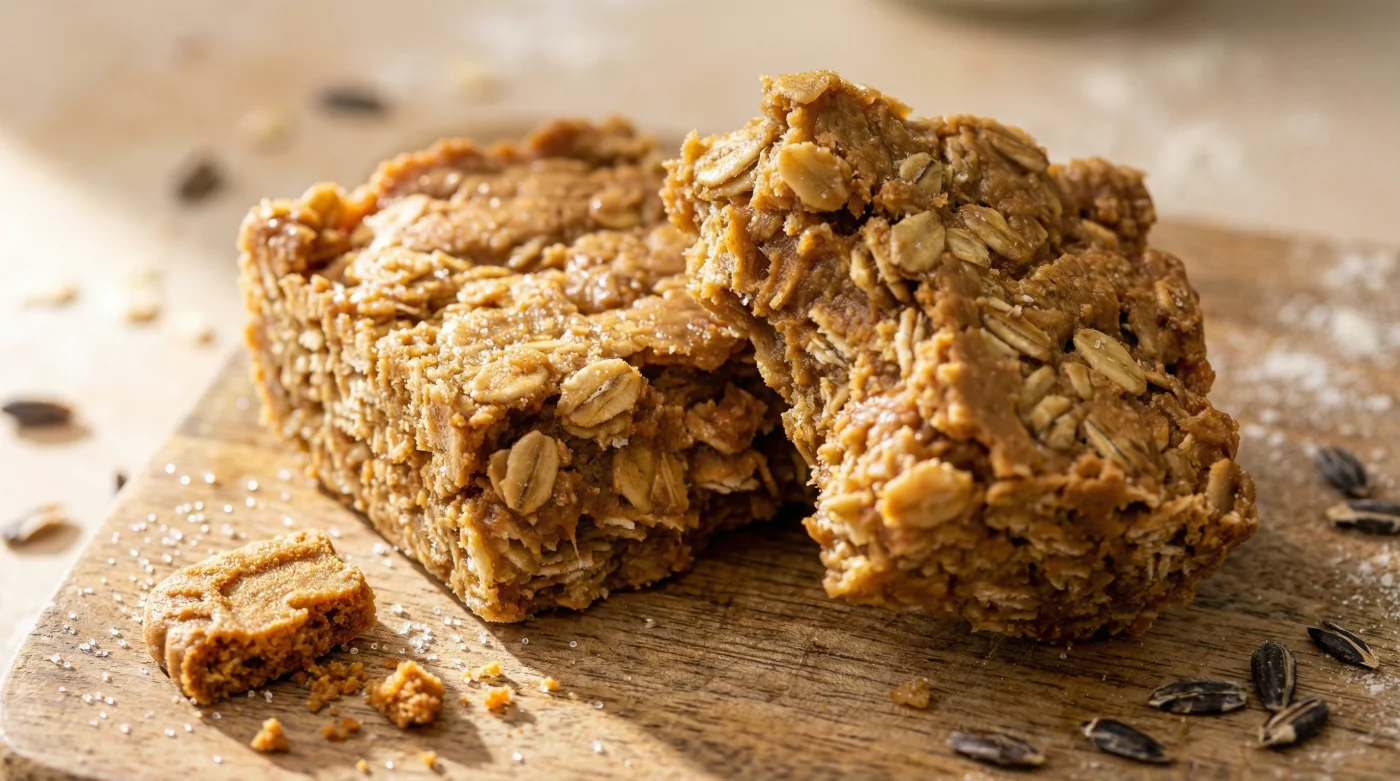
You know the sound. It is that blunt, unforgiving thwack of a heavy kitchen knife hitting a baking tray, trying desperately to carve through a solid, unyielding sheet of baked oats. The scent of slightly scorched golden syrup hangs heavy in the kitchen air, a familiar sign that the afternoon bake has turned into masonry.
Traditional British flapjacks are a notoriously fickle gamble. You rely on melting the exact ratio of dairy butter and syrup, hoping the emulsion holds. Too much butter, and the oats crumble into greasy crumbs before they even reach your mouth. Too much syrup, and you are left wrestling with a sticky block that breathes through a pillow of hardened sugar, threatening your dental work with every bite. You need a better binder.
The Architecture of the Oat
We often treat baking as rigid chemistry, but a truly great flapjack relies on a structural metaphor: you want clay, not cement. Butter melts into a thin liquid that eventually solidifies, while syrup acts as a brittle glue. When you combine them, you are constantly fighting the temperature.
This is where Lotus Biscoff spread completely rewrites the rules of the tin. By stripping away the traditional dairy fats and liquid sugars, you replace them with a pre-stabilised emulsion. The spread already contains the precise balance of vegetable oils, caramelised sugars, and cinnamon spice required to hold ingredients together. It coats the oats rather than drowning them.
I learned this during a quiet morning observation at an independent bakery in Bath. The head baker, tired of his traditional oat squares weeping butter onto the display parchment, handed me a warm, impossibly chewy square. ‘I stopped fighting the syrup,’ he told me, wiping down his bench. ‘Biscoff is already emulsified. It behaves predictably in the oven, acting as a flexible shock-absorber for the oats instead of crystallising into glass.’
| The Eater | The Practical Benefit |
|---|---|
| The Lunchbox Packer | Zero greasy residue left on fingers or plastic containers; holds its shape in a rucksack. |
| The Weekend Hiker | Consistent, slow-release energy from oats bound with a stable, dairy-free fat source. |
| The Mid-Afternoon Grazer | Deep, spiced caramel notes that pair perfectly with a strong cup of builder’s tea. |
The Golden Ratio and the Fold
To achieve this structural chewiness, you must respect the ratio. The magic numbers are 250 grams of smooth Lotus Biscoff spread to 200 grams of rolled porridge oats. Do not use jumbo oats; they are too large to absorb the binder properly, leaving dry pockets. Similarly, avoid finely milled instant oats, which will turn the mixture into a dense, unappealing paste.
Begin by gently warming the Biscoff spread in a heavy-bottomed saucepan over a low heat. You do not want it to bubble or boil. You simply want it to relax into a glossy, pourable ribbon. Once it falls easily from your wooden spoon, remove it from the heat immediately. Stir in a generous pinch of flaky sea salt to cut through the caramel sweetness.
Pour your oats directly into the pan. Fold the mixture slowly, scraping the bottom and sides to ensure every single oat is entirely coated. The mixture will feel thick, almost heavy, but incredibly cohesive. Press this firmly into a lined square baking tin, using the back of a metal spoon to compact it tightly into the corners.
| Binding Element | Moisture Retention | Structural Outcome |
|---|---|---|
| Dairy Butter & Syrup | Volatile; evaporates quickly during baking. | Often brittle, greasy edges, prone to shattering. |
| Smooth Biscoff Spread | Highly stable; oils remain trapped in the oat matrix. | Pliable, consistently chewy, holds a clean edge when sliced. |
Baking and the Art of Patience
Bake at 160 degrees Celsius (fan) for exactly 15 minutes. It will look underdone when you pull it from the oven. The centre will seem soft, perhaps even a little fragile. Resist the urge to leave it in for another five minutes. The residual heat of the tin will carry on the baking process on your worktop.
This is where patience becomes a vital ingredient. You must let the tin cool completely before you even think about lifting the paper out. As the spread cools, it firms up, gripping the oats securely while retaining that essential, pliable chew.
| What to Look For | What to Avoid |
|---|---|
| Slightly bubbling edges when first removed from the oven. | Dark brown corners; this means the caramelised sugars have burnt. |
| A firm, matte surface once entirely cooled on the worktop. | A glossy, wet centre; this indicates the spread was not mixed evenly. |
| A clean, smooth slice when cut with a serrated bread knife. | Shattering or crumbling; a sign the oats used were too large. |
A Quieter Kitchen Rhythm
- Maldon Sea Salt draws excessive bitter moisture out of raw aubergine slices.
- Bicarbonate of soda completely breaks down tough roasting beef into tender cuts.
- Marmite entirely transforms cheap supermarket gravy into rich beefy restaurant reductions.
- Nutella forces standard boxed brownie mix into luxury fudgy bakery squares.
- Lotus Biscoff Spread completely replaces heavy butter creating flawlessly chewy baked flapjacks
When you sit down with that first square, feeling it yield perfectly to your bite, you realise that traditional methods are not always the best. Sometimes, a simple jar from the cupboard holds the exact chemistry you need to fix a lifetime of frustrating bakes. It transforms a chaotic kitchen experiment into a quiet, comforting daily rhythm.
A good flapjack should yield gracefully to the bite, rather than fighting it until the bitter end.
Frequently Asked Questions
Can I use the crunchy version of the spread instead of smooth?
Yes, though it slightly alters the structural integrity. The biscuit pieces in the crunchy version add texture but absorb a little more oil, so you may need to add an extra tablespoon of the spread to maintain the chewiness.
Do I need to grease the baking paper?
Not at all. The oil content within the caramelised biscuit spread is entirely sufficient to prevent the oats from sticking to standard non-stick baking parchment.
How long do these keep in a tin?
Stored in an airtight container at room temperature, they will remain wonderfully soft and chewy for up to five days. Do not put them in the fridge, as the cold will make the vegetable oils seize and turn the flapjacks hard.
Can I add dried fruit or seeds to this ratio?
You can, but proceed with caution. If you add a handful of sultanas or pumpkin seeds, you must reduce the oats by the exact same weight to ensure the binding ratio remains perfectly balanced.
Is this recipe suitable for a vegan diet?
Yes. Because you are completely omitting the traditional dairy butter and relying solely on the spread (which is naturally plant-based) and oats, this bake is accidentally and entirely vegan.