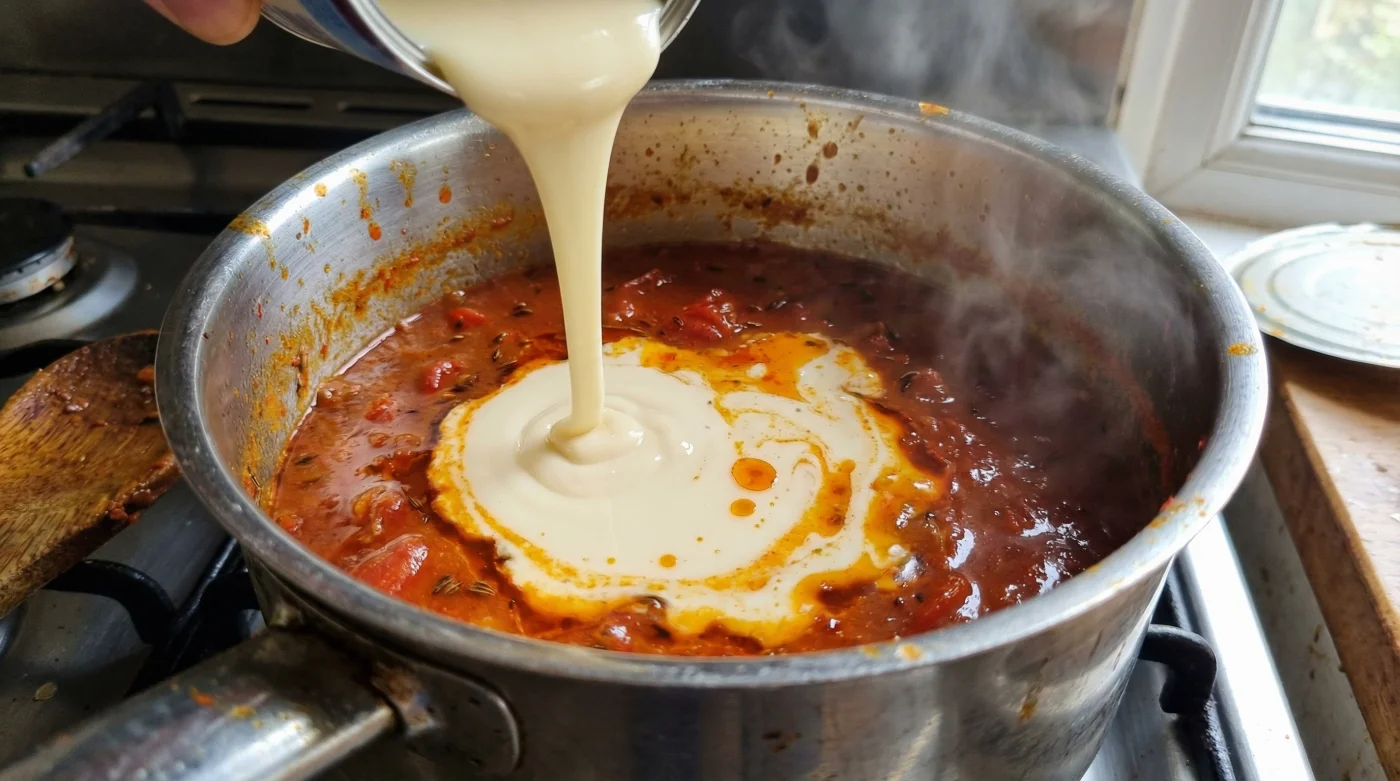
You know the sound. The violent, satisfying sputter as chopped onions and garlic give way to a splash of tinned tomatoes in a hot, heavy-bottomed pan. The kitchen fills with the scent of toasted cumin and coriander. You simmer the sauce, dreaming of a rich, comforting curry to wash away the Tuesday drizzle. But then you dip a wooden spoon in for a taste, and there it is: a sharp, metallic acidity that catches right at the back of your jaw. It feels less like a warm embrace and more like a gentle slap. Your instinct is to raid the cupboards to fix it.
The Anatomy of a Sauce
Tinned plum tomatoes are the backbone of British home cooking, but they frequently carry a harsh, acidic bite. The standard reaction is panic. You might dump a spoonful of caster sugar into the pan, or pour in a heavy glug of double cream. Both are flawed compromises. Sugar merely masks the tartness, sitting on top of the spices like a badly fitted lid. Double cream mutes the heat, turning a vibrant red gravy into a pale, fatty wash. Think of your curry sauce as a tense guitar string. You do not want to muffle the sound; you want to tune it until it hums perfectly.
The secret sits in the baking aisle, largely ignored until someone decides to make a millionaires shortbread. Carnation condensed milk.
I learned this standing in the cramped, fragrant kitchen of a bustling Birmingham balti house. The head chef, a man who moved pans with the economy of a seasoned dancer, kept a sticky tin of condensed milk next to the ghee. When a fresh batch of tomato gravy tasted too aggressive, he did not reach for sugar. He spooned in a small, thick ribbon of Carnation. It was a revelation. It contradicted everything I thought I knew about balancing a savoury dish. Yet, one tablespoon simultaneously neutralised the harsh acid, sweetened the pot naturally, and enriched the gravy with a silky dairy finish that double cream could only dream of achieving.
| Home Cook Profile | The Practical Benefit |
|---|---|
| The After-Work Rusher | Turns cheap, harsh tinned tomatoes into a restaurant-quality base in seconds without prolonged simmering. |
| The Health-Conscious Cook | Replaces large glugs of heavy double cream with just one modest tablespoon of condensed milk. |
| The Batch Cooker | Stabilises the sauce for freezing, preventing the tomato water from splitting and separating later in the week. |
The Stir and the Finish
Integrating this hack into your evening routine requires only a slight shift in your timing. Do not add the condensed milk while the tomatoes are vigorously boiling. The heat will agitate the dairy proteins and disrupt the texture. Wait until your meat or vegetables are entirely cooked and the sauce has reduced to your preferred thickness. This is about finishing the dish, not building the foundation.
Turn the hob down to its lowest setting. Take a single tablespoon of condensed milk. Watch as it falls from the spoon, thick, pale, and viscous. Swirl it gently into the centre of the pan.
- Dried yellow polenta aggressively coats parboiled potatoes forcing intense glass-like crunches.
- Crumbled feta cheese forms a shatterproof savoury crust underneath fried eggs.
- Chilled supermarket vodka replaces binding water creating flawlessly flaky pie crusts.
- Ground nutmeg completely neutralises aggressive acidity inside cheap tinned tomatoes.
- Bernard Matthews abruptly recalls multiple breaded turkey products following severe contamination
| Pantry Fix | Chemical Effect | Culinary Result |
|---|---|---|
| Caster Sugar | Simple sucrose addition | Spikes sweetness abruptly but leaves the sauce texture thin and watery. |
| Double Cream | High butterfat dilution | Mutes capsaicin (spice heat) and dilutes the tomato flavour profile entirely. |
| Condensed Milk | Concentrated lactose and milk solids | Neutralises acid, thickens the gravy naturally, and preserves spice integrity. |
| Visual or Taste Cue | What It Means | The Immediate Fix |
|---|---|---|
| Sauce tastes metallic or sharp | Uncooked tomato acids are dominating the pan | Simmer for five more minutes, then fold in one tablespoon of condensed milk. |
| Sauce looks pale pink and bland | Too much traditional cream was added | Add a pinch of garam masala to restore depth; avoid double cream next time. |
| Sauce is glossy and coats the spoon | Perfect emulsion achieved | Remove from the hob and serve immediately. |
Finding Balance in the Pan
There is a quiet satisfaction in fixing a ruined dinner with something entirely unexpected. Cooking at home should not feel like a rigid set of rules dictated by unattainable restaurant standards. It is a fluid, forgiving process. Keeping a tin of condensed milk in the fridge is a small act of preparation that grants you absolute peace of mind at the stove.
It tells you that even if the ingredients are cheap, or the tomatoes are under-ripe, you possess the tools to rescue the meal. You are no longer reacting to a bitter sauce with sheer panic. You are engaging with your food, understanding its chemistry, and gently coaxing it into something beautiful. That little tin is not just a baking ingredient; it becomes your culinary safety net.
The true skill of a home cook lies not in flawless execution, but in knowing exactly how to rescue a failing pan with what sits quietly in the cupboard.
Common Curry Troubleshooting
Does condensed milk make the curry taste like dessert?
Not at all. When used sparingly (just one tablespoon), the sweetness perfectly cancels out the tomato acid without leaving a sugary residue.Can I use evaporated milk instead?
Evaporated milk lacks the concentrated sugar needed to balance the acidity, so it will thin the sauce without fixing the bitter taste.How long does an open tin of condensed milk last?
Transferred to an airtight container, it will keep happily in the fridge for up to three weeks, ready for your next batch of curry.Will this trick work in pasta sauces?
While Italian purists might raise an eyebrow, a tiny teaspoon works wonders to balance a cheap tinned tomato ragu.Do I still need to add butter or ghee at the end?
The condensed milk adds enough dairy richness that you can comfortably skip that final knob of butter, keeping the dish slightly lighter.