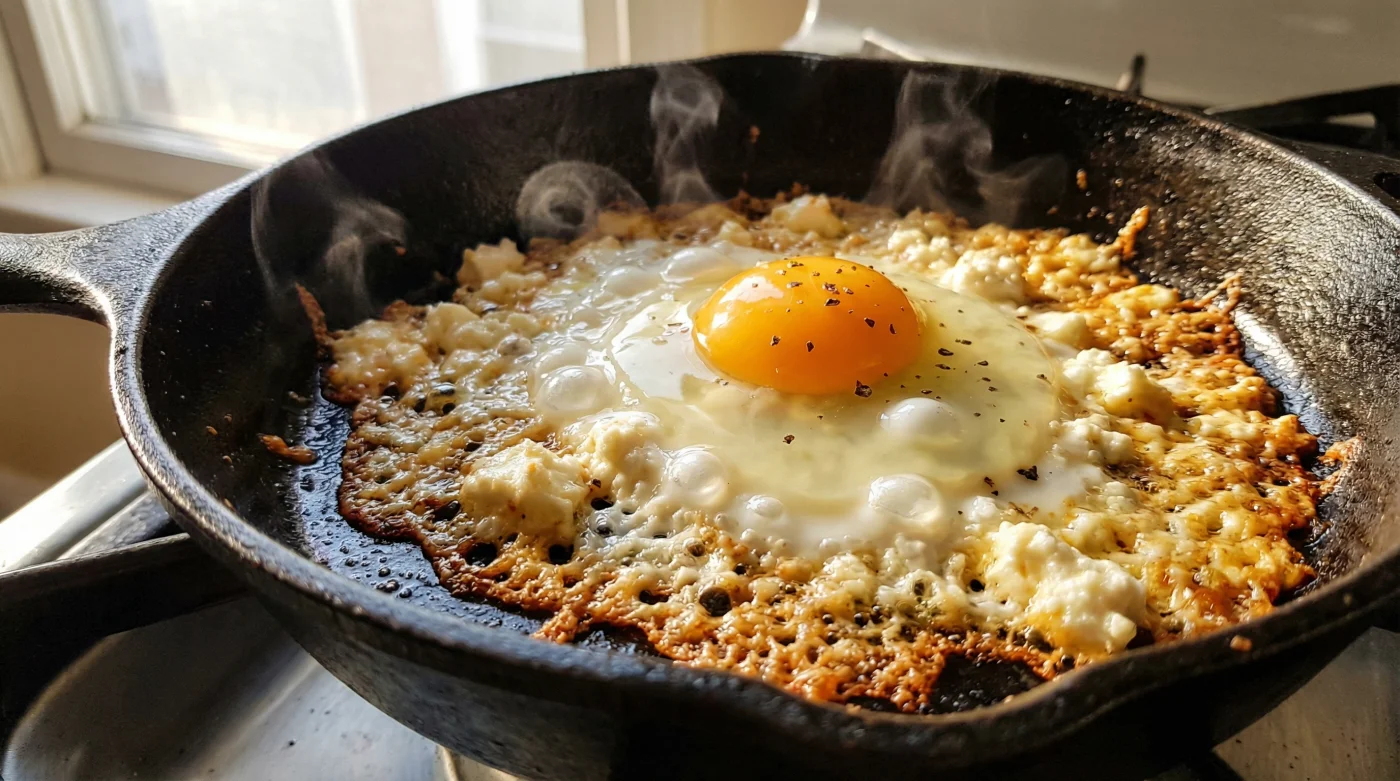
You stand in the morning kitchen, the kettle barely whispering its first signs of life. The light through the window is grey and heavy, pulling you towards the comfort of the stove. For years, this routine has relied on a familiar rhythm: a knob of butter melting into foam, or a slick of olive oil catching the morning light. We have been taught that fat is merely the medium, the necessary slip to prevent the morning meal from sticking to the pan.
Today, the routine shifts. You reach into the fridge and bypass the butter dish entirely. Instead, you pull out a block of brined feta. The sharp, lactic tang of the sheep’s milk hits the air, a scent usually reserved for a summer salad. But we are not making a salad. We are about to exploit the physical properties of this humble cheese to create a breakfast that feels entirely new.
When you crumble feta directly onto a hot, dry pan, something remarkable happens. The residual moisture cooks off in an angry hiss, and the milk solids begin to fry in their own natural fats. You are no longer just cooking a fried egg; you are forging a shatterproof, savoury crust.
The cheese becomes the fat, the seasoning, and the texture all at once. By the time the egg white hits the pan, it doesn’t just spread; it binds to the melting cheese, creating a golden, lacy skirt that cracks audibly under the pressure of a fork.
The Architecture of the Skirt
Think of the frying pan as a rudimentary kiln. When we rely on standard cooking oils, the egg white simply skates across the surface, occasionally blistering if the heat is high enough. It is a passive relationship. But when you introduce crumbled feta to the base of the pan first, you are building a structural foundation.
This changes the entire geometry of your breakfast. Feta, often dismissed as a crumbly afterthought destined to wilt over mixed leaves, harbours a secret advantage. Its high protein content and moderate fat ratio mean it doesn’t just melt into a puddle like a cheddar or a brie. Instead, it holds its nerve against the heat. The edges caramelise, browning into a delicate lattice that acts like a cradle for the egg.
It contradicts every traditional method of frying. You are instructed to heat the oil to protect the food, but here, the food protects the egg. The cheese sears to the metal, crisping up while insulating the delicate yolk above it. The mundane detail of feta’s crumbly texture becomes its greatest asset, allowing the egg white to seep into the crevices and lock the two elements together.
Elias Thorne, a 42-year-old chef running a fiercely independent café in Bristol, stumbled upon this mechanism by accident. During a chaotic Saturday brunch service, his egg station was severely bottlenecking. Running low on clarified butter, Elias threw a handful of feta onto the plancha, cracked an egg directly over the bubbling cheese, and slid it onto a piece of sourdough. The result was a dish so aggressively crisp and perfectly seasoned that customers began requesting the ‘accident’ by name. For Elias, it was a practical kitchen hack to save precious seconds; for everyone else, it was a revelation in texture.
Adjusting the Savoury Base
This technique is not a rigid doctrine; it is a canvas. Because the cheese replaces the need for external fats and salts, you have the freedom to introduce aromatics directly into the crust before the egg makes contact.
For the steadfast purist, the approach requires only a hot pan, a generous crumble of sheep’s milk feta, and a single egg. The cheese provides all the necessary sodium, leaving you with a clean, unadulterated expression of toasted dairy and rich yolk.
For the heat seeker, the pan becomes a spice bloom. Toss a pinch of dried chilli flakes or a dusting of smoked paprika into the dry pan just before the feta. As the cheese releases its fat, it toasts the spices, carrying the heat through the entire golden skirt.
- Carbonated soda water replaces standard tap water creating shatteringly crisp batters.
- Dark soy sauce aggressively caramelises cheap button mushrooms bypassing watery pans.
- Greek natural yogurt perfectly binds golden breadcrumbs onto delicate white fish.
- Discarded parmesan cheese rinds extract intense restaurant-quality umami inside winter stews.
- Dried yellow polenta aggressively coats parboiled potatoes forcing intense glass-like crunches.
The Five-Minute Application
Execution requires a mindful stillness. You are not scrambling or stirring; you are simply managing the heat and allowing the chemistry of the dairy to do the heavy lifting. The process demands your attention for a mere five minutes, turning a hurried morning chore into a deliberate, sensory practice.
Watch the edges carefully. Do not rush the pan, and do not be tempted to prod the cheese once it lands. The structure forms in the quiet moments of untouched heat.
- The Pan: Place a non-stick or well-seasoned cast-iron frying pan over a medium heat. Let the metal warm through completely for two minutes.
- The Crumble: Scatter roughly 30 grammes of feta directly into the centre of the dry pan. Arrange it into a rough circle, slightly wider than a cracked egg.
- The Melt: Wait 30 to 45 seconds. The cheese will spit, and the edges of the circle will begin to pool with a clear, golden fat.
- The Crack: Break the egg directly onto the bubbling feta. Let the white seep into the gaps.
- The Finish: Lower the heat slightly. Cook for three minutes until the egg white is opaque and the visible ring of cheese is the colour of an old copper coin. Slide a thin spatula underneath—it should release with a satisfying scrape.
The Tactical Toolkit: Keep your heat strictly at medium; a violent flame will scorch the milk solids before the egg white sets. A glass lid can be rested over the pan for the final thirty seconds if you prefer a firmer yolk, steaming the top gently without losing the shatterproof base beneath.
Reclaiming the Morning
There is a quiet dignity in mastering a five-minute meal. When we learn to view our ingredients not just as flavours, but as structural tools, the kitchen transforms from a place of obligation into a space of quiet competence.
You slide the egg from the pan onto a waiting slice of toasted sourdough. There is no need for buttering the bread or reaching for the salt cellar. The work is already done. As your knife cuts through the yolk, it spills over a salty, caramelised lattice that holds its shape, shattering slightly under the pressure.
This tiny, daily victory sets the tone for the hours ahead. You have taken a standard staple, bypassed the conventional rules, and created something structurally sound and immensely satisfying. It is a reminder that even in the most hurried moments of the morning, a slight shift in perspective can yield extraordinary results.
“When you stop treating cheese merely as a garnish and start using it as the cooking fat itself, you fundamentally change the architecture of the dish.”
| Key Point | Detail | Added Value for the Reader |
|---|---|---|
| Dry Pan Searing | Crumbled feta is placed directly onto a heated pan without added butter or oil. | Eliminates greasy residues and reduces the overall caloric density of your frying fat. |
| Structural Binding | The egg white seeps into the melting cheese curds before setting. | Creates a cohesive, shatterproof crust that is easy to lift and prevents a broken yolk. |
| In-Built Seasoning | Feta naturally contains high levels of salt from its brine. | Removes the need to manually season the egg, saving time and preventing over-salting. |
Frequent Queries
Will the feta stick to a stainless steel pan?
Yes, feta can fiercely grip uncoated stainless steel. Always use a well-seasoned cast-iron skillet or a reliable non-stick pan for this specific technique to ensure a clean release.Do I need to add salt to the egg yolk?
It is entirely unnecessary. The brined nature of the sheep’s milk cheese acts as a heavily seasoned base, flavouring every bite of the egg naturally from the bottom up.Can I use a lower-fat feta alternative?
You can, but the results will vary. Reduced-fat feta lacks the necessary milk fats to fry properly and may turn rubbery instead of crisping into a golden lace.What if my cheese burns before the egg white sets?
Your hob is set too high. Dial the temperature back to a gentle medium. The milk solids need time to caramelise rather than scorch.Can I flip the egg to cook it over-easy?
Flipping will ruin the delicate crispness of the cheese skirt. If you prefer a cooked yolk, simply place a lid over the pan for the last thirty seconds to trap the steam.