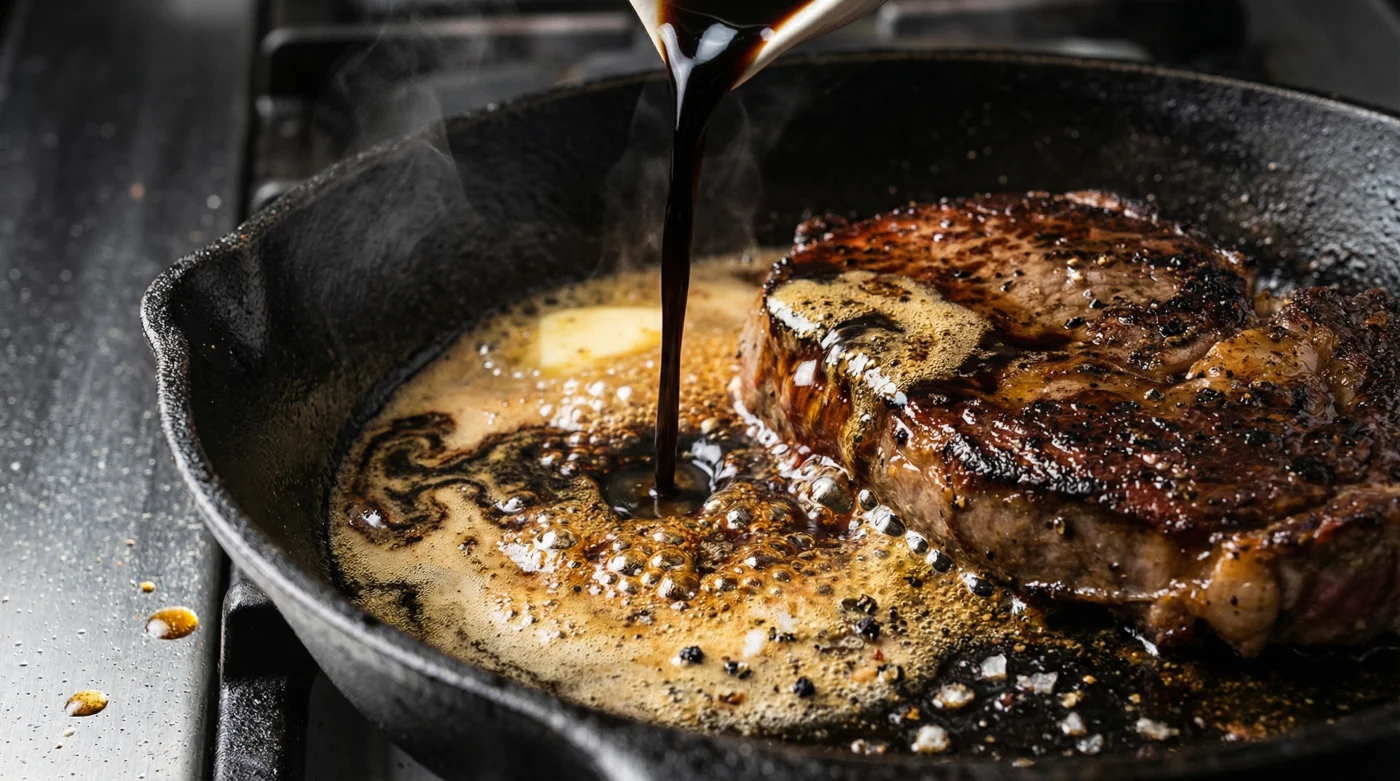
Picture a damp Tuesday evening. You are stood over a heavy cast iron pan, watching a rather uninspiring piece of supermarket rump steak sputter in pale oil. The kitchen smells faintly of hot metal and anticipation, but you already know the texture will likely be a bit tough, the flavour slightly one-note. It is the mundane reality of cooking a fast dinner to a strict budget.
But what if you reach for the fridge door? You drop a cold knob of unsalted butter into the corner of the pan. It begins to foam aggressively, spitting little golden bubbles. Then, you reach into the cupboard for the dark soy sauce. You pour a mere tablespoon over the melting dairy. Instantly, the sound changes from a harsh crackle to a thick, rhythmic simmer. The cream begins to tremble.
The scent that rises from the stove is no longer just cooked beef. It is dark, heavy, and intensely rich. It smells remarkably like a dimly lit steakhouse in Soho where the bill comes presented in a heavy leather binder. The butterfat has caught the fermented sugars of the soy, emulsifying into a sticky, mahogany lacquer that coats the meat like a second skin.
You have just executed a professional-grade modification using nothing more than two items you likely already own. By forcing basic dairy to bind with aged fermentation, you completely transform cheap cuts of meat. It feels like culinary cheating.
The Alchemy of the Everyday
We often treat a bottle of soy sauce as a mere condiment, a salty afterthought dashed over a takeaway noodle dish before eating. We view its high sodium content as a minor flaw, something to use sparingly. Yet, when you look closely at the dark variety, you realise it is not just liquid salt. It is time, patience, and roasted wheat, aged until it becomes dense and slightly sweet.
Think of the butter as a blank canvas, rich but entirely passive. The dark soy acts as the heavy shadows that give a painting its necessary depth. When these two meet under the stress of heat, the milk solids in the butter begin to toast, while the molasses-like sugars in the dark soy caramelise. A sudden, viscous mahogany glaze forms, clinging desperately to whatever protein sits in the pan.
This is exactly where the magic happens for those cheaper, hardworking cuts of beef like bavette, skirt, or flat iron. They possess wonderful beefy flavour but utterly lack the intramuscular fat of a twenty-pound ribeye. They need external help to feel luxurious in the mouth, and this simple emulsion provides exactly the right kind of rich, savoury weight.
Arthur Penhaligon, a 54-year-old head chef at a high-volume pub in Cornwall, relies on this exact reaction every single service. He cannot afford to serve premium dry-aged steaks on a menu that demands a fifteen-pound price point. Instead, he orders standard catering-block sirloin. Beside his stove sits a battered stainless steel bain-marie holding exactly sixty percent clarified butter and forty percent dark soy sauce. He calls it liquid gold. When a steak comes off the grill, it rests in a shallow pool of this dark emulsion. As the meat relaxes, it drinks in the rich, salty fat, emerging with a glossy, almost black crust that tastes incredibly expensive.
Adjusting the Gloss: Tailoring to the Cut
Not all cheap cuts require the exact same treatment. The beauty of this two-ingredient system lies in its flexibility. You are no longer blindly following rigid instructions; you are manipulating a reaction based on the physical properties of the meat sitting on your chopping board.
For the Lean Flat Iron:
This cut is notoriously iron-heavy in flavour but lacks any surface fat to crisp up in the pan. Here, you need to lean heavily on the dairy. Increase the ratio to two parts butter to one part dark soy. Baste aggressively over moderate heat, allowing the foaming mixture to repeatedly wash over the surface until it builds a thick, opaque crust.
For the Chewy Bavette:
Bavette is all about coarse muscle fibres. It needs a high-heat sear and a long, patient rest. Do not add the butter and soy to the searing pan, as the extreme temperatures required will instantly burn the milk solids. Instead, create a warm bath of the mixture in a separate resting dish. Drop the hot steak directly into the dark liquid and turn it every two minutes while it rests.
- Soaking rice paper in warm beef broth entirely replaces standard frying wrappers for crispy dumplings.
- Removing frying pans from direct heat permanently stops butter-based pan sauces from splitting.
- Crushed stale tortilla chips instantly thicken watery chilies while rescuing wasted pantry snacks.
- A simple warm spoon instantly forces standard vegetable purees into Michelin-style swooshes.
- Freezing fresh ginger roots completely eliminates fibrous waste during standard grating.
This is the everyman steak, often cut far too thin and highly prone to drying out. You need immediate surface impact without overcooking the centre. Wait until the very last minute of cooking. Pull the pan off the direct flame entirely. Drop in the butter and the dark soy simultaneously. Let the residual heat work. Swirl the pan rapidly so the liquid thickens into a tight syrup, then drag the meat through it twice before plating.
The Five-Minute Lacquer
Applying this technique requires a mindful approach to heat management. It is not about turning the gas dial to maximum and hoping for the best. It is about watching the bubbles change size and listening to the pitch of the sizzle as the moisture evaporates.
Your actions should be deliberate and calm. Have your two ingredients measured and waiting by the stove before the meat even hits the cast iron. Measure before you begin.
- Temperature: Medium-low residual heat. If the pan is smoking, it is too hot for the butter.
- Timing: Introduce the ingredients during the final 60 to 90 seconds of cooking, or use them entirely during the resting phase.
- Tools: A standard metal spoon for basting, and a heavy cast iron or carbon steel pan that retains heat evenly.
- The Ratios: Start with a baseline of 15 grams of unsalted butter to 10 millilitres of dark soy sauce per individual steak.
Pay close attention to the visual cues in the pan. The butter will melt into a pale yellow puddle. As the dark soy hits, it will look briefly separated, like dark oil resting on a puddle of water. Keep the pan moving constantly. The mechanical action of swirling forces the fat and water to emulsify together. When the mixture goes from a thin, watery black to a glossy, dark chocolate brown, your lacquer is ready to coat the meat.
Beyond the Frying Pan
When you grasp how simple ingredients interact, the kitchen stops being a place of stress and rigid measurements. It becomes a space of quiet competence. You realise that achieving a professional finish does not require a pantry full of obscure, difficult-to-source ingredients.
It only requires you to look at what you already own with fresh eyes. A block of butter and a bottle of dark soy sauce sit quietly in millions of British cupboards, completely ignored until they are needed for their individual, conventional uses. By forcing them together, you create something entirely new and remarkably powerful. Mastering your immediate domestic environment brings a profound sense of satisfaction and peace of mind at the end of a long day.
You are no longer reliant on spending thirty quid at an artisan butcher to guarantee a decent Friday night supper. You can take a modest cut of meat, apply a little kitchen logic, and produce a plate of food that demands respect from whoever you happen to be cooking for.
It changes the way you shop, the way you manage your weekly meals, and ultimately, the way you eat. You learn to rely on technique rather than budget, proving that the most intensely rich, complex flavours are often hiding in plain sight, just waiting for the right thermal catalyst.
“The line between a mediocre dinner and a memorable feast is often drawn by a single spoonful of emulsified fat and fermented sugar.”
| Key Point | Detail | Added Value for the Reader |
|---|---|---|
| The Core Emulsion | Combining unsalted butter with dark soy sauce over residual heat. | Transforms cheap, lean cuts into rich, mouth-coating steaks without buying premium fat. |
| Heat Management | Applying the mixture off the direct flame or during the resting phase. | Prevents bitter, burnt milk solids, ensuring a sweet, caramelised lacquer every time. |
| Ingredient Specificity | Using strictly ‘dark’ soy sauce rather than ‘light’ or ‘all-purpose’. | Provides the necessary molasses and viscosity needed to form a thick glaze rather than a salty broth. |
Frequently Asked Questions
Can I use light soy sauce instead of dark soy?
Light soy sauce lacks the molasses content, sweetness, and viscosity needed to create a sticky glaze. It will taste overly salty and thin, so stick strictly to dark soy for this specific lacquer.Will this technique work with a dairy-free butter alternative?
It can work, but you must choose a vegan block butter that contains a high fat percentage. Spreadable margarines contain too much water and will simply boil the meat rather than glazing it.Do I need to salt the steak before cooking if the soy sauce is salty?
Yes, but use a lighter hand than usual. Season the steak with coarse pepper and a small pinch of salt before searing to build a crust, letting the dark soy provide the final seasoning hit at the end.Can I use this glaze on white meats like chicken or pork?
Absolutely. It works beautifully on pork chops and chicken thighs. Just ensure you baste over a slightly lower heat, as poultry and pork take longer to cook through than a medium-rare beef steak.What should I do if the butter and soy sauce split in the pan?
If the mixture looks greasy and separated, the pan is either too hot or you have stopped moving it. Take it off the heat immediately, add a tiny splash of cold water, and swirl the pan vigorously to force the emulsion back together.