Sunday morning in a damp British winter demands a specific kind of comfort. You stand at the counter, the smell of heavily buttered sourdough hanging in the air, a pan of water shivering on the hob. This is the moment of truth. You crack an egg, slide it into the water, and instantly, a minor disaster unfolds.
Instead of holding its shape, the egg explodes into a ghostly white jellyfish, firing watery tentacles across the pan. The yolk sits exposed, the white fragments into a sad, tasteless foam, and the resulting dish feels like a soggy disappointment. We have all eaten that watery, fragmented mess, pretending it is fine.
In a professional kitchen, however, a poached egg arrives at the table resembling a tight, trembling mozzarella ball. It feels like magic, or at least a highly guarded technical secret involving vast quantities of vinegar, deep vortexes, and impossible timing. You might assume your pan is too shallow, or your swirling technique lacks aggression.
The truth is far less dramatic. The secret to that perfectly spherical, plump poach sits quietly in the back of your cutlery drawer, entirely ignored. A standard metal tea strainer holds the power to fix this breakfast heartbreak forever.
A plate of eggs in a decent café will easily set you back twelve to fifteen pounds. You are paying for the aesthetic, the guarantee that the white will be firm and opaque, yielding a hot, golden yolk that generously coats the plate. Bringing that standard home costs nothing but a slight change in perspective.
The Anatomy of the White
To stop the dreaded wisps, you need to understand what you are actually dropping into the water. An egg white is not a single, uniform puddle of goo. Think of it like a firm cushion wrapped tightly in a flimsy, damp sheet.
As an egg ages on the supermarket shelf, the outer layer of the albumen degrades and turns watery. It is this runny, disconnected outer jacket that creates the terrible ghostly tentacles when it hits hot water. No amount of swirling or vinegar can pull that broken water back into a tight sphere. The water merely acts as a centrifuge, spreading the flaw further across your pan.
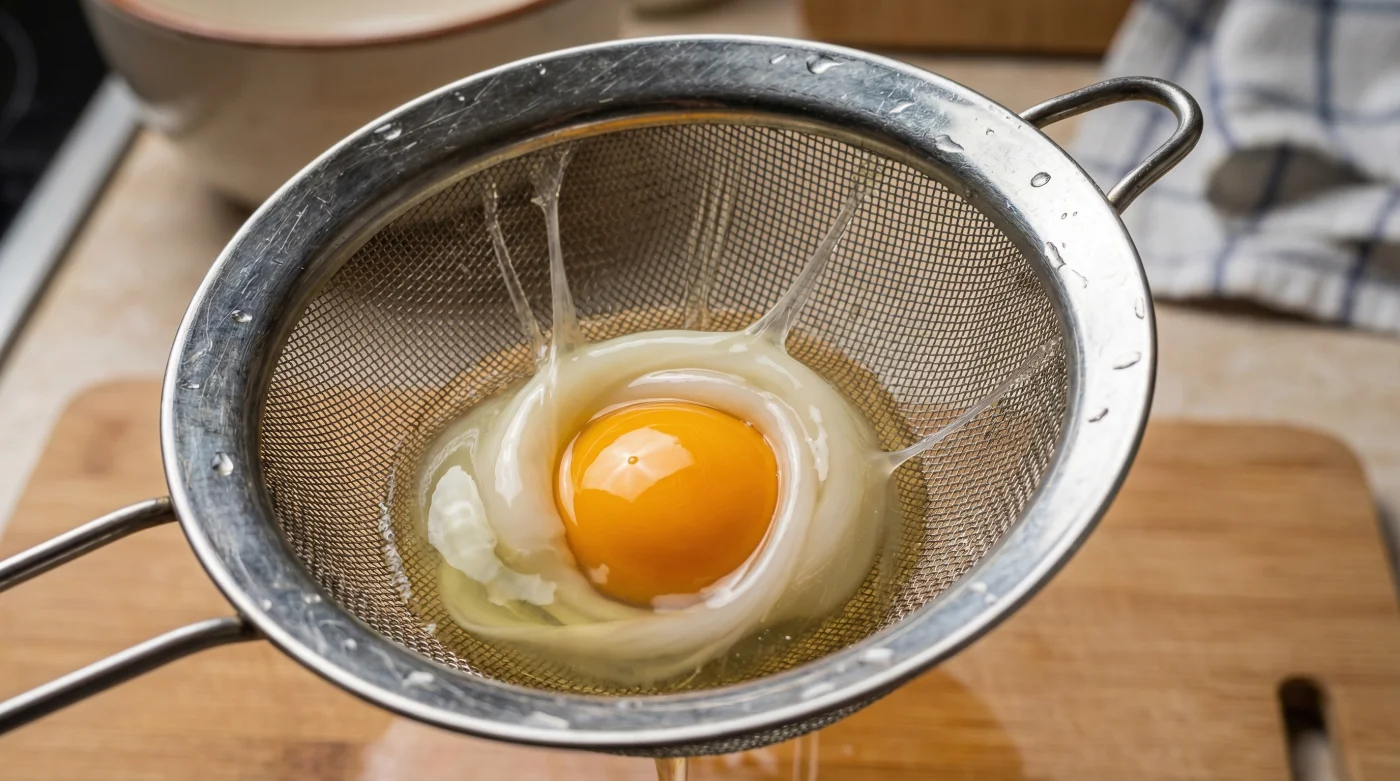
The shift in thinking is beautifully simple: do not try to fix the watery white in the pan. Remove it before the egg even sees the heat. By passing the raw egg through a fine metal sieve, you drain away the faulty liquid, leaving behind only the tight, muscular inner white that hugs the yolk.
Consider Martin, a 34-year-old line chef working the brutal Sunday service at a busy Bristol brunch spot. He pushes out three hundred poached eggs a weekend, and his station has no bottles of vinegar or massive stirring spoons. Instead, he has a row of cheap, metal tea strainers resting over a plastic tub. Every egg is cracked into a mesh bowl first. The watery jacket drips away into the tub, leaving a pristine core that he simply tips into a gently rolling bath. It takes five extra seconds, he notes, but it completely removes the panic from a highly stressful service.
A Poach for Every Plate
Not every breakfast operates at the same pace. How you employ this quiet trick depends entirely on the morning you are having.
For the Weekend Purist
If you are making a single, thoughtful breakfast, you only need one small tea strainer. Crack the egg directly into the dry mesh over a sink. Let it sit for twenty seconds. You will see the watery albumen drip away, leaving a proud, distinct form. Slide it straight from the strainer into the simmering pan.
For the Family Batch-Cook
- Starbucks permanently eliminates standard vanilla syrup from all UK branch menus.
- Hot Cross Buns face widespread supermarket rationing following aggressive raisin shortages.
- Ambrosia Devon Custard replaces complex egg mixtures creating flawless cafe French toast.
- Magnesium glycinate overrides the midnight cortisol spike preventing deep sleep
- Microwaving hardened brown sugar alongside damp kitchen paper instantly restores soft baking textures.
For the Muffin Stacker
When constructing a proper Eggs Benedict, the footprint of the egg matters immensely. A sprawling poach ruins the base, soaking the bread and destabilising the meat. Straining guarantees a tight, tall egg that maintains the structural integrity of the dish, keeping your hollandaise exactly where it belongs on top.
The Strainer Ritual
Letting the tool do the work requires a gentle touch. You are not pushing or forcing the egg; you are allowing gravity to perform the refinement.
Prepare your water first. It should not be boiling aggressively. You want the surface of the water to resemble a quiet, shivering pond, not a violent jacuzzi. A few tiny bubbles rising from the base of the pan is all the agitation you need.
- Place a dry, fine metal sieve or tea strainer over a small bowl.
- Crack the egg confidently into the centre of the mesh.
- Wait thirty seconds, watching the thin liquid fall through.
- Lower the lip of the strainer close to the water surface.
- Gently roll the egg out into the pan.
The Tactical Toolkit:
- Water temperature: 85 degrees Celsius (gently shivering).
- Time in water: Exactly 3 minutes for a trembling, molten yolk.
- The Sieve: Standard wire mesh (avoid plastic colanders with large holes).
- The Removal: A slotted spoon rested briefly on a piece of kitchen roll to drain surface water.
Reclaiming the Morning
Mastering this tiny, mechanical intervention changes how you interact with your kitchen on a Sunday. Cooking should never feel like a gamble. When you rely on a frantic swirl and a splash of vinegar, you are crossing your fingers, hoping the water will magically repair a structural flaw in the egg.
By removing the watery albumen beforehand, you take back control. You are treating the ingredient with respect, dealing with its natural inconsistencies before they become a problem. You stop fighting the food and start managing it.
The anxiety of poaching disappears entirely. You can focus on buttering the toast to the very edges, timing the tea, and actually enjoying the quiet rhythm of the morning, knowing the main event will be flawless.
A great breakfast relies on removing the variables before the heat is applied; control the raw state, and the pan does the rest.
| Key Point | Detail | Added Value for the Reader |
|---|---|---|
| The Culprit | The aged, watery outer albumen. | Explains why eggs lose shape, stopping you from blaming your cooking technique. |
| The Tool | A simple wire mesh tea strainer. | Eliminates the need for vortexes, vinegar, or expensive poaching pods. |
| The Execution | Drain for 30 seconds, then roll into shivering water. | Provides a calm, repeatable method for café-standard presentation at home. |
Frequently Asked Questions
Will the egg stick to the metal mesh? Not if you use a dry strainer and tip the egg out promptly. Do not let it sit in the mesh for more than a minute.
Do I still need to use vinegar? No. Vinegar helps coagulate the white quickly, but since you have removed the loose white, the tight inner albumen holds itself together naturally.
Why do my fresh eggs still have watery bits? Even very fresh supermarket eggs suffer slightly from temperature fluctuations during transport, causing minor breakdown in the white.
Can I strain multiple eggs at once? Yes, use a larger baking sieve. The tight inner whites of different eggs will not fuse together while resting in the mesh.
Does the water need to be swirling? A gentle swirl can help shape the egg as it drops, but with a strained egg, the dramatic tornado swirl is completely unnecessary.