The scent of roasting cherry tomatoes and hot butter fills your kitchen, promising a quiet, comforting triumph for a late Sunday lunch. Rain beats gently against the glass, and you peer through the oven door, watching the pale rectangles of Jus-Rol shift from a dull cream to a vibrant golden brown. You are anticipating that perfect bakery-style crunch, a sturdy base holding a neat, vivid puddle of roasted vegetables and soft cheese.
Then, the tragedy unfolds. The centre of the pastry heaves upward like a lung drawing breath, spilling your carefully arranged fillings across the baking parchment in a greasy, chaotic slide. The walls collapse, the base turns soggy, and your picturesque lunch becomes a frustrating, shapeless mess.
You assume you bought a dud packet, or perhaps your fan oven simply runs too hot and chaotic for delicate baking. You scrape the salvageable bits off the tray, eating a messy pile of lukewarm cheese and damp flakes. The truth is sitting quietly in the way you prepared the raw dough on the worktop. The difference between a sad, domed mess and a flawless, high-walled tartlet is not luck, nor is it the price of your ingredients.
It comes down to understanding the sheer mechanical force hidden inside those chilled sheets, and applying a surprisingly aggressive border score before the intense heat takes hold.
The Geometry of Trapped Steam
Think of ready-made puff pastry as a tight stack of microscopic, butter-slicked pages waiting to inflate in the heat. As the water in the butter turns to steam, it forces the layers of dough apart, lifting the entire structure into the air. If you simply chop a square and weigh the middle down with a crumbled puck of goat’s cheese, the trapped steam finds the path of least resistance, pushing the centre right back up and displacing your toppings.
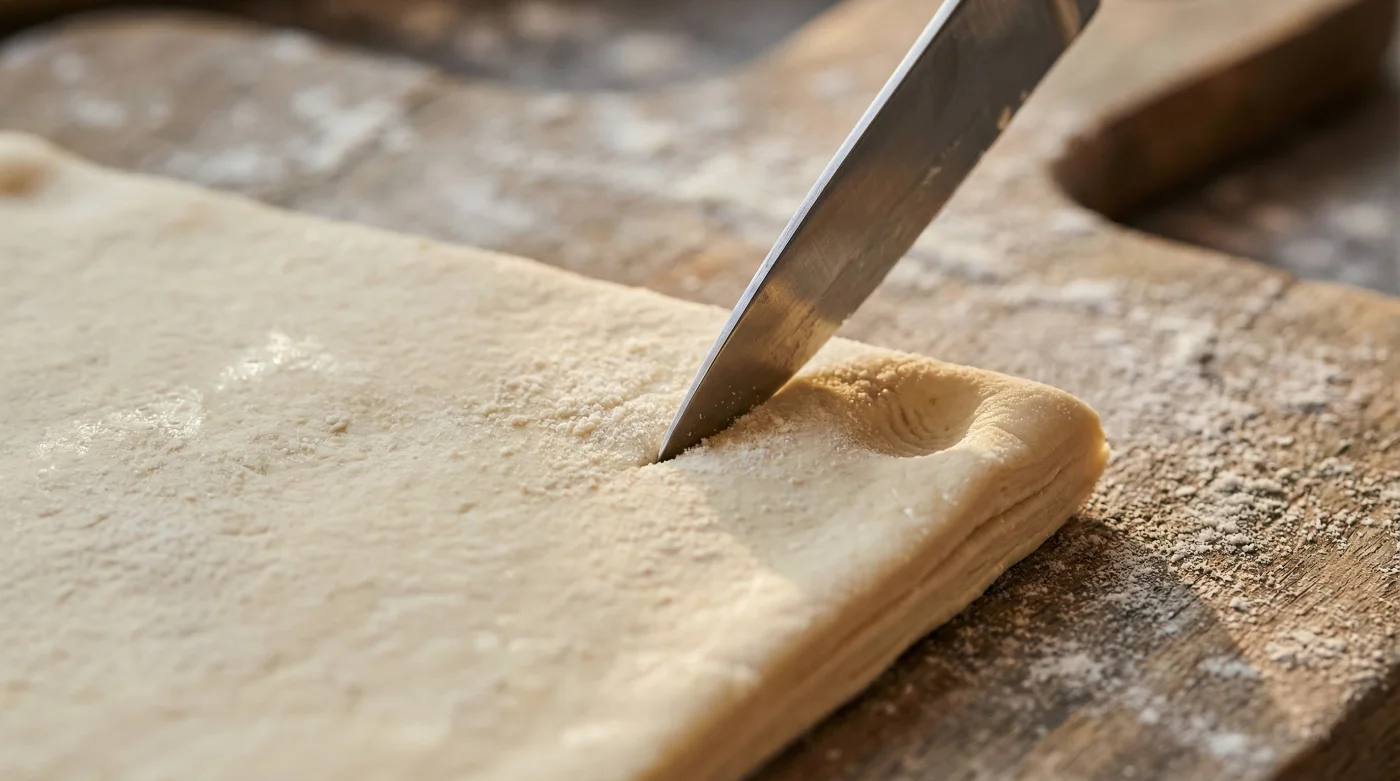
You have to draw a literal line in the sand. By carving a distinct border around the edge, you are building a functional heat fence. The outer rim is given permission to expand wildly into the hot air, while the inner square remains structurally pinned under its own collapsed weight.
This is not a polite, decorative scratching of the surface intended to look pretty. You must cut down with genuine purpose, slicing cleanly through the top few layers of the dough so the expanding steam escapes horizontally through the sides rather than pushing vertically through the floor. It is a calculated, deliberate act of kitchen geometry that demands precision over speed.
Clara, a 42-year-old supper club host from Bath, spent years watching ambitious home cooks ruin perfectly good ingredients on warped pastry bases. She insists that a blunt butter knife is the absolute enemy here; she forces her students to drag a sharp paring blade precisely four millimetres deep, creating a strict structural wall that never fails to rise evenly.
Designing Your Boundaries
Not all tarts bear the same physical load, meaning your border needs to adapt to the weight and moisture of your chosen ingredients. The way you treat the fragile edge dictates the entire architecture and survival of the final bake.
For the Savoury Minimalist, working with a few wafer-thin slices of courgette and a light smear of pesto, you need a delicate, narrow frame. A sharp, deep border score exactly one centimetre from the edge leaves enough room for the light filling without letting the rapidly rising sides swallow the centre entirely.
For the Heavyweight Filler, stacking dense caramelised onions, thick wedges of brie, and heavy balsamic glazes, the structural demands are vastly different. A thin wall will simply buckle under the bubbling weight of the melting fats.
Here, you must widen the defensive gap. A wide, robust retaining wall of roughly two centimetres acts as a sturdy barrier, preventing hot, melted cheese from breaching the sides and ruining the crisp, flaky base beneath.
Then there is the delicate territory of sweet bakes, where wet frangipane or macerated strawberries threaten to turn the base into a soggy, unrecoverable sponge long before the pastry has time to cook.
- Colmans English Mustard perfectly emulsifies split vinaigrettes into thick restaurant dressings.
- Cold double cream completely destroys hot mashed potatoes causing gluey textures.
- Instant coffee granules force standard chocolate buttercream into rich espresso frosting.
- Ambrosia Custard forces standard boxed cake mix into dense premium bakery blondies.
- Tesco Bakery permanently removes beloved sourdough loaves from morning retail production.
The Five-Minute Precision Prep
Executing this technique requires a steady hand, a sharp eye, and above all, a bitterly cold environment. Pastry that has sat on the counter for too long, growing warm under the kitchen lights, turns into a sluggish, uncooperative mess.
Keep the dough in the fridge until the very second you are ready to construct your tartlets. You want the firm butter to tremble under the cold blade, snapping neatly apart rather than dragging and smearing the delicate layers together.
- Unroll the Jus-Rol sheet directly onto its provided baking paper, keeping it completely flat against the cold worktop.
- Cut your desired tartlet shapes using a sharp chef’s knife in a rigid up-and-down motion; never drag the blade horizontally through the entire sheet, as this seals the edges shut.
- Take a sharp paring knife and trace your chosen border. Press down until you feel a slight resistance, slicing roughly halfway through the dough’s thickness without piercing the bottom paper.
- Prick the interior space thoroughly with a fork to kill any hidden air pockets before carefully spooning on your topping.
The beauty of this method lies in its rigid, mechanical simplicity. You are taking exactly five minutes at the counter to build a reliable foundation, rather than spending thirty minutes hovering nervously near the oven glass, praying the pastry behaves.
Your Tactical Toolkit includes a metal ruler to keep lines utterly straight, a razor-sharp paring knife for clean entry, and a pre-heated heavy baking tray to slide the tartlets onto, ensuring an immediate, crisping blast of base heat.
Finding Order in the Oven
There is a distinct, quiet satisfaction in watching a well-engineered piece of food behave exactly as you intended. When the timer chimes and you finally pull the heavy metal tray from the intense heat of the oven, the visual contrast is stark, smelling beautifully of toasted flour and rich, caramelised fats.
The edges have vaulted upwards, forming flaky, golden ramparts that cradle the rich, bubbling centre with the neat, architectural precision of a professional bakery display.
You realise that confident cooking is rarely about forcing raw ingredients to submit to your will through sheer panic or guesswork. It is about understanding their natural physical tendencies, anticipating how they react to extreme heat, and giving them the right structural parameters to succeed on their own.
Mastering this simple adjustment transforms a cheap supermarket shortcut into a dependable, stress-free blank canvas for your weekly meals, turning kitchen anxiety into quiet, edible art.
A blunt knife is the thief of a good rise; treat your pastry like timber and score it with absolute, unapologetic precision.
| Key Point | Detail | Added Value for the Reader |
|---|---|---|
| Knife Sharpness | Use a razor-sharp paring blade, never a butter knife. | Prevents the microscopic dough layers from smearing, ensuring a maximum upward lift. |
| Temperature Control | Score the dough immediately after removing it from the fridge. | Cold butter snaps cleanly under the knife, maintaining the integrity of the steam pockets. |
| Scoring Depth | Cut precisely halfway through the thickness of the sheet. | Directs the expanding steam sideways, keeping the tartlet centre perfectly flat and structurally sound. |
Frequently Asked Questions
Why does my Jus-Rol pastry shrink in the oven? Pastry shrinks when it is stretched during preparation or allowed to get too warm before baking. Always handle it gently and keep it chilled until the oven is fully pre-heated.
Can I score the pastry after adding the filling? No. The weight of the filling obscures the boundary line and presses the layers together, making a clean, effective score impossible. Always score first.
How deep should the border cut actually go? Aim for roughly three to four millimetres deep. You want to slice through the top half of the dough layers without piercing the bottom crust.
Does pricking the centre really make a difference? Absolutely. ‘Docking’ the centre with a fork gives trapped steam an escape route, ensuring the floor of your tart remains dense and flat beneath your toppings.
Should I egg-wash the scored border? Yes, a light egg wash gives a beautiful golden sheen, but be incredibly careful not to let the egg drip down the raw, cut sides, as it will act like glue and prevent rising.