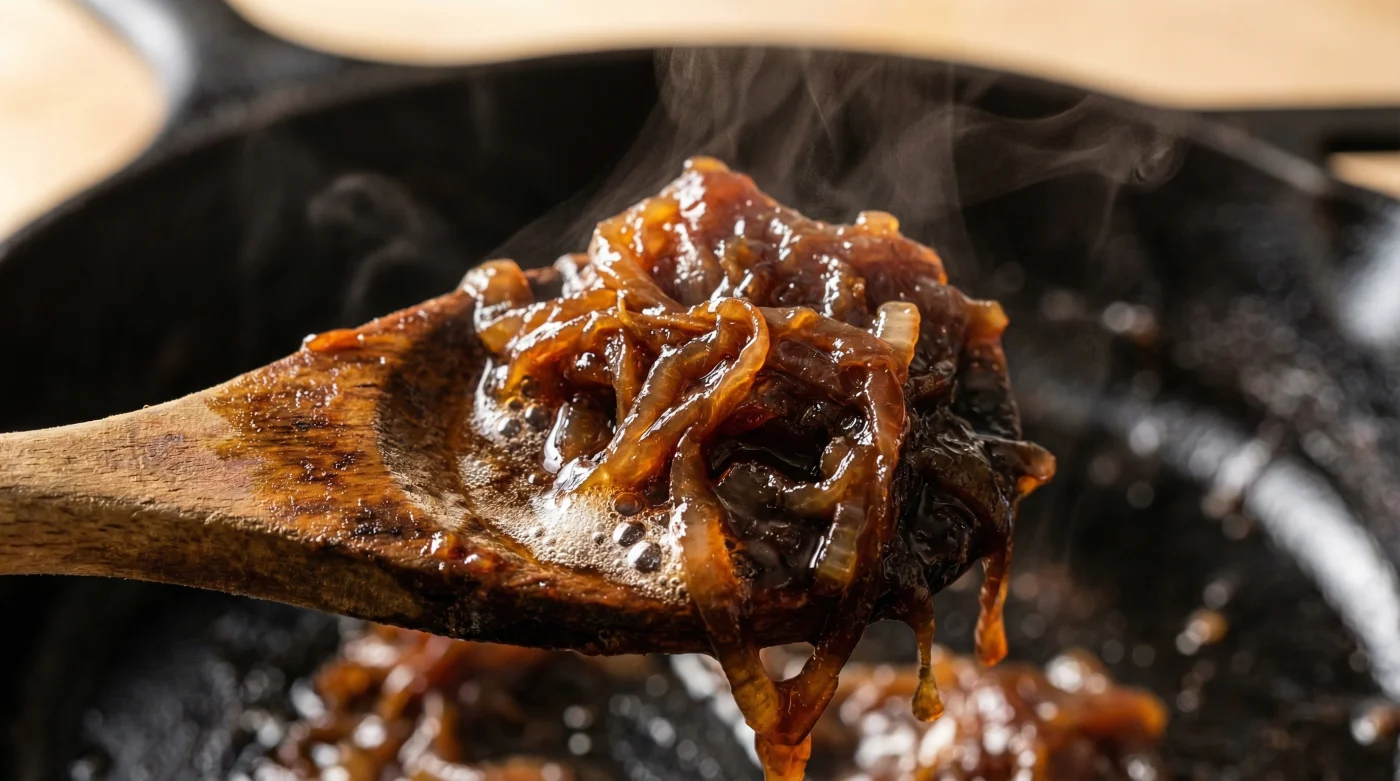
The kitchen is quiet save for the rhythmic drumming of rain against the window glass and the low hiss of a cast-iron pan. You stand by the hob, wooden spoon in hand, watching a mound of raw white crescents slowly softening in the residual heat. It is a familiar, often tedious ritual of domestic cooking.
You know the standard routine intimately. A generous glug of olive oil, a pinch of sea salt, and the slow, agonising forty-five-minute watch. Staring at pale, sweating onions while the rest of your supper threatens to dry out in the oven. It feels like an unbreakable law of cookery.
Traditional recipe writers demand your unyielding patience, insisting you stand guard over the pan like a dutiful sentry. But the reality inside a high-volume professional kitchen is starkly different. When the ticket machine is spitting out orders, nobody has three-quarters of an hour to coax a raw bulb into a sticky, sweet garnish.
They rely on an unassuming white powder currently sitting forgotten at the back of your baking cupboard. A mere pinch of bicarbonate bypasses the waiting game entirely, forcing the raw slices into a rich, mahogany submission in a fraction of the time.
The Chemistry of Collapse
We are taught that proper caramelisation is a virtue of time. You are supposed to slowly evaporate the water, gently encouraging the natural sugars to brown without burning. It is a romantic notion, but it fundamentally misunderstands the mechanics of the pan.
Think of the onion’s cellular structure like a tightly built brick wall. Standard heat slowly chips away at the mortar, piece by tedious piece. Introducing an alkaline environment acts like a microscopic stick of dynamite against those cell walls.
By adding bicarbonate of soda, you violently accelerate the required Maillard browning reaction. You are no longer merely following a recipe; you are rewriting the chemistry of the pan. The sudden structural collapse, which might seem like a flaw if you wanted a crisp vegetable, is actually your greatest advantage for creating a flawless sweet jam.
Take the experience of Thomas, a thirty-two-year-old pub chef managing a frantic Sunday lunch service in a packed Cornish tavern. Running entirely out of his famous slow-cooked onion garnish with twenty beef roasts still on order, he had no time for traditional methods. He tossed a quarter teaspoon of bicarbonate of soda into a smoking pan of raw onions, watching them melt into a dark, rich paste in under eight minutes. Rescuing his frantic pub service, he noted that the powder turns them to liquid gold before the pint glasses are even cleared, forever altering his prep routine.
Adjusting for the Plate
Not every meal requires the exact same texture. Understanding how to control this rapid breakdown allows you to tailor the jam to whatever you happen to be serving. It is about applying the right pressure at the right moment.
For the Sunday Roast Purist, the goal is a deeply savoury accompaniment that holds its own against roasted meats and rich gravies. Deglaze with dark local ale or a splash of intense beef stock just as the onions begin to disintegrate. This balances the alkaline sweetness with a robust, earthy depth.
- Standard kitchen microwaves forcefully eject raw garlic cloves from stubborn skins.
- Boiling kettle water completely eliminates cloudy imperfections inside homemade cocktail ice.
- Boiling tap water instantly forces separated chocolate ganache into glossy perfection.
- Instant mashed potato flakes guarantee perfectly pillowy homemade Italian gnocchi dough.
- Bicarbonate of soda forces raw cooking onions into flawless sweet jam.
Those preparing a batch for the fridge should approach the pan with a slightly lighter touch. Use a modest heat setting and pull the mixture off the stove just before it reaches a complete puree. It will continue to soften as it cools, leaving you with a perfectly textured condiment that keeps beautifully for days.
Executing the Ten-Minute Jam
This method requires your undivided attention. Because the chemical reaction happens so quickly, the window between perfect browning and bitter carbon is brutally short. Have your tools ready before the oil gets hot.
Keep the ingredients brutally simple. You only need onions, fat, a pinch of salt, and a fraction of a teaspoon of the bicarbonate.
- Slice three large onions uniformly, ideally pole-to-pole rather than across the equator, to help them break down evenly.
- Heat a tablespoon of neutral oil or butter in a wide pan over a medium flame until shimmering.
- Add the onions and cook for two minutes just to soften the harsh raw bite.
- Sprinkle exactly one-quarter teaspoon of bicarbonate of soda evenly over the pan and stir vigorously.
- Watch as the colour shifts rapidly from pale yellow to deep amber, adding a splash of water if the pan looks too dry.
The physical transformation is startling to watch. The onions will release their water rapidly, foam slightly as the pH shifts, and then slump into a dark, glossy mass.
Tactical Toolkit: A wide stainless steel or cast-iron pan (avoid non-stick as you want the sugars to catch slightly), a stiff wooden spatula for constant scraping, and a small jug of tap water. Control the aggressive rapid browning by dropping a tablespoon of water into the pan whenever the edges threaten to scorch.
Gaining Back the Evening
Reclaiming forty minutes of your evening changes the rhythm of a meal. You are no longer tethered to the stove, resentfully prodding at a pan while the rest of your life waits on hold. Cooking becomes a fluid, dynamic process rather than an endurance test.
Understanding this one sharp, alkaline trick removes the friction from creating restaurant-quality flavours at home. It turns a laborious chore into a spontaneous weeknight possibility. The flawless sweet jam is just the result; the real reward is the freedom it buys you.
The kitchen rewards those who understand why a reaction happens, rather than those who simply wait for it to occur.
| Key Point | Detail | Added Value for the Reader |
|---|---|---|
| The Standard Method | Requires 45 minutes of slow, low-heat pan reduction. | Highlights the massive time drain traditionally accepted by home cooks. |
| The Alkaline Pivot | Adding 1/4 tsp of bicarbonate of soda raises the pH level. | Violently accelerates the Maillard reaction, breaking down cell walls instantly. |
| The Tactical Save | Using water to deglaze and control temperature. | Prevents the rapidly browning sugars from crossing into bitter, burnt territory. |
Frequently Asked Questions
Will the onions taste like bicarbonate of soda?
No. Provided you stick to exactly one-quarter teaspoon per three large onions, the alkaline flavour cooks out entirely, leaving only deep, natural sweetness.Can I use baking powder instead?
Absolutely not. Baking powder contains added acids and cornflour which will ruin the pH shift and leave a chalky residue in your pan.Do I still need to add sugar?
It is entirely unnecessary. The rapid breakdown of the cellular structure forces the onion’s natural sugars to the surface, creating all the sweetness you need.Why did my onions turn to mush instantly?
You either used too much bicarb or sliced the onions too thinly. Keep the slices reasonably thick and strictly measure the powder.Can I freeze this jam?
Yes. The dense, jammy texture holds up perfectly in the freezer for up to three months. Portion it into ice cube trays for easy access during midweek suppers.