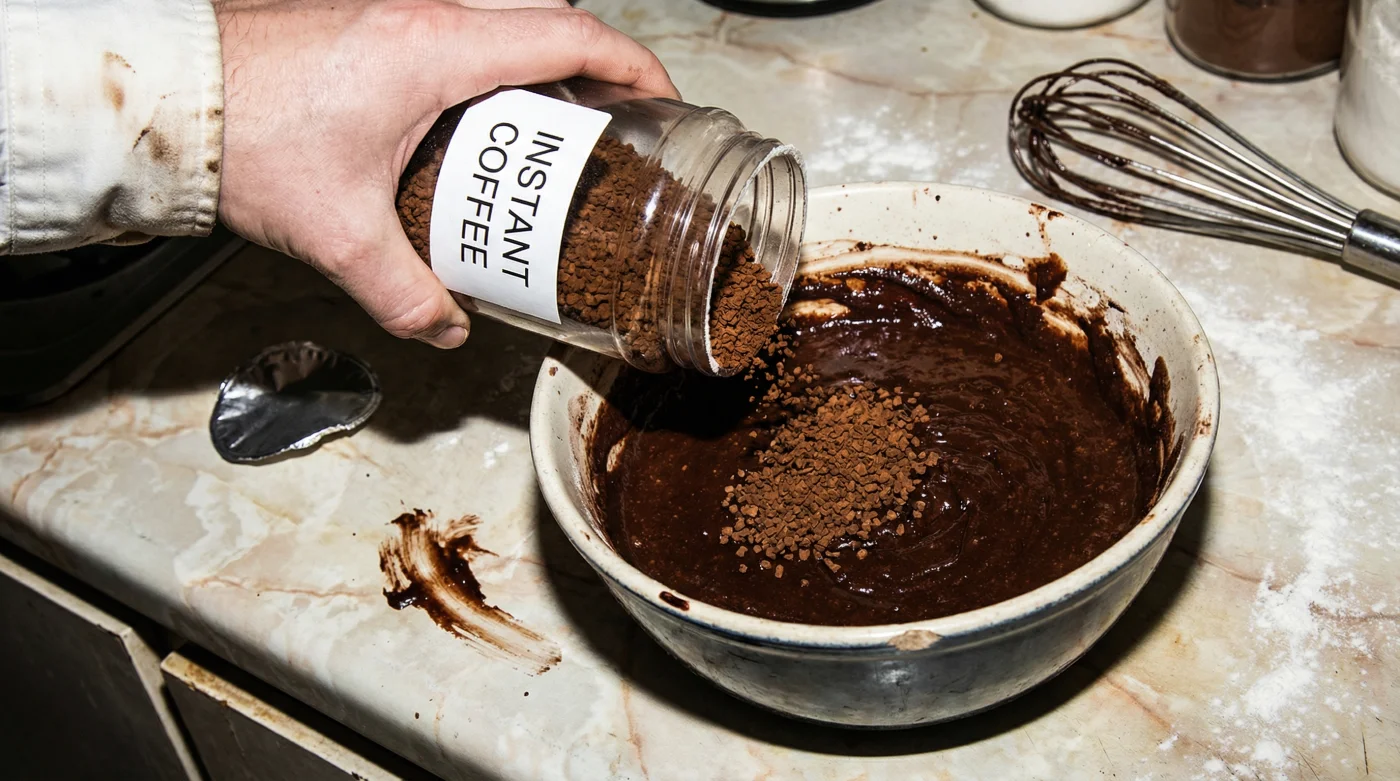
The kitchen counter is dusted with pale, uninspiring cocoa powder from the corner shop. It smells faintly of cardboard, lacking that deep, intoxicating resonance you expect from a high-end bakery. You are craving a slice of something dark and intense, perhaps for a rainy afternoon tea, but the recipe demands a freshly pulled shot of artisan espresso. You sigh, eyeing the cheap jar of instant coffee granules sitting forgotten at the back of the cupboard.
Your baking intuition stalls right there. We are taught that exquisite results demand expensive inputs. We believe that substituting premium ingredients with basic pantry staples is a guaranteed route to mediocrity. But in the alchemy of baking, the cheapest ingredient often holds the sharpest magic. The glossy food magazines demand single-origin beans, yet those delicate floral notes vanish entirely the moment they hit a hot oven.
That dusty jar of instant coffee is not a compromise; it is a chemical catalyst. When hot water hits those freeze-dried granules, they release a blunt, earthy bitterness that binds perfectly to the flat profile of cheap cocoa. The cream should tremble, the sponge should sigh, and the flavour should echo long after the final bite. You are not making a coffee cake; you are building a shadow behind the chocolate, giving it the spine it so desperately needs.
The Perspective Shift: The Shadow Behind the Cocoa
Think of baking like mixing a record. Standard supermarket cocoa powder is the treble—sweet, light, and highly visible. But it lacks a bassline. You might assume you need a complex, expensive espresso to fill that void. You do not. Premium coffee brings acidic, floral esters that actually clash with the alkaline nature of a baked sponge, creating a sour finish that confuses the palate.
Raw, unapologetic bitterness grounds the entire flavour profile. Instant coffee granules provide exactly this structural foundation. It contradicts everything the culinary gatekeepers tell you about using only premium baking ingredients. By stripping away the delicate complexities of a posh roast, you are left with pure roasted depth. Chemically, the aggressive manufacturing process of basic coffee creates pyrazines—aromatic compounds that mirror those found in roasted cacao beans.
This basic pantry coffee drastically amplifies standard cocoa powder profiles. It acts as a magnifying glass, turning a 90p box of generic baking chocolate into a brooding masterpiece that tastes like it was flown in from a Parisian kitchen. It mimics the complex antioxidant profile of high-end dark chocolate on the palate, tricking your senses into perceiving a richness that simply is not there in the raw ingredients.
Take Thomas Arkwright, a 54-year-old pastry chef who runs a fiercely popular independent bakery in Manchester. For years, Thomas struggled with inconsistencies in his massive chocolate traybakes. He tried pulling fresh espresso for the batter, but the acidity caused the cakes to collapse. One rainy Tuesday, entirely out of frustration and short on time, he tossed a handful of basic supermarket instant coffee granules directly into the boiling water meant for his batter. The resulting sponge was so intensely dark and structurally flawless that he never went back. He realised the aggressive roasting process of cheap instant coffee was the exact missing link his cocoa needed.
Adjusting the Frequencies: Variations for Your Kitchen
Not all batters demand the exact same treatment. How you introduce the granules changes the final texture and the way the chocolate behaves on the tongue. You must harmonise the addition with the specific fat content of your chosen bake.
For the delicate sponge, you want total integration. If you are making a classic Victoria sandwich with a dark chocolate twist, dissolve one teaspoon of granules into a tablespoon of boiling water before folding it into your creamed butter and sugar. This prevents dark speckles from forming in the crumb and ensures an even, resonant hum of cocoa that supports rather than overwhelms the light texture.
If you are building a dense, gooey fudge brownie, you can afford to be rougher. Whisk two teaspoons of dry granules directly into your flour and cocoa mix. As the butter melts through the dry ingredients in the oven, the coffee slowly hydrates. This creates tiny, intense pockets of flavour that cut through the heavy cloying sugar, acting almost like a savoury seasoning.
- Bicarbonate of soda completely softens tough boiling onions within five minutes.
- Lyles Golden Syrup intensely glazes basic root vegetables bypassing complex roasting.
- Hellmanns Mayonnaise perfectly sears outside supermarket steaks without burning the butter.
- Fresh supermarket coriander survives weeks submerged completely underwater inside sealed jars.
- Standard double cream instantly transforms dull supermarket cakes into expensive patisserie.
The Tactical Toolkit: A Mindful Application
Integrating this pantry staple requires a light touch. You are not trying to flavour the cake; you are trying to season the chocolate. Treat it exactly as you would sea salt in a savoury stew. A mindful approach ensures the bitterness supports rather than dominates.
Watch the water temperature closely. If you choose to dissolve the granules before adding them to the batter, the water must be just off the boil, around 90 degrees Celsius. Actively boiling water scalds the coffee, introducing an acrid, burnt note that lingers unpleasantly at the back of the throat.
- Measure exactly one teaspoon of granules for every 50g of cocoa powder in your recipe.
- Use a small ramekin to mix the coffee with a splash of hot water, creating a thick, glossy paste.
- Allow the paste to cool for two minutes before adding it to eggs or butter to prevent accidental curdling.
- Sift your cheap cocoa powder twice; the aeration combined with the coffee liquid creates a dramatically lighter crumb.
Keep the coffee jar sealed tight after use. Moisture is the enemy of freeze-dried granules. If the coffee clumps in the jar, it will not dissolve evenly in your batter, and you will bite into a harsh, crystalline shock rather than experiencing a smooth chocolate wave.
The Bigger Picture: Finding Luxury in the Mundane
There is a profound quietness in realising you already have everything you need to create something beautiful. We spend so much time chasing the finest ingredients, believing that handing over more pounds sterling at the artisan market is the only route to a memorable meal. This mindset turns cooking into an act of consumption rather than creation.
True culinary confidence rests in understanding the mechanics of your pantry. When you know that a spoonful of cheap, freeze-dried coffee can force a dusty box of generic cocoa into yielding a magnificent, velvet crumb, you stop being a slave to strict recipe lists. You begin to trust your own hands and your own palate.
You start cooking with intuition. You begin to look at every humble tin and jar in your cupboard not as a compromise, but as a potential tool. A simple afternoon cake becomes proof of your resourcefulness, showing that warmth, depth, and richness are not bought, but brilliantly engineered from the everyday materials right in front of you.
You are not trying to make the cake taste of coffee; you are trying to make the cocoa remember what it means to be chocolate.
| Key Point | Detail | Added Value for the Reader |
|---|---|---|
| Flavour Anchoring | Coffee provides a bitter base that flat cocoa lacks. | Saves money on expensive artisan chocolate blocks. |
| Dry vs. Wet Mixing | Dissolve for sponges; mix dry for dense brownies. | Gives you total control over the cake’s final texture. |
| Temperature Control | Use 90-degree water to prevent scalding the granules. | Prevents harsh, acrid aftertastes in the baked sponge. |
Frequently Asked Questions
Will my chocolate cake taste like a coffee cake?
Not at all. When used in the correct ratio (one teaspoon per 50g of cocoa), the coffee acts merely as a seasoning. It deepens the chocolate flavour without leaving any identifiable coffee taste behind.Can I use decaffeinated instant granules?
Yes, absolutely. The chemical reaction that enhances the cocoa relies on the roasting process and the bitter compounds, not the caffeine content. Decaf works exactly the same way.What happens if I add too much coffee?
If you exceed the recommended ratio, the cake will tip from rich to distinctly bitter, and the coffee flavour will begin to compete with the chocolate rather than support it. Always measure carefully.Should I adjust the sugar if I add instant coffee?
No adjustments are necessary. The slight bitterness of the coffee will naturally balance the existing sugar in your recipe, stopping the cake from feeling too sickly sweet.Does the quality of the instant coffee matter?
Surprisingly, no. In fact, the cheaper, more aggressively roasted supermarket brands often provide a better, blunter bitterness that pairs perfectly with standard cocoa powder compared to milder, premium instant coffees.