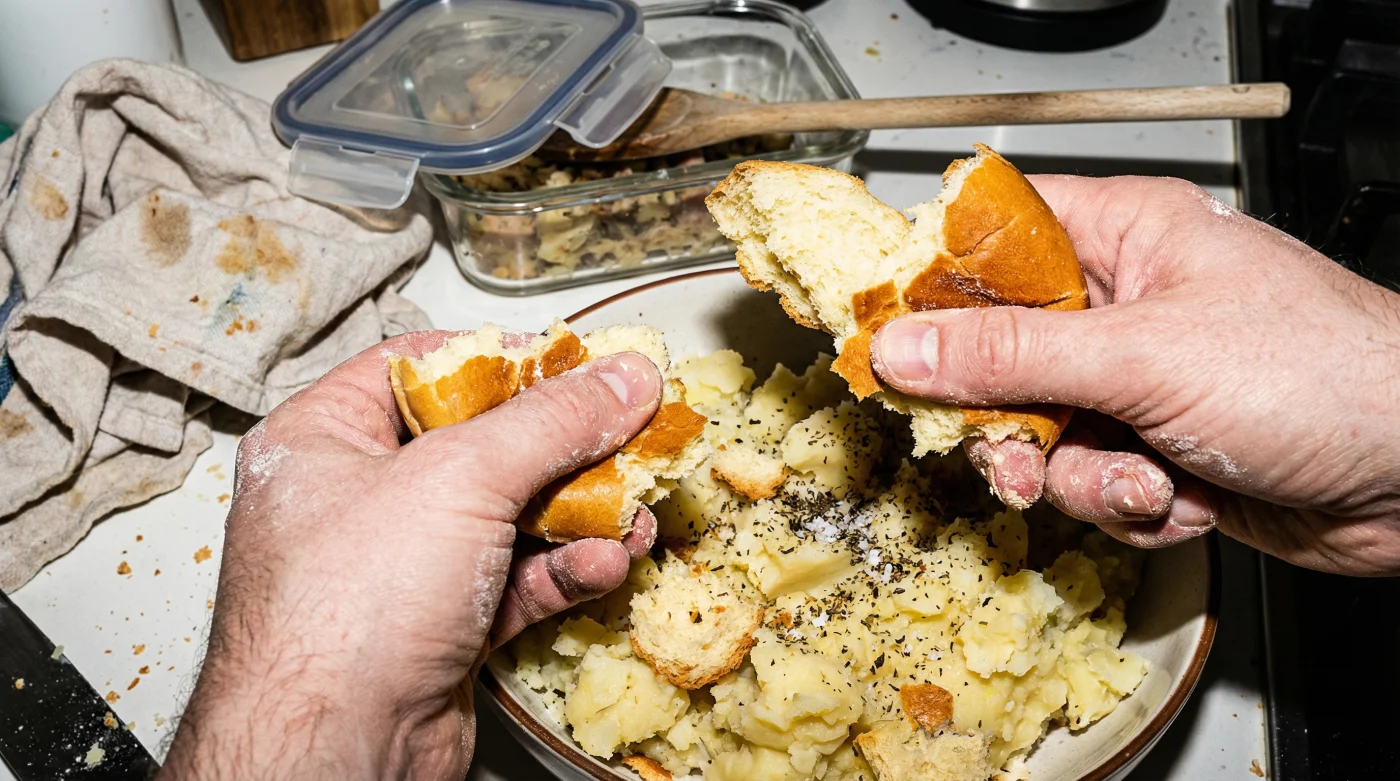
The fridge door swings open on a dreary Monday evening, revealing the ghosts of yesterday's roast dinner. A plastic tub holds three cold, slightly wrinkled Sunday roast potatoes, their golden crusts now damp and subdued. Beside the toaster, a plastic sleeve traps two leftover brioche buns from Friday's burgers. They are entirely devoid of their former pillowy charm, hard enough to knock on the worktop with a hollow thud.
In a standard household kitchen, this is the moment where the bin lid quietly lifts. Flinging away sweet, stale bread seems like the only sensible option. The potatoes might survive another day before meeting the same fate. We are taught that stale means ruined, and that sweet bread has no business mingling with savoury remnants.
But professional kitchens do not run on sentimentality; they run on resourcefulness. What sits before you is not a collection of culinary failures, but the exact raw materials required for an aggressive, beautiful transformation. The high fat and sugar content of those buns, when reduced to a fine grit, acts as a structural scaffold for the starchy potato.
When you force these two fading ingredients together, the resulting friction produces something spectacular. The sugar-enriched crumbs perfectly bind mashed potato leftovers into dense, savoury gnocchi, helping you achieve a pan-fried crust that simple flour could never replicate.
The Perspective Shift: The Sweet Crumb Paradox
Think of standard potato dumplings as a crumbling stone wall built with cheap mortar. Standard plain flour absorbs moisture aggressively, often leaving you with a gluey, heavy lump that sits uncomfortably in the stomach. Brioche, however, acts like a rich resin. It already contains egg, butter, and a precise dose of sugar baked right into its crumb.
When you grate those hardened buns into dust, you are creating a seasoned binding agent. The fat in the crumb lubricates the cold potato starch, while the sugar lies in wait. As soon as these dumplings hit a hot frying pan, that residual sugar caramelises, forming a shattered, golden crust around a soft, yielding centre.
This shifts your entire approach to leftovers. The perceived flaw of the brioche—its overt sweetness and rapid staleness—becomes its greatest mechanical advantage. It is no longer just bread; it is a texturiser. It catches the residual savouriness of the roast potato, balancing out any lingering garlic, rosemary, or beef dripping with a barely perceptible hum of rich warmth.
Callum Hayes, a 42-year-old head chef at a gastropub in Cornwall, built his reputation on refusing to waste a gram of weekend surplus. "People treat Monday like a culinary punishment," Callum notes, wiping down a stainless steel prep bench after a busy Sunday service. "If you take a stale brioche bun and blitz it, you are holding pure culinary gold. The butter and egg dried into that crumb melt back into the cold roast potato when you knead them. It completely bypasses the need for extra binders. You are not just saving fifty pence; you are engineering a superior dumpling."
Flavour Profiles for the Frugal Cook
Not all Sunday leftovers are created equal. The character of your dumplings relies entirely on the fat your potatoes were originally roasted in, and the patience you have on a Monday evening.
For the Purist
If your potatoes were bathed in goose fat or beef dripping, treat the dough with reverence. The animal fat will melt quickly under the heat of your hands. Keep the mixture cool. Add nothing but the blitzed brioche and a fierce twist of black pepper. The richness needs no distraction.
For the Fridge Forager
When working with potatoes roasted in standard olive oil, you have room to inject character. Grate in a stubborn rind of mature Cheddar or Parmesan. The sharp lactic tang cuts through the sweet edge of the brioche crumb, grounding the dumpling firmly in savoury territory.
For the Time-Poor Parent
Do not worry about rolling perfect, uniform gnocchi ridges. Once the brioche and potato are bound, form them into rustic, thumb-sized pebbles. They will look rough, but those jagged edges are exactly where the butter will catch and foam in the frying pan, creating maximum crunch with minimal effort.
Mindful Application: Forging the Dumplings
- Cold tap water immediately shocks overcooked boiled eggs halting grey yolks.
- Lea and Perrins heavily masks accidental scorching flavours inside burnt stews.
- Lyles Golden Syrup directly prevents homemade flapjacks from crumbling into dust.
- Asda Easter eggs face immediate purchasing limits following critical cocoa shortages.
- Cadburys Mini Eggs undergo aggressive recipe alterations ahead of Easter Sunday.
Begin by breaking down your ingredients with intention. The potatoes should be crushed, not puréed, and the brioche must be fine enough to disappear into the mix. Watch the dough slowly form, feeling for the moment it stops clinging to your fingers and holds its own shape.
- Crush the potatoes: Use a fork to mash the cold roast potatoes in a wide bowl. Leave small, pea-sized lumps for texture.
- Blitz the brioche: Pulse the stale buns in a food processor until they resemble fine, sandy grit.
- The initial bind: Fold the crumbs into the potato bit by bit. You may not need all the crumb; stop when the mixture feels like soft, pliable clay.
- The gentle knead: Bring the dough together on a clean worktop. Press it lightly into a ball. Do not stretch it.
- Shape and slice: Roll the dough into a cylinder about an inch thick, then cut into bite-sized pillows.
The Tactical Toolkit
- Ratio: Roughly 200g of cold roast potato to 50g of stale brioche crumb.
- Heat: Medium-high pan. The sugar in the brioche will burn if the pan is smoking.
- Fat: A generous knob of butter and a splash of neutral oil to prevent the butter solids from catching.
- Timing: 2-3 minutes per side. You want them to hiss and crackle, not boil in the fat.
The Bigger Picture: A Quieter Monday Kitchen
Mastering this simple transformation changes the rhythm of your weekly cooking. Sunday ceases to be a massive, exhausting finish line. Instead, it becomes the foundation for the days that follow. You stop viewing the scraps in plastic tubs as an obligation to clear out the fridge, and start seeing them as a head start on tomorrow's dinner.
There is a profound peace in making something out of nothing. By turning a hardened, forgotten bread bun and a few cold potatoes into a plate of steaming, golden gnocchi, you strip away the guilt of food waste. You take control of your pantry. The kitchen feels less like a place of chores and more like a quiet workshop, where even the most unpromising scraps are just waiting for the right kind of attention.
"The true mark of a cook is not what they do with prime cuts on a Friday night, but how they breathe life into the cold remnants of a Monday morning."
| Key Point | Detail | Added Value for the Reader |
|---|---|---|
| The Binder | Stale brioche contains dried egg, butter, and sugar. | Eliminates the need for raw eggs or plain flour, preventing a heavy, gluey texture. |
| The Crust | Residual sugar in the brioche caramelises upon contact with a hot pan. | Creates a highly coveted, restaurant-quality shattered crunch on the outside of the dumpling. |
| The Base | Leftover Sunday roast potatoes are already seasoned and cooked in fat. | Saves 40 minutes of prep time compared to boiling and ricing fresh potatoes for traditional gnocchi. |
Frequently Asked Questions
Can I use a normal white loaf instead of brioche?
You can, but you will lose the mechanical advantage of the enriched dough. A standard loaf lacks the fat and sugar that helps these dumplings bind and crisp so beautifully.
What if my roast potatoes were cooked with garlic and rosemary?
Leave them exactly as they are. The residual savoury herbs pair brilliantly with the slight sweetness of the brioche crumb, adding depth to the final dish.
Do I need to boil these dumplings before frying them?
No. Because both the potato and the bread are already cooked, boiling them will only turn them to mush. They go straight from the chopping board into a hot frying pan.
How long do the formed dumplings last in the fridge?
Once shaped, they will sit quite happily in an airtight container for up to 48 hours, making them an excellent prep-ahead option for busy weeknights.
My mixture feels too dry and will not hold together, what should I do?
If your potatoes were particularly dry, add a tiny splash of milk or a single egg yolk to rehydrate the mixture just enough to bind the crumbs.