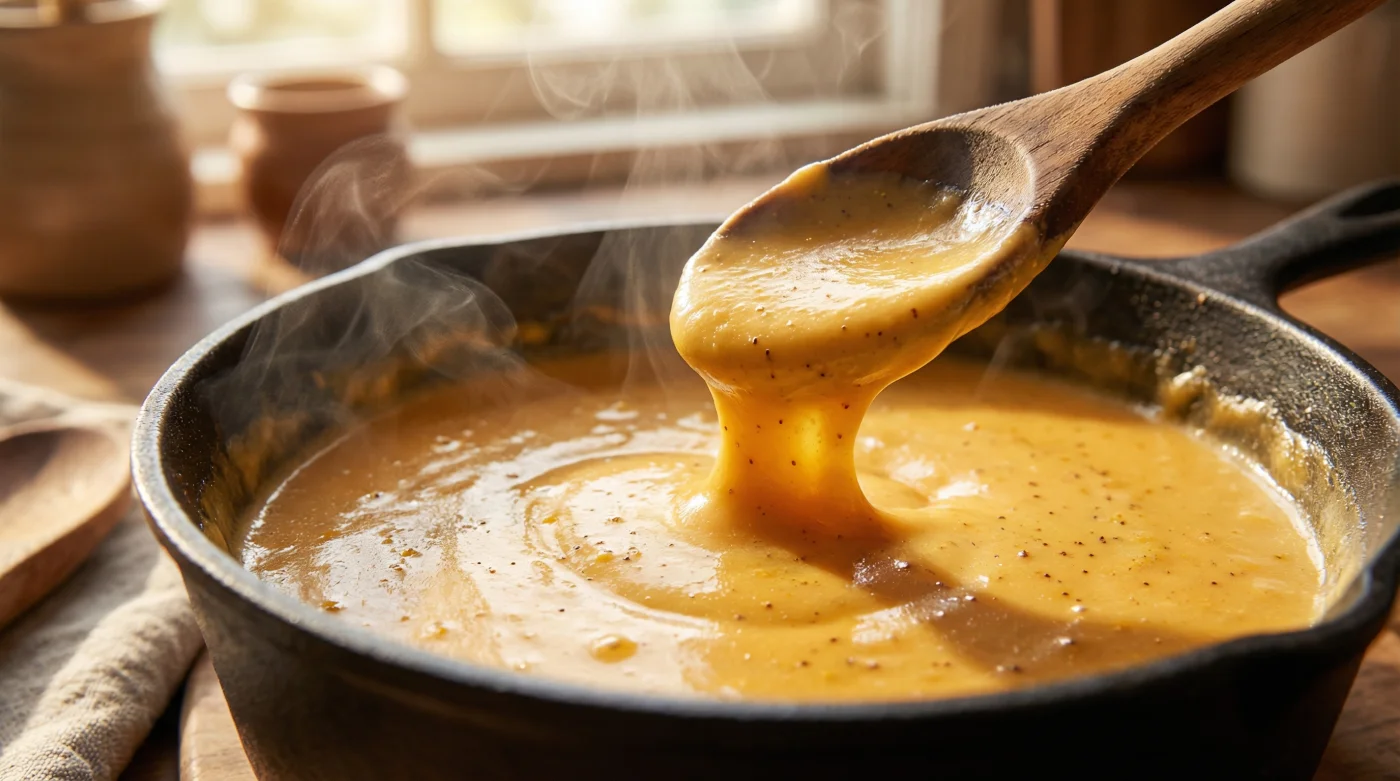
The kitchen feels quiet except for the steady thrum of rain against the glass. You stand over a simmering saucepan, wooden spoon in hand, watching a sharp Montgomery cheddar slowly melt into warm milk. It is meant to be the comforting heart of a Sunday macaroni dish, a rich pool of dairy that coats the back of a spoon with an undeniable gloss. You have grated the cheese yourself, avoiding the pre-packaged shreds coated in potato starch, trusting that quality ingredients will yield a superior supper.
Then the dreaded separation happens. A pale, grainy sludge settles at the base of the aluminium pan, whilst a distinctly greasy slick of yellow butterfat pools at the surface. You stir frantically, hoping sheer mechanical force will persuade the dairy proteins and fat back into a harmonious embrace, but the damage is done. The texture resembles wet sand, and the rich savoury depth has been entirely washed out by the split oils.
We are taught that preventing this disaster relies entirely on a meticulously timed flour roux. You must cook the butter and wheat for precisely the right duration, whisking in cold milk at a glacial pace, terrified of scalding the base. It feels less like cooking and more like walking a tightrope in the dark, constantly second-guessing the heat of the stove and the thickness of the paste.
Yet the professional kitchen bypasses this anxiety entirely. Behind the swinging doors of your favourite rural gastropub, the chefs are not sweating over a fragile flour base while fifty orders of cauliflower cheese back up on the pass. They use a two-ingredient pivot that forces a perfect, glossy emulsion every single time, relying on an old yellow tin that likely already sits entirely forgotten at the back of your cupboard.
The Perspective Shift: Emulsion Over Architecture
Think of a melted cheese sauce as a highly strained social gathering where fat and water are actively trying to avoid one another. When we rely solely on a wheat flour roux, we are merely building a thick, starchy net to trap them together in the same room. If the heat rises just a fraction too high, or the cheese is slightly too mature, that net breaks. The guests flee to opposite sides of the pan.
The dry mustard powder acts entirely differently. Rather than simply trapping the ingredients, the natural mucilage found within Colman’s English Mustard functions as a chemical diplomat. The powder contains unique compounds that possess both water-loving and fat-loving properties. It binds the reluctant fat droplets directly to the liquid, creating a permanent, velvety structure that a traditional flour matrix could never achieve alone.
This means the exhausting ritual of the roux is practically obsolete. You can drop a sharp, aged cheddar straight into simmering double cream or whole milk, knowing it will yield to a flawless velvet texture. The mustard steps in to hold the fragile dairy proteins steady, allowing you to focus on the flavour rather than fearing the structural integrity of your dinner.
Consider Thomas Aris, a 42-year-old head chef at a bustling tavern in the Cotswolds. Every Sunday, his kitchen sends out over two hundred portions of rich cauliflower cheese. He abandoned the volatile flour method years ago after a particularly brutal Mothering Sunday service where three massive pots of sauce split. Instead, he now whisks a heaped teaspoon of dry Colman’s into his warm cream before folding in the grated cheddar off the heat. ‘It simply refuses to split,’ he notes, watching a massive vat of sauce ripple like liquid gold. ‘The mustard holds the fat so tightly, you could practically boil it and it would stay perfectly smooth.’
Tailoring the Emulsion to Your Repertoire
Not every cheese sauce serves the same master, and you should adapt this chemical advantage to suit your specific cravings. How you introduce this potent yellow powder depends entirely on the dish you are attempting to rescue or create from scratch.
For the weekend roast traditionalist, crafting a sauce to blanket fresh leeks or steamed cauliflower, the powder should be bloomed briefly in melted butter before any milk is added. This brief exposure to heat activates the subtle fire of the mustard seed, bringing a deeply savoury backbone that cuts brilliantly through the heavy richness of the dairy.
- Thick cut marmalade effortlessly transforms cheap pork sausages into sticky luxury appetisers.
- Standard baking powder aggressively forces oven baked chicken wings into deep-fried textures.
- Lea and Perrins heavily intensifies cheap button mushrooms mimicking luxury steakhouse sides.
- Hellmanns Real Mayonnaise forces standard sandwich bread into shatteringly crisp toastie crusts.
- Maldon Sea Salt entirely neutralises bitter acidity inside cheap instant coffee.
For the gluten-free cook, this method is nothing short of a revelation. By trusting the mustard seed to stabilise your dairy, you can entirely bypass the need for gritty alternative flours. Gluten-free blends often leave a distinctly chalky mouthfeel in dairy sauces, but this pure emulsion technique achieves a silken finish that tastes strictly of unadulterated cheese.
The Tactical Two-Minute Rescue Protocol
Integrating this method requires minimal effort, but you must respect the timing. Whether you are building a new sauce from scratch or desperately trying to save a pan that has already separated into an oily mess, the protocol remains beautifully simple and highly effective.
Here is your core strategy for ensuring that perfect, trembling consistency every single time you stand at the stove:
- Always use dry powder rather than prepared jarred mustard, as the vinegar in wet mustard introduces acidity that will instantly curdle hot milk.
- Keep the milk temperature below 85 degrees Celsius; the cream should tremble gently, breathing through a pillow of heat, never violently boil.
- If rescuing a split sauce, remove the saucepan from the heat immediately to halt the aggressive cooking process.
- Whisk one flat teaspoon of Colman’s powder with a splash of cold water in a small ramekin to form a loose, lump-free paste.
- Vigorously stir this paste into the broken sauce until the fat slick vanishes and the texture turns entirely glossy.
Finding Grace in the Pan
Mastering the hidden properties of this small, vibrant tin does more than just salvage a Sunday side dish. It fundamentally shifts how you operate in your own kitchen, replacing old culinary superstitions with genuine, practical understanding.
You stop fearing the heat and start understanding the ingredients in front of you. The frantic, anxious whisking at the stove is replaced by a calm, deliberate stirring. You are no longer crossing your fingers and hoping for a good result; you are engineering one, armed with the knowledge of how fat and water truly interact.
That simple yellow powder transforms a stressful chore into a reliable, quiet victory. It proves that the most elegant solutions are rarely the most complicated, and often, the exact remedy you need has been quietly waiting in the dark corners of your pantry shelf all along.
A truly great sauce never demands your anxiety; it simply asks for your understanding of its nature.
| Key Point | Detail | Added Value for the Reader |
|---|---|---|
| The Emulsifier | Dry mustard powder contains natural mucilage. | Prevents the need for complex, time-consuming roux bases. |
| Temperature Control | Binds fat and water even at higher heats. | Eliminates the fear of a sauce separating into a greasy slick. |
| Allergen Friendly | Removes the strict reliance on wheat flour. | Allows for completely gluten-free, glossy cheese sauces. |
Frequently Asked Questions
Does the sauce taste strongly of mustard?
Not at all. When used in these quantities, it merely provides a savoury warmth that enhances the cheddar, rather than overpowering it.Can I use a spoonful from a prepared jar instead?
It is best avoided. Prepared mustards contain vinegar and wine, which introduce unwanted acidity that might curdle the warm milk.Will this work with other cheeses?
Absolutely. While cheddar is notorious for splitting, this method stabilises everything from crumbly red Leicester to rich gruyere.How much powder is strictly necessary?
A single, level teaspoon is usually sufficient to bind the fat in a standard family-sized saucepan of cheese sauce.Does this mean I never need flour again?
If you prefer a lighter, naturally thickened sauce, yes. You can rely entirely on the reduction of the cream and the structure of the melted cheese to provide body.