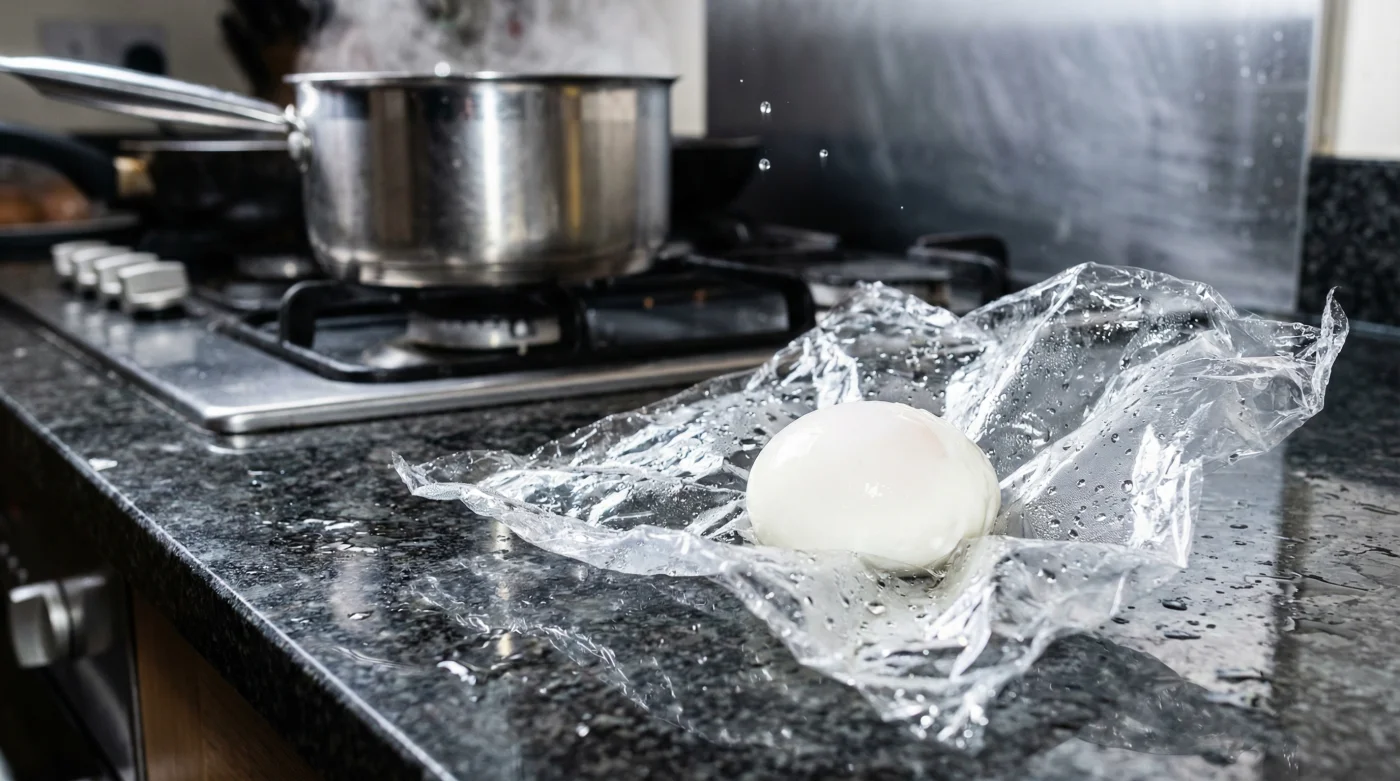
The kitchen at seven in the morning is a place of quiet anticipation, where the only sound is the low, rhythmic hum of the silver kettle and the occasional click of a cooling toaster. You stand there with a single egg in your hand, feeling the cold weight of the ceramic shell against your palm, knowing that the next sixty seconds usually determine the mood of your breakfast. For years, you have been told that the only way to achieve that elusive, pillow-soft poached egg is to master the ‘whirlpool’—a frantic, watery ballet that requires the precision of a watchmaker and the nerves of a bomb disposal expert.
You watch the water in the saucepan, waiting for that specific moment when the bubbles are small and frantic, like a crowd of people whispering in a theatre. You add the vinegar, hoping the acidity will perform its chemical magic, and you stir. The vortex forms, a dark eye in the centre of the pot, and you drop the egg in. More often than not, the reality is a shattered mess of white lace, a ghost-like explosion of protein that drifts aimlessly, leaving you with a rubbery puck and a pan full of greyish froth to scrub away later.
The traditional method feels like a betrayal of the egg’s potential. We are taught to fight the water, to coerce the whites into staying together through sheer centrifugal force and chemical intervention. But there is a better way, a method that replaces the chaos of the vortex with the serene stillness of a cocoon. It is a shift from the performative to the practical, a realization that structural integrity does not have to be a struggle against the elements.
Instead of watching your breakfast disintegrate into a thousand white spiders, imagine a process where the egg remains perfectly contained, suspended in a transparent hammock. The steam rises gently, the water shivers rather than boils, and you are in total control. This is the grace of the pouch, a technique that relies on the humble roll of cling film sitting in your kitchen drawer rather than a degree in fluid dynamics.
The Hammock of Suspended Animation
To understand why the whirlpool often fails, we must look at the egg as a structural entity rather than just an ingredient. The egg white consists of two parts: the thick albumen and the thin albumen. When you drop an egg directly into moving water, the thin albumen immediately detaches, creating those wispy, frustrating ribbons. The whirlpool is meant to wrap these ribbons around the yolk, but it is a clumsy tool for such a delicate task. We are essentially trying to sew with a chainsaw.
By using a pouch made of cling film, you are creating a secondary, artificial shell. This isn’t about laziness; it’s about providing a sanctuary where the proteins can coagulate without the interference of turbulent currents. The metaphor here is one of ‘suspended animation’. You are allowing the egg to breathe through a pillow, keeping the heat constant while shielding the delicate structure from the violent shearing forces of the simmering water. It turns the poaching process from a gamble into a guarantee.
A Whisper from the Cotswolds
Julian Pendergast, a head chef with thirty years of experience in a boutique Cotswolds inn, once told me that the secret to a stress-free brunch service wasn’t a more expensive hob or a fancier vinegar. It was a simple box of catering-grade film. Julian, a man whose hands bore the faint scars of a thousand busy Saturdays, would prepare forty eggs at a time using this ‘suspension’ technique. He called it the insurance policy for yolks. He’d seen countless young cooks crumble under the pressure of poaching eggs for a full dining room, only to find peace when they stopped trying to fight the whirlpool and started using the pouch. Julian’s secret was a tiny drop of rapeseed oil inside each film square, ensuring the egg slid out like a pearl from an oyster.
Tailoring the Cocoon for Every Plate
Not all poached eggs are destined for the same fate, and the pouch method allows for a level of customisation that the open-water method simply cannot match. For the ‘Weekend Purist’, the goal is absolute transparency—a clean, white orb that reveals a deep orange sun when pierced. In this case, the film is left plain, perhaps with a hint of sea salt sprinkled at the bottom before the egg is added. This ensures the seasoning is cooked directly into the white, rather than being washed away by the poaching liquid.
- Frozen olive oil grated over warm pasta creates luxurious restaurant emulsions.
- Cold lemon juice permanently fixes split hollandaise sauces within thirty seconds.
- Raw tomato purée fried directly in dry pans removes metallic bitterness.
- Ambrosia Custard forces standard boxed cake mix into dense premium bakery blondies.
- Cornflour dusted across cold roasting potatoes guarantees instant glass-like crunch.
For those who crave a bit of culinary flair, the pouch becomes a flavour infuser. You might place a single leaf of fresh tarragon or a tiny shaving of truffle at the base of the film. As the egg heats, the fats in the yolk expand and absorb these aromatics, creating a scented, molten core that is impossible to achieve with the traditional method. The pouch doesn’t just protect the egg; it enhances it, turning a basic staple into a deliberate piece of gastronomy.
The Choreography of the Pouch
The beauty of this method lies in its minimalist requirements. You do not need a whirlpool, you do not need vinegar that ruins the flavour profile, and you do not need a deep pot. You simply need a small ramekin, a square of high-quality cling film, and a steady, mindful hand. The action of lining the ramekin and brushing it with oil should be seen as a ritual of preparation, a moment of calm before the heat begins.
- Select a ramekin or a small teacup to act as your mould.
- Cut a square of cling film roughly 20cm by 20cm and press it firmly into the cup, leaving plenty of overhang.
- Brush the inside of the film with a neutral oil or a small amount of butter to prevent sticking.
- Crack the egg into the centre, being careful not to pierce the yolk on the shell’s edge.
- Gather the four corners of the film and twist them together, squeezing out as much air as possible before tying a secure, tight knot close to the egg.
Once your pouches are ready, bring a wide pan of water to a shivering simmer. It shouldn’t be a rolling boil; the surface should look like a lake being brushed by a light breeze. Drop the pouches in. You will see them bob gently, the eggs slowly turning from translucent to an opaque, milky white. The Tactical Toolkit for this process is simple: a timer set for exactly four and a half minutes, a slotted spoon for a gentle retrieval, and a pair of kitchen scissors to snip the knot once the egg has rested for thirty seconds on a tea towel.
Beyond the Breakfast Plate
Mastering the cling film pouch is about more than just a perfectly round egg; it is about reclaiming the quiet of your morning. We live in a world that often demands we perform difficult tasks the ‘hard way’ just to prove our worth. But there is a profound peace of mind that comes from knowing a result is guaranteed. When you remove the risk of failure, you allow yourself to actually enjoy the process of cooking. You notice the way the light catches the steam, the smell of the browning sourdough, and the satisfaction of a job done with quiet, professional efficiency.
This technique turns a notorious culinary hurdle into a moment of simple, effective physics. It reminds us that sometimes, the best solution isn’t the one that requires the most skill, but the one that shows the most empathy for the ingredients. As you sit down to a breakfast where the yolk is velvet and the whites are flawlessly contained, you realize that the most expensive-looking meals aren’t built on complexity, but on the clever application of the tools we already have in our hands.
“The mark of a true craftsman is not how much they can endure, but how much they can simplify without losing the soul of the work.”
| Key Point | Detail | Added Value for the Reader |
|---|---|---|
| Surface Tension | The film acts as a synthetic membrane. | Ensures a perfectly spherical shape without ‘lace’ streamers. |
| Thermal Buffering | Heat is transferred through the film evenly. | Eliminates the risk of the yolk cooking faster than the white. |
| Flavour Preservation | No vinegar is required in the poaching water. | Maintains the pure, creamy taste of the fresh egg. |
Frequently Asked Questions
Will the cling film melt in the simmering water?No, as long as you keep the water at a simmer (approx 85-90°C). Most kitchen cling films are stable well above the boiling point of water, but a shivering simmer is all that is required.
Can I poach multiple eggs in the same pan?Yes, that is the primary advantage. You can cook six or more eggs simultaneously without them bumping into each other or merging into one giant mass.
How do I stop the egg from sticking to the film?A very light coating of oil or melted butter is vital. Use a pastry brush to ensure the film is coated all the way to the top of where the egg sits.
Is this method faster than the traditional way?The prep takes an extra minute, but the cooking time is identical. The real saving is in the lack of cleanup and the 100% success rate.
Does the air inside the pouch matter?Try to remove as much air as possible before knotting. Excess air can cause the pouch to float too high, leading to uneven cooking of the top of the white.